Hassan Pardawalla
Parda Sense Solutions
social
About Me
Builder, Culture Nerd, Systems Guy, Chaos Translator
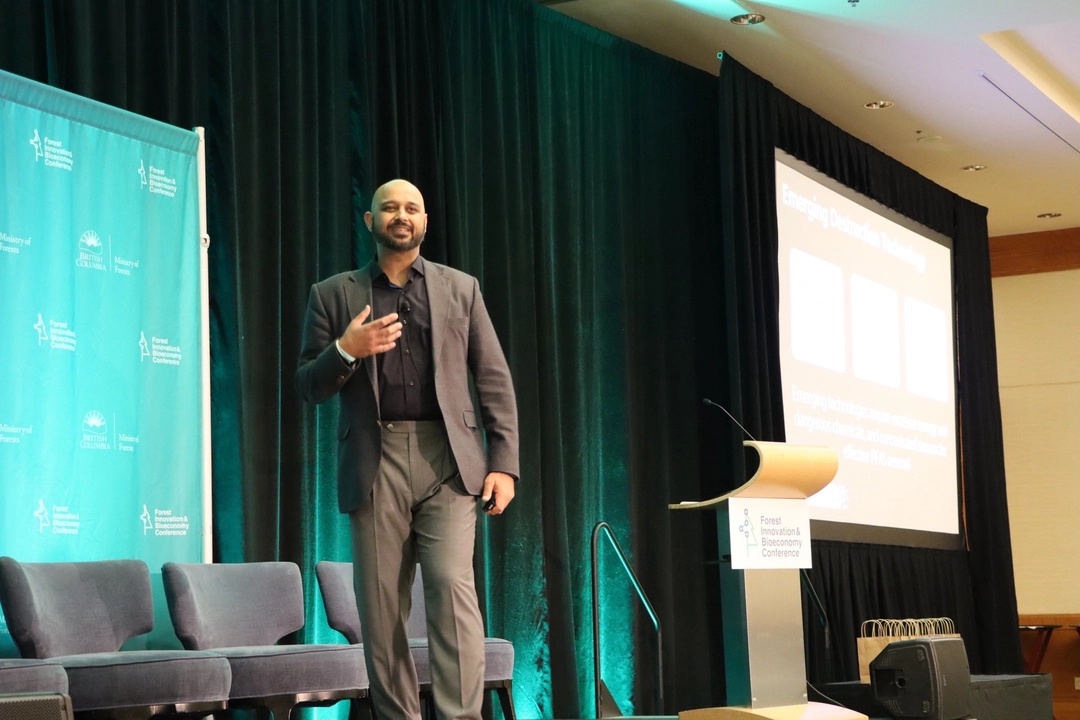
Hi, I’m Hassan, founder of Parda Sense Solutions, a global citizen, swiss army knife, culture‑builder, process-cartographer, chemical engineer with an MBA, and a person who thrives in chaos.
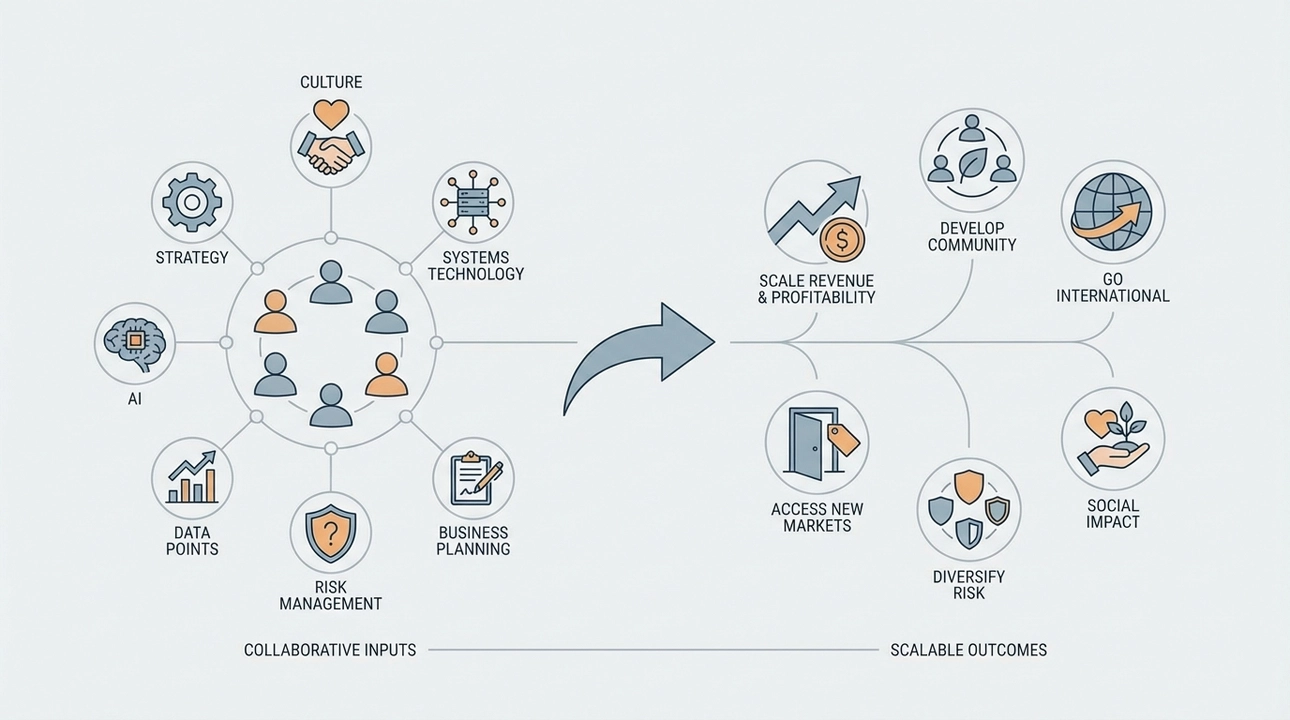
I help growing businesses untangle complexity, build intentional cultures, optimize the processes everyone secretly complains about, and prepare for risks before Murphy’s Law shows up uninvited. My work blends strategy, multicultural insight, and common sense - the kind of “uncommon sense” that comes from years of building processes, mapping systems, and helping organizations scale in the real world.
I’m not the ideas guy — I’m the ‘say less, we’re doing this crazy thing’ guy.”
Where I Come From (And Why It Matters)
I’m shaped by a multicultural upbringing and a career that spans industries, continents, and growth stages. I’ve worked in places with polished boardrooms, places with no boardrooms at all, and places where the system was basically a spreadsheet named “final_FINAL_v7_edit_(1)_v9.xlsx.”
Across it all, one theme kept showing up: businesses grow, break, rebuild, and grow again — but people are always at the center.
That belief is exactly why Parda Sense Solutions exists.
What I Do
1. Build Intentional, Human‑Friendly Culture
Culture shouldn’t be accidental or assumed.
I help organizations define values, strengthen leadership, align teams, and turn “how we do things here” into a lived experience — not a poster.
2. Design Systems People Can Actually Use
I map and improve systems, processes, and operations so companies can scale without the internal chaos.
Whether it’s S&OP, cross‑functional workflows, or process redesign, I make the complex simple and the invisible visible.
3. Help Leaders Prepare for the Unexpected
From market expansion to internal risks, I help organizations plan intelligently.
We can’t stop unexpected things from happening — but we can make sure you have a plan when they do.
Who I Work With
I work with visionary founders and business owners who are growing quickly and need their operations to keep up. I help them enter new markets, strengthen their systems, roll out innovative ideas and build cultures that support real, sustainable growth. If you're looking to build a company that can grow confidently and bring your team along with you, we’ll work well together.
Why I Started Parda Sense Solutions
The truth? I’ve always loved solving messy, human, head‑scratching problems.
I’ve seen too many good companies struggle not because they lacked talent or ambition, but because their culture wasn’t aligned, their systems weren’t ready, or their leaders were carrying too much on their own shoulders. So I built Parda Sense Solutions to bring together everything I’ve learned, people, systems, culture, growth, risk, and real-world operational insight, into something that actually helps businesses move forward with clarity.
My Values (a.k.a. How I Work)
Here are my fundamental values that help shape a thriving, sustainable future.
Adaptability: Business, life moves; we move with it.
Community: Work should build people, not drain them.
Curiosity: Ask, explore, question, learn.
Diverse Perspectives: No echo chambers here.
Fun & Humour: Serious work doesn't need to feel serious.
Grit: Growth isn’t glamorous; perseverance matters.
Multiculturalism: Different perspectives = richer solutions.
Other LInk
One Take Powered by Backers Podcast
The Value of Coaching for Non-Profit Leaders
Grounded Innovation: Agriculture and Food Summit
What I Do!
Culture. Systems. Risk Analysis. Scale.
What I Do
1. Build Intentional, Human‑Friendly Culture
Culture shouldn’t be accidental or assumed.
I help organizations define values, strengthen leadership, align teams, and turn “how we do things here” into a lived experience — not a poster.
2. Design Systems People Can Actually Use
I map and improve systems, processes, and operations so companies can scale without the internal chaos.
Whether it’s S&OP, cross‑functional workflows, or process redesign, I make the complex simple and the invisible visible.
3. Help Leaders Prepare for the Unexpected
From market expansion to internal risks, I help organizations plan intelligently.
We can’t stop unexpected things from happening — but we can make sure you have a plan when they do.
Who I Work With
Whether you're a high-growth venture ready to scale, an SMB that has hit a plateau, or a visionary founder seeking to expand into new markets, I bring the expertise and operational vision to help you unlock your next phase of growth. With a track record of successfully leading business transformations, managing complex operations, and driving sustainable scaling strategies, I provide the insights and leadership needed to take your business to the next level.
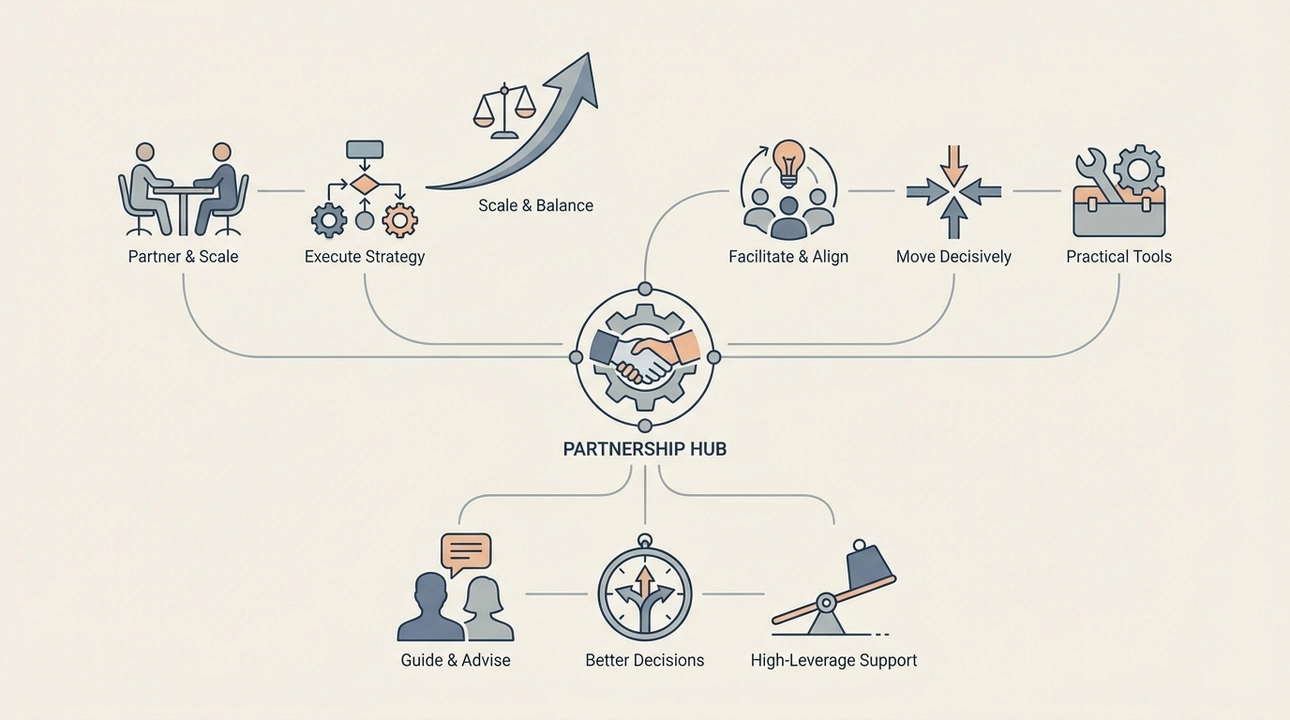
Operations Leadership (Fractional / Interim)
I partner with leadership teams to design and run the operating systems required to scale — without breaking culture or burning out people. This work focuses on translating strategy into execution through clear decision-making, accountable teams, efficient processes, and resilient systems. Ideal for organizations moving from founder-led to leader-led operations, navigating rapid growth, complexity, or change. Book a call
Workshops & Facilitation
I design and facilitate working sessions that help leaders and teams think clearly, align quickly, and move decisively. These workshops combine strategy, operations, culture, and leadership development — grounded in real business challenges, not theory. Every engagement is customized to your growth stage, goals, and people, with practical tools teams can apply immediately.
Advisory & Mentorship
I work as a trusted advisor and mentor to founders and executives navigating scale, complexity, and leadership transition. This engagement provides experienced perspective, pattern recognition, and candid guidance across operations, culture, decision-making, and organizational design. It’s a high-leverage relationship designed to help leaders make better decisions faster — without taking on day-to-day execution.
Is Hassan for You?
Are you facing any of these challenges?
Looking to scale your business efficiently and sustainably?
Leading an energy, cleantech, or sustainability venture with PMF and now ready to expand?
Running a BIPOC-owned SMB generating revenue for 7+ years but feeling stuck at a plateau?
A founder or business owner seeking to upskill and expand into new locations, countries, or continents?
Struggling to improve your organizational culture and operations but unsure where to start?
If you answered yes to any of these, Hassan is the expert you need to talk to. Book a Call Today to discuss your challenges and discover how Hassan can help you scale with clarity, confidence, and purpose.
Coffee Chat
Book a 30-minute free chat with Hassan to explore your business goals and challenges. Whether you need strategic guidance, operational insights, or leadership advice, this session is designed to provide you with actionable ideas and a clear path forward. Let’s discuss how Hassan can help elevate your business and unlock its full potential.
Questions? Send a quick email
Subscribe to Newsletter
Book Recommendations
Blog
The Company That Fired Honesty Every Year. And Called It Strategy.
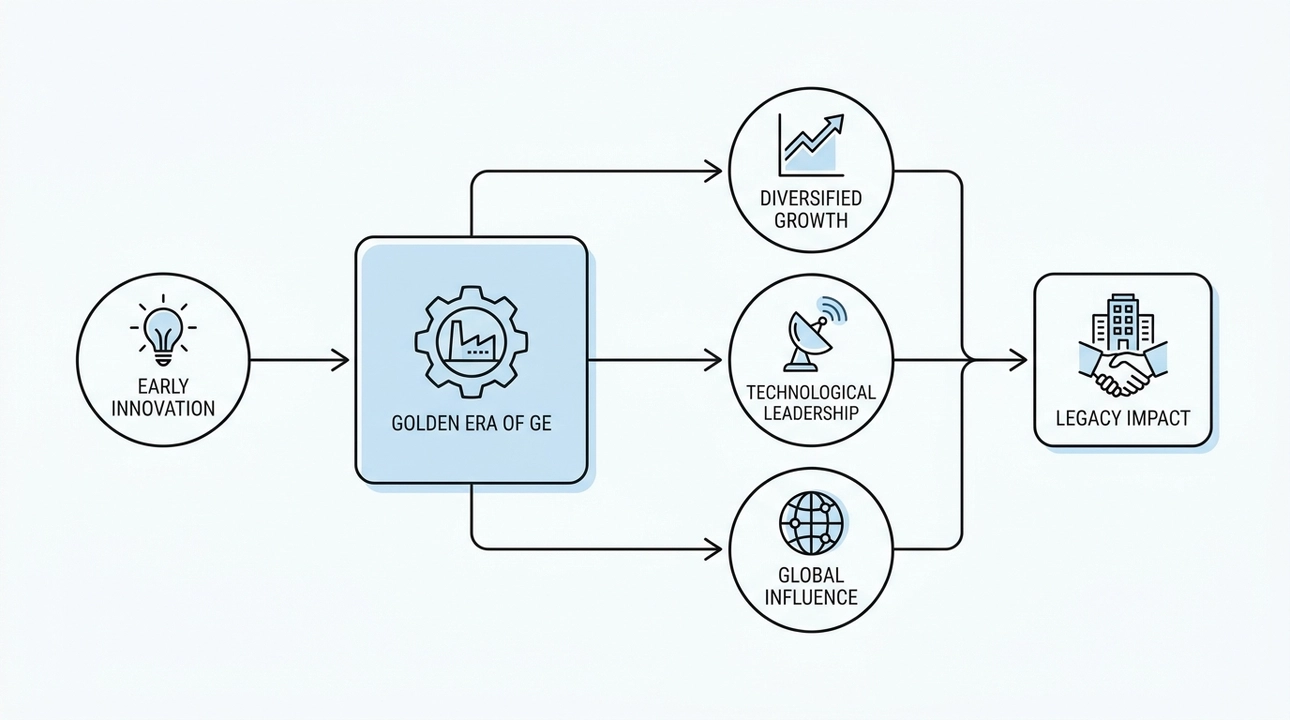
Jack Welch walked into GE in 1981 and found a company that had been sleepwalking for decades. Twenty-nine layers of management. A bureaucracy so thick that a good idea from the factory floor took years to reach anyone who could act on it. Revenue growing at exactly the rate of the American economy. Not because GE was exceptional. Because GE was everywhere, and the whole machine had been designed to avoid risk rather than create value.
THE PERSONAL WHY
Jack Welch | The Working-Class Kid Who Ran on Hunger
Jack did not come from money. Son of a railroad conductor in Peabody, Massachusetts. First in his family to earn a PhD. He grew up in a world where nothing was given and everything was earned.
When he took the chairmanship of GE in 1981, he inherited a company designed to avoid risk rather than create value. His first response: dismantle it. Jack fired 100,000 people in his first five years. Eliminated 29 layers of management. His nickname became Neutron Jack. Remove the people, keep the buildings.
The hunger that drove him out of Peabody never left. For twenty years, that hunger produced extraordinary results. The problem: he built a company that ran on fear of disappointing him. And called it a performance culture.
THE BACKGROUND
GE in 1981 | What He Walked Into
GE in 1981 was the prototypical American industrial conglomerate. Jet engines, lightbulbs, appliances, financial services, television broadcasting. Everything, everywhere. A sprawling empire growing by acquisition and inertia for decades.
Revenue grew from $25B to over $100B under Jack. [Fortune, 2001]
Market cap reached $499B at peak. The most valuable company on earth.
Fortune named GE Most Admired Company in 1998, 1999, and 2000.
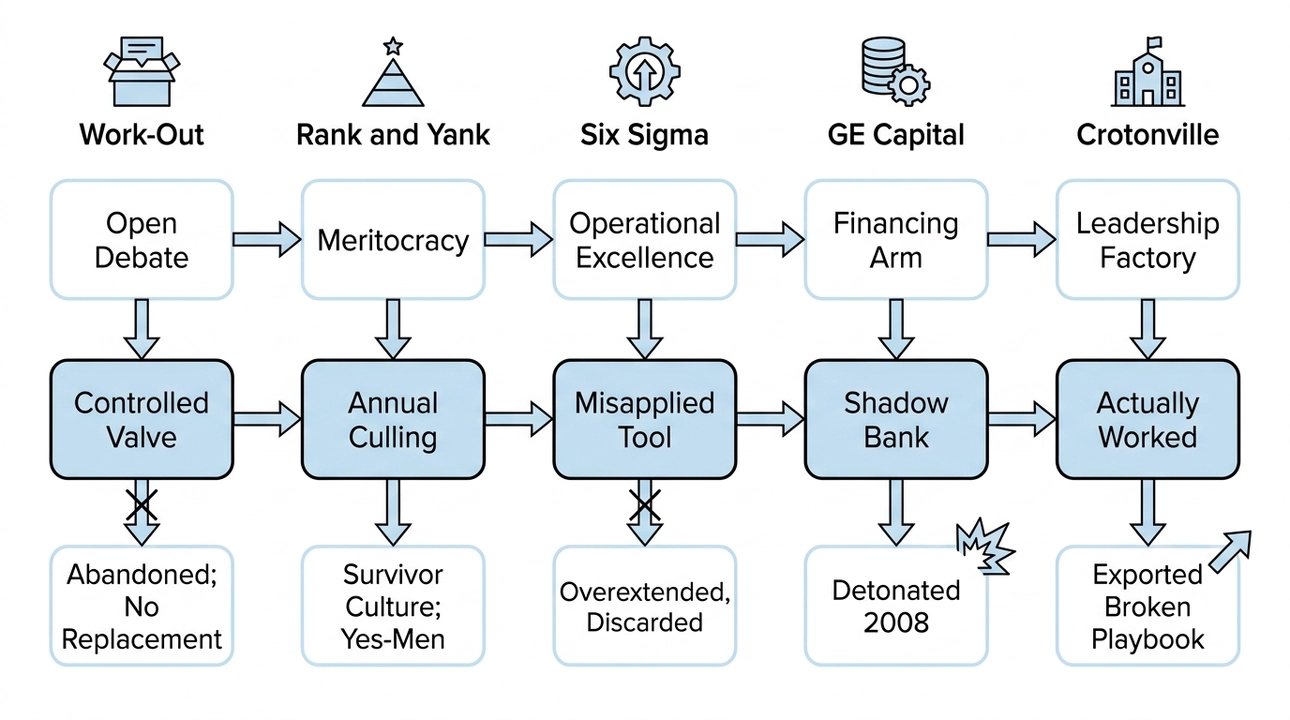
But the foundation had cracks nobody wanted to see. GE Capital had been quietly drifting from its original purpose and had become the load-bearing wall of the entire building. A wall built on quicksand.
THE CULTURE
What Jack Built | The Good, The Bad, and the Structurally Broken
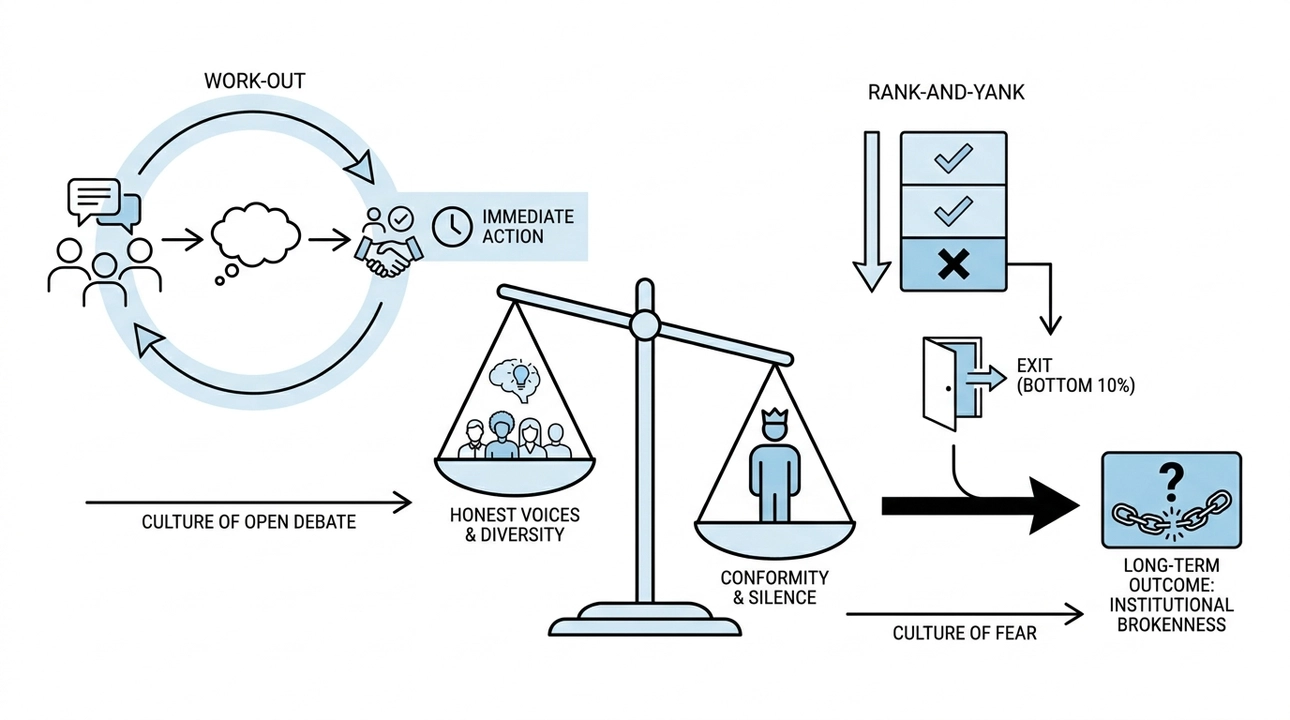
Jack genuinely believed in open debate. He created Work-Out. Groups of 20 to 100 employees, from factory floor to middle management, spent three days identifying what was broken and presenting solutions directly to managers. Managers had to respond on the spot. Yes, no, or a specific date. No deflection.
"Work-Out helped us create a culture where everyone began playing a part, everyone's ideas began to count, and leaders led rather than controlled."
Source: Jack Welch [Jack: Straight from the Gut, 2001]
By 1992, over 200,000 GE employees, two-thirds of the entire workforce, had participated in a Work-Out session. [Dave Ulrich, Steve Kerr and Ron Ashkenas, The GE Work-Out, McGraw-Hill, 2002] That is not HR. That is a knowledge transfer system that most 300,000-person organizations never build at all.
But Jack also built rank-and-yank. Every year, the bottom 10% of performers out. No exceptions. Good years. Bad years. Always. He called it the "vitality curve." It was, in practice, a firing schedule.
Work-Out said: speak up, your opinion matters. Rank-and-yank said: watch your back, because being the most inconvenient person in the room this quarter has consequences. When those two messages live in the same building, one always wins. It is not the one on the poster.
Pop Culture Reference | Peaky Blinders (BBC, 2013 to 2022):
In Peaky Blinders, Ada Shelby is the only Shelby sibling who refuses to participate in the family's criminal enterprise. She is the sharpest observer in every room. She says what nobody else will say. She names the thing the family would rather leave unnamed. She represents institutional honesty. Every organization needs an Ada. Jack's rank-and-yank fired Ada every year for twenty years. Promoted the people who knew how to look like Ada without actually being her. Then Jack retired, and the machine he left behind had no honest voices left in it.
DEI Note:
GE under Jack was notably poor on diversity. The culture rewarded aggressive, combative intellectual performance, which historically favoured specific demographics and penalized others. The vitality curve disproportionately impacted people who challenged norms. [David Gelles, The Man Who Broke Capitalism, Simon and Schuster, 2022]
THE FRAMEWORKS
What Worked, What Did Not, and What Masqueraded as Both
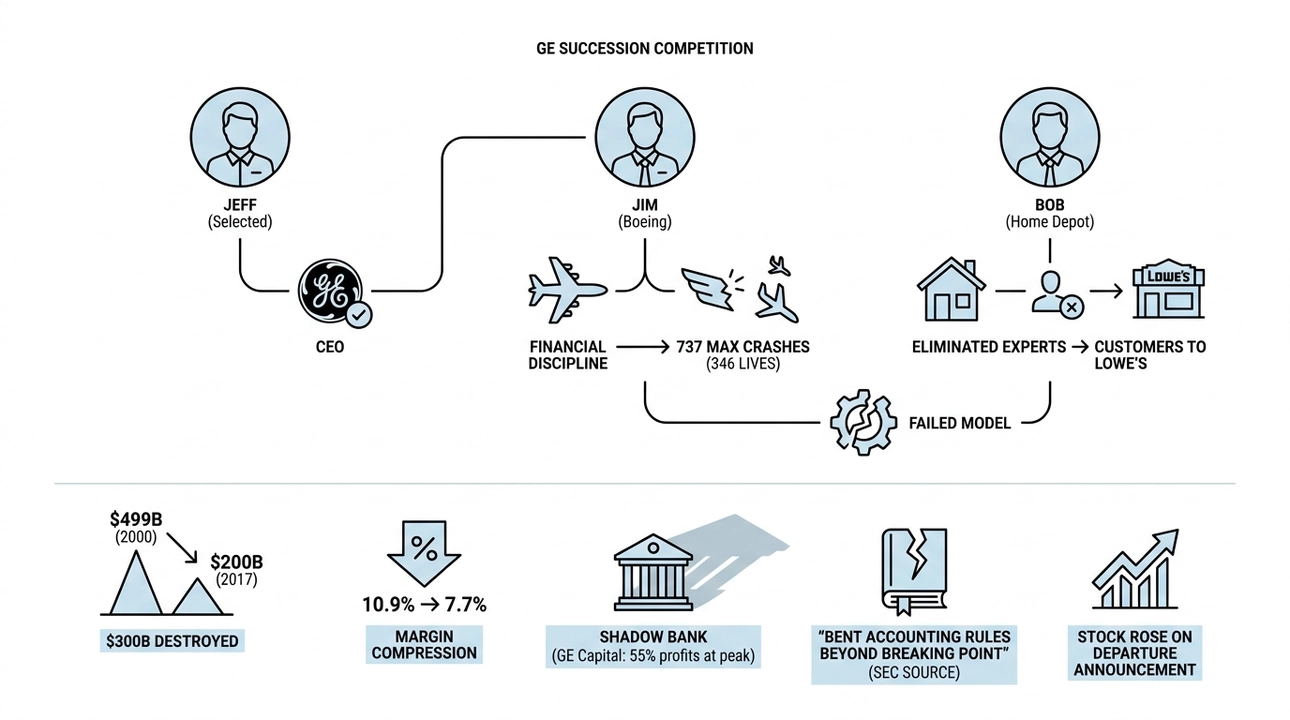
The succession horse race: Jack ran a public competition between Jeff Immelt, Jim McNerney, and Bob Nardelli. He picked Jeff. Jim went to Boeing, where his GE-trained financial discipline helped create conditions for two 737 MAX crashes that killed 346 people. [Harvard Business School Working Knowledge, 2024] Bob went to Home Depot, eliminated expert floor staff, and drove customers straight to Lowe's. Both were executing exactly what they had been trained to do. The model was the problem.
THE RESULTS
The KPIs That Tell the Real Story
Market cap peak (2000): $499B. Jeff's exit (2017): $200B. $300B destroyed. [Bloomberg, 2017]
Net income margin: compressed from 10.9% to 7.7% while claiming transformation. [Fortune, 2017]
GE Capital share of profits: 55% at peak. Industrial company becomes shadow bank. [Yale Insights, 2021]
Stock rose on Jeff's departure announcement. The market knew before the board acted.
"GE bent the accounting rules beyond the breaking point."
Source: Head of Enforcement, US Securities and Exchange Commission [NPR, 2022]
MURPHY'S LAW
The Risk That Became the Crisis
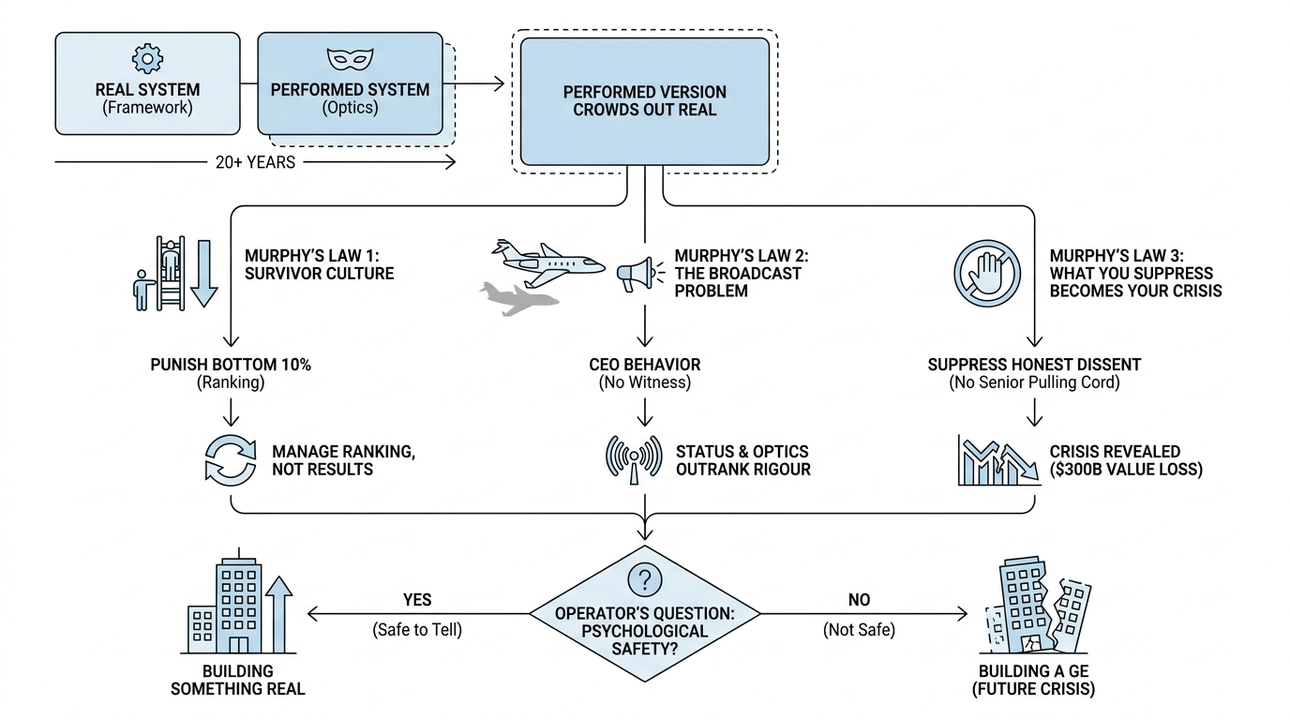
Jack built a machine optimised for one thing: looking like it was working. Every framework had a real version and a performed version. Over twenty years, the performed version crowded out the real one.
Murphy's Law 1: The Survivor Culture
When you build a system that punishes the bottom 10% regardless of absolute performance, you do not eliminate bad performers. You train everyone to manage their ranking, not their results.
Murphy's Law 2: The Broadcast Problem
Culture is not what is in the values document. Culture is what the CEO does when nobody important is watching. Jeff travelled with two private jets, a spare plane permanently tailing his aircraft. That behaviour broadcast one signal inside GE: status and optics outrank rigour. [Praemium Research, 2022]
Murphy's Law 3: What You Suppress Becomes Your Crisis
GE suppressed honest dissent for twenty years. By 2008, there was apparently nobody left in a senior position willing to pull the cord. The 2008 financial crisis did not break GE. It revealed what had already broken. And it cost shareholders $300B in value. [Yale Insights, 2021]
The operator's question for your company: does the person closest to the problem feel safe enough to tell you about it? In the room. To your face. Without it costing them their position? If yes, you are building something real. If no, you have already started building a GE. The only question is how long before the numbers show it.
____________________________________________________________
71 Hours. Three Strategies. One Clear Path Forward.
I work directly with Series A/B founders and growth-stage SMBs. 71 hours with your team and access to your data. Three strategies, three business plans, resource planning, ROI analysis, and a high-level execution roadmap. With a retainer pathway for execution.
Work with me!
Visionary. Operator. Engineer.
The Three-Act Playbook Every Scaling Company Needs.
Apple just announced its third CEO transition in 50 years. Each handoff was a masterclass in organizational evolution and a mirror for every Series A, Series B, and growth-stage SMB navigating their next plateau.
Hassan Pardawalla
Business Advisor & Fractional COO | April 20, 2026
This morning, Apple announced that Tim Cook is stepping down as CEO. His successor is John Ternus, a 25-year Apple veteran and Head of Hardware Engineering. The reaction from markets was calm. The reaction from people who build companies for a living should be anything but.
Because what Apple just did for the third time in its history is something most companies never pull off even once: a deliberate, sequenced leadership transition that matched the right type of leader to the right stage of organizational complexity.
This is not luck. It is a framework. And it applies directly to the founders and operators I work with every day.
Act One: The Visionary
Steve Jobs (1997–2011)
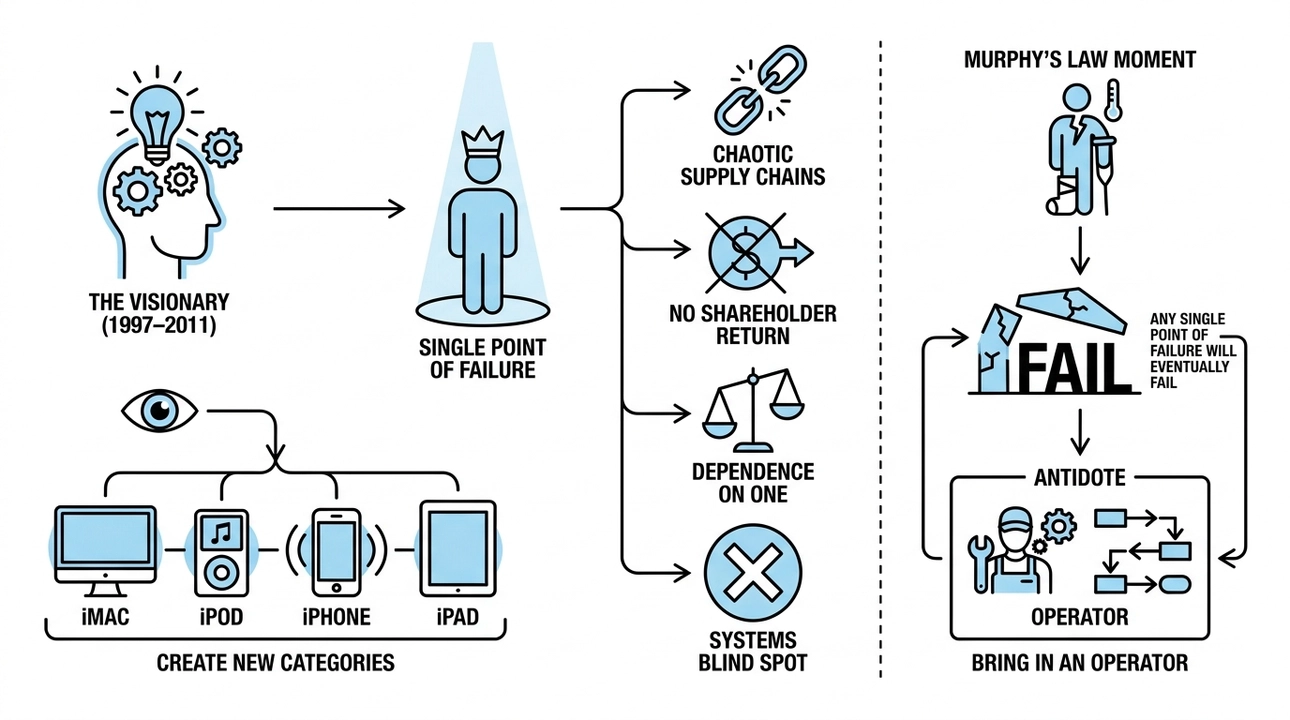
Steve did not return to Apple in 1997 to manage a company. He returned to reimagine one. His job was to create entirely new categories from nothing: the iMac, the iPod, the iPhone, the iPad. He operated on instinct, culture, and an almost irrational conviction about what people would want before they knew they wanted it.
His superpower was vision. His blind spot was systems. Apple under Jobs was a company that ran on the brilliance of one person. Supply chains were chaotic. There was no shareholder return program. The organization depended heavily, dangerously, on Jobs himself.
Murphy’s Law Moment
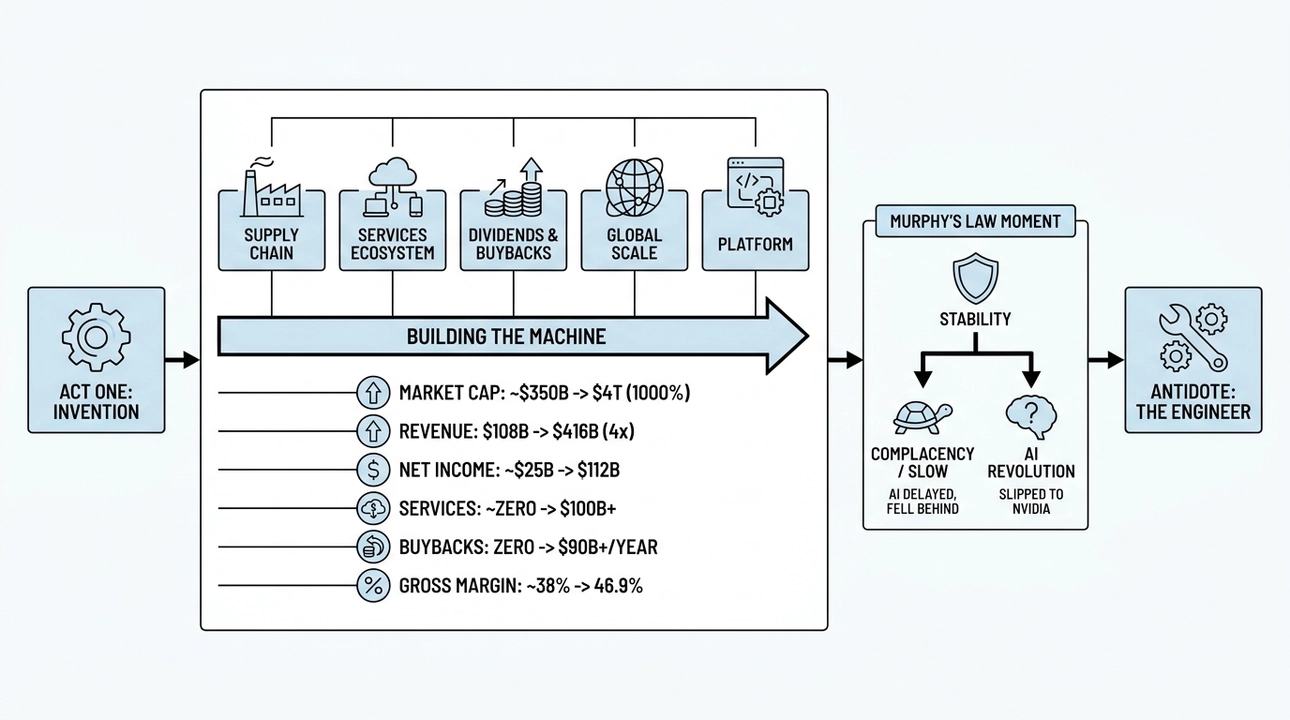
When Jobs fell ill and eventually stepped down in 2011, the fear was not that Apple had bad products. It was that Apple was Steve. If something could go wrong with the man, everything around him would too. This is Murphy’s Law at the organizational level: any single point of failure will eventually fail. The Visionary, by design, is a single point of failure. Another example is Elon, Tesla and X.
The antidote: you do not replace a Visionary with another Visionary. You bring in an Operator.
Act Two: The Operator
Tim Cook (2011–2026)
Cook’s mandate was not to invent. It was to build the machine that scales the invention. And by any KPI you care to name, he delivered one of the greatest operational runs in corporate history.
Selected outcomes during Tim’s tenure
Market cap: about $350B to $4T (about +1,000%)
Revenue: $108B/year to $416B/year (4x)
Net income: about $25B to $112B (FY2025)
Services: near zero to $100B+/year
Cash and buybacks: from no dividend program to $90B+/year in buybacks
Gross margin: about 38% to 46.9%
Tim built the supply chain. He created the services ecosystem. He launched dividends and buybacks to reward investors. He opened Apple to the world across manufacturing, retail, and policy. He turned a product company into a platform.
Cook did not out-Jobs Jobs. He out-operated everyone else. Which is precisely what the company needed.
Hassan Pardawalla, Fractional COO
But here is the honest analysis: the Operator’s job is to build the engine, optimize the margins, and create the stability that funds the next wave. Cook did all of that. What he could not do, or did not fully do, was lead Apple through the AI revolution. That is not a failure of Cook. That is the nature of Act Two.
Murphy’s Law Moment
Apple, despite having the most loyal hardware base and some of the most profitable margins in tech, fell behind in AI. They turned to Google to power Siri. Their AI rollout was delayed. Their once-dominant position as the world’s most valuable company slipped to Nvidia.
Murphy’s Law again: the very stability that the Operator creates can breed complacency. The systems that made you efficient can make you slow. When everything is optimized, the next disruption hits harder because you are not built to move fast, you are built to run smoothly.
The antidote: you do not replace an Operator with another Operator. You bring in an Engineer.
Act Three: The Engineer
John Ternus (2026–?)
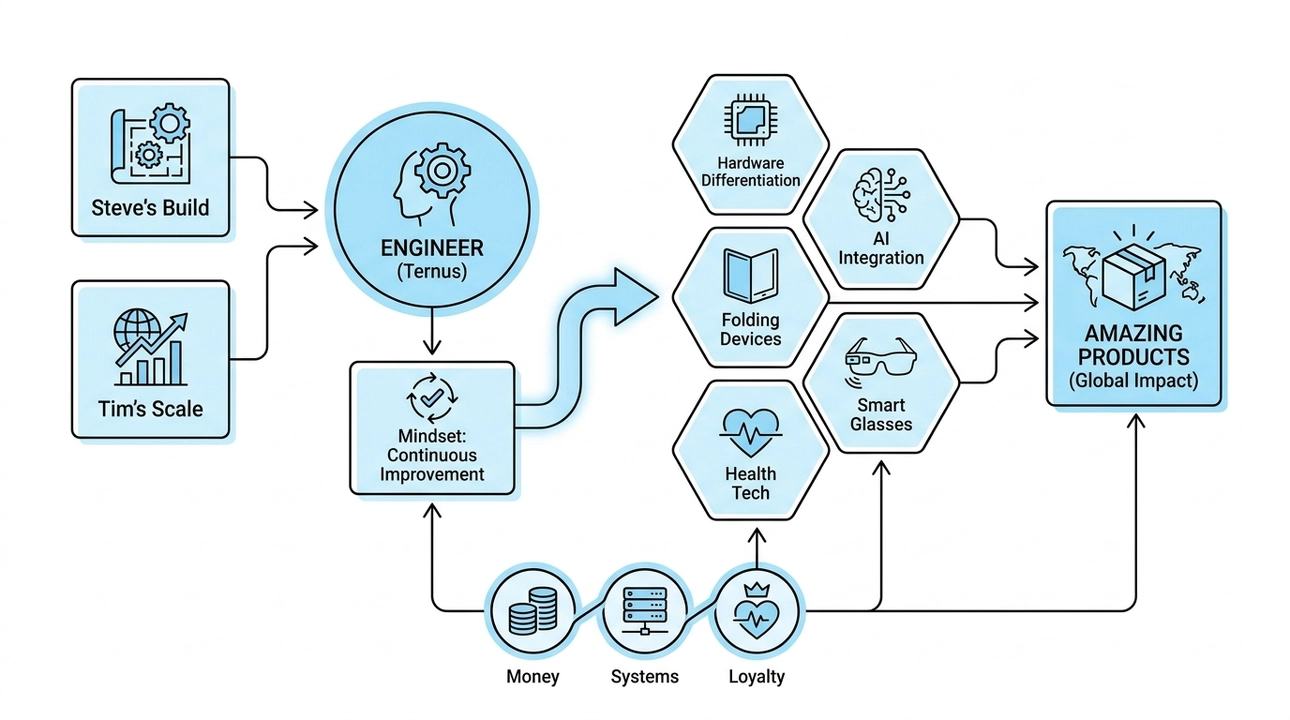
Ternus is not a Visionary conjuring new categories from thin air. He is not an Operator building financial systems and supply chains. He is something rarer at the top of a $4 trillion company: a deeply technical insider who spent 25 years absorbing everything Steve built and everything Tim scaled, and who now has the mandate to make it all excellent.
His stated philosophy: “We never think about shipping a technology. We always think about how can we leverage technology to ship amazing products.” That is the Engineer’s mindset. Not invention. Not operations. Continuous improvement: rigorous, product-first, quality-obsessed.
Analysts are already pointing to what this means: more hardware differentiation, better AI integration into physical products, a push into folding devices, smart glasses, and health technology. The money is there. The systems are there. The brand loyalty is there. Now the job is to make products so good the world cannot ignore them.
The Framework: Three Leaders, Three Stages
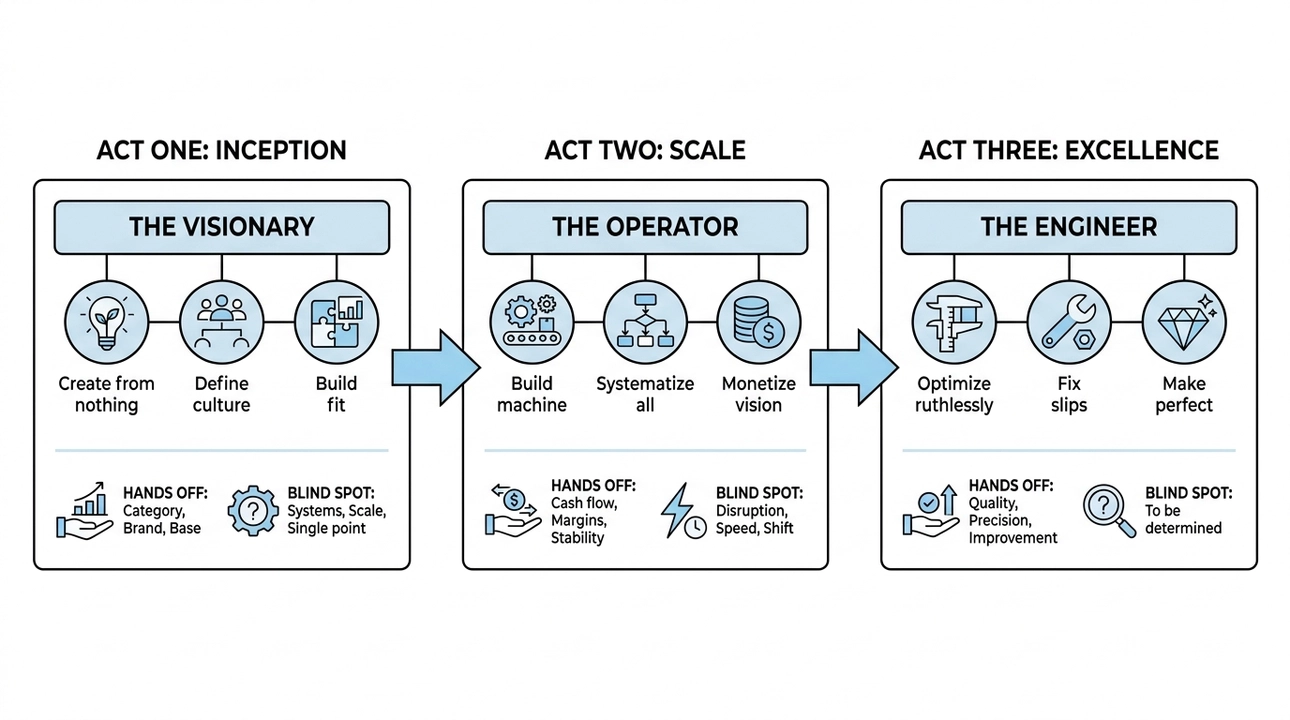
Act One (Inception): The Visionary
Primary job: Create something from nothing. Define the culture. Build product-market fit.
Hands off: A category, a brand, a loyal customer base
Blind spot: Systems, scale, single point of failureAct Two (Scale): The Operator
Primary job: Build the machine. Systematize everything. Monetize the vision.
Hands off: Cash flow, margins, ecosystems, stability
Blind spot: Disruption, speed, the next platform shiftAct Three (Excellence): The Engineer
Primary job: Optimize ruthlessly. Fix what slipped. Make the product perfect.
Hands off: Quality, precision, continuous improvement
Blind spot: To be determined, this act is just beginning
Why This Matters for Your Company
You are not Apple. But you are running the same play at a different scale.
If you are a Series A or Series B founder, or an SMB trying to cross the next revenue threshold, the question is not just “what do we need to do?” It is “what type of leader do we need right now, and what are we hiring them to hand off?”
Most companies fail at this sequencing. They keep the Visionary too long, long after the company needs systems and scale. Or they bring in a heavy Operator before the product has actually found its market. Or they optimize for efficiency before the engine is worth optimizing.
Murphy’s Law Applied
Whatever stage you skip will become your crisis. Skip the Operator and your vision dies in chaos. Skip the Engineer and your scale calcifies into mediocrity. Every stage is load-bearing.
Where I Fit
The Operator’s Role and What I Do
My work sits squarely in Act Two. I come in after the Visionary has proven something worth building and before the Engineer has something worth perfecting.
I build the operational infrastructure: KPI frameworks, financial models, investor-ready documentation, go-to-market systems, team structures, and the monitoring and evaluation scaffolding that turns a promising company into a scalable one.
Across 13+ ventures, from cleantech startups to growing SMBs, the pattern is consistent: founders have the vision, but not the systems. They have traction, but not the architecture to sustain it. They are ready to grow, but not yet ready to scale.
That is the gap I close. I build the machine, optimize the margins, and create the stability so the next leader, whether an internal operator or an engineer, inherits something worth running.
If your company is between stages, if you have proven the model but have not built the machine, that is where a fractional COO creates the most asymmetric value. You get the operator’s toolkit without the full-time overhead. You get the systems, the frameworks, the financial discipline, and the institutional knowledge transfer built in and handed off.
Because that is the real lesson of Apple’s three-act story. Every leader’s job is to make themselves replaceable by building something better than themselves.
Let’s talk about your Act Two.
If you are a founder or operator navigating a growth plateau, I would love to hear where you are stuck. This is exactly the work I do, and I am selectively taking on new engagements in 2026.
Book a conversation:
Human-Centric Systems for Scaling Teams: Turning Tribal Knowledge Into Visual, Repeatable Operations

Scaling rarely breaks because of ambition. It breaks because the work lives in people’s heads.
Early-stage teams run on shared context. Everyone knows where the files are, who owns what, and how decisions get made. When something gets dropped, someone else picks it up. That scrappy rhythm feels like culture, but it is often just proximity.
Then growth hits. Headcount doubles or triples. New people arrive without the lived history that made the early days work. Hand-offs get messy. Expectations become implied instead of explicit. Leaders start “helping” by taking work back, and the organization quietly trains itself to depend on a few veterans.
That is the moment systems are needed. Not generic software workflows. Not an off-the-shelf playbook. Human-centric systems: process and communication designed around how the team actually works, how culture is actually formed, and how knowledge is actually transferred.
The real scaling problem is knowledge transfer, not tools
Most companies do not fail to scale because they lack technology. They fail because the organization cannot reliably reproduce outcomes when new people join.
In the earliest phase, ownership is obvious because the team is small. People improvise, fill gaps, and coordinate in real time. Once the team grows, that same approach becomes expensive. It creates:
- Passive knowledge locked inside a few people
- Inconsistent delivery because “the way” is not documented
- Bottlenecks around founders or operators who become the default problem-solver
- Confusion about how to communicate and when to escalate
The painful part is that the work is still getting done, so the dysfunction stays hidden. It shows up later as delays, avoidable mistakes, and a culture that feels different than intended.
A scalable system is not a set of rules. It is a shared understanding of how work moves through the business.
Culture changes with every hire, whether it is managed or not
Culture is often treated like a set of statements. Values on a wall. A page in a handbook. A few stories shared at onboarding.
But culture is built through actions first, then stories. What gets rewarded? What gets tolerated. How decisions are made when nobody is watching.
When new people join, they bring new habits, assumptions, and ways of working. If the business is not intentional, culture drifts. Misalignment grows quietly:
- A new hire optimizes for speed while leadership expects precision
- One team communicates primarily by text, while another expects email and documentation
- Different interpretations of “ownership” create friction and rework
Managing culture during scale is not about controlling people. It is about defining the operating story through consistent behaviour.
That means clarifying what the organization wants to foster, then training new team members on how those values show up in day-to-day work. It also means recognizing that culture will evolve and choosing its direction rather than inheriting it.
Start with trust, then interrogate the day-to-day until the truth appears
Process work fails when it is treated as a documentation project. People will not reveal how work truly happens unless there is trust. And even when they try, most cannot accurately describe their own routines without structured prompts.
A practical starting point is simple: talk to everyone, deeply.
The most reliable approach is in-depth interviews that unpack the entire day:
1. Have team members walk through what happens, from the first task to last
2. Record the conversations to reduce loss and misinterpretation
3. Repeat interviews at least twice to confirm, clarify, and capture what was missed
4. Validate not just actions, but why those actions were taken and what felt difficult
This is where passive knowledge surfaces. The small choices that make things work. The shortcuts that exist for a reason. The hidden dependencies nobody mentions because “everybody knows that.”
Without this step, systems become fictional. They describe how leadership wishes work happened, not how it actually happens.
Make systems visual so humans can actually use them
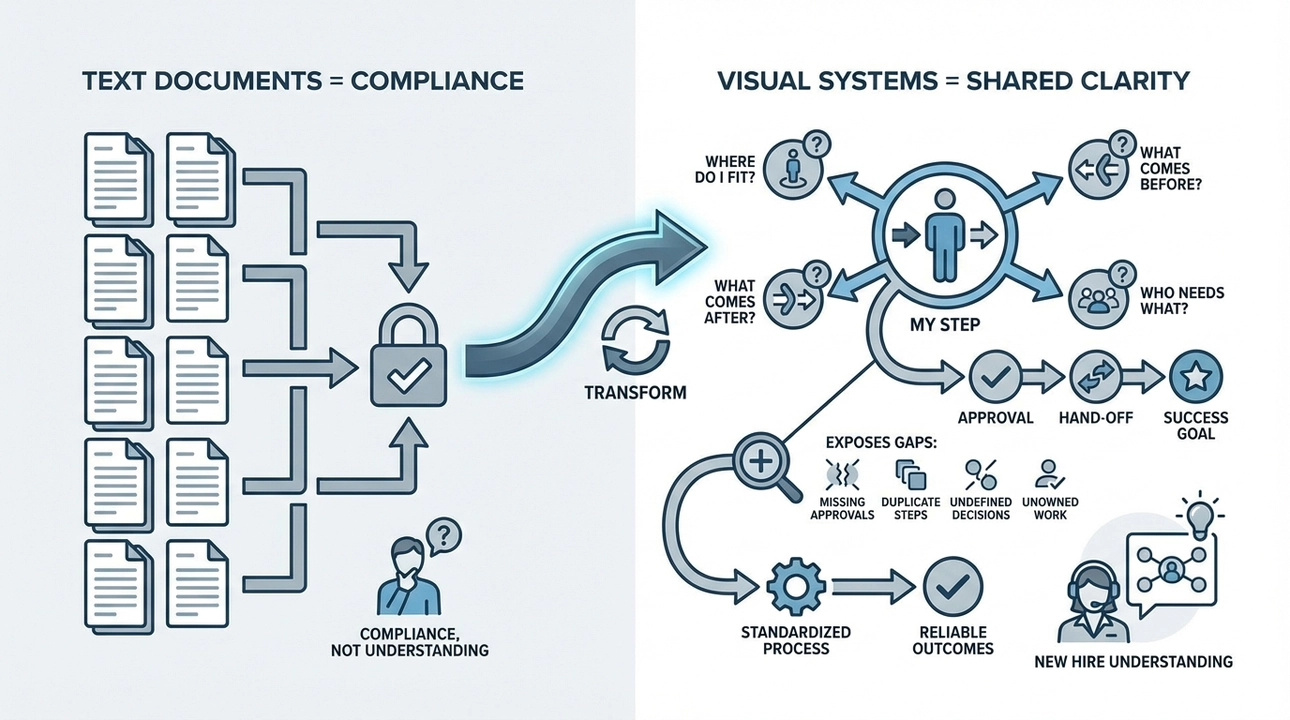
Text documents do not scale understanding. They scale compliance. The goal is not to create more reading. The goal is to create shared clarity.
Visual process maps work because they match how people think. A diagram shows flow, ownership, and hand-offs instantly. It helps a new team member answer the questions that matter most:
- Where do I fit?
- What comes before my step?
- What does success look like after my step?
- Who needs what from me, and when?
A visual system also exposes gaps that written instructions often hide. Missing approvals. Duplicate steps. Undefined decisions. Unowned work.
Once a process is mapped, it becomes easier to standardize. Not to make work rigid, but to make outcomes reliable.
A useful test: if a new hire cannot understand the process in a short review of a diagram, the system is not ready.
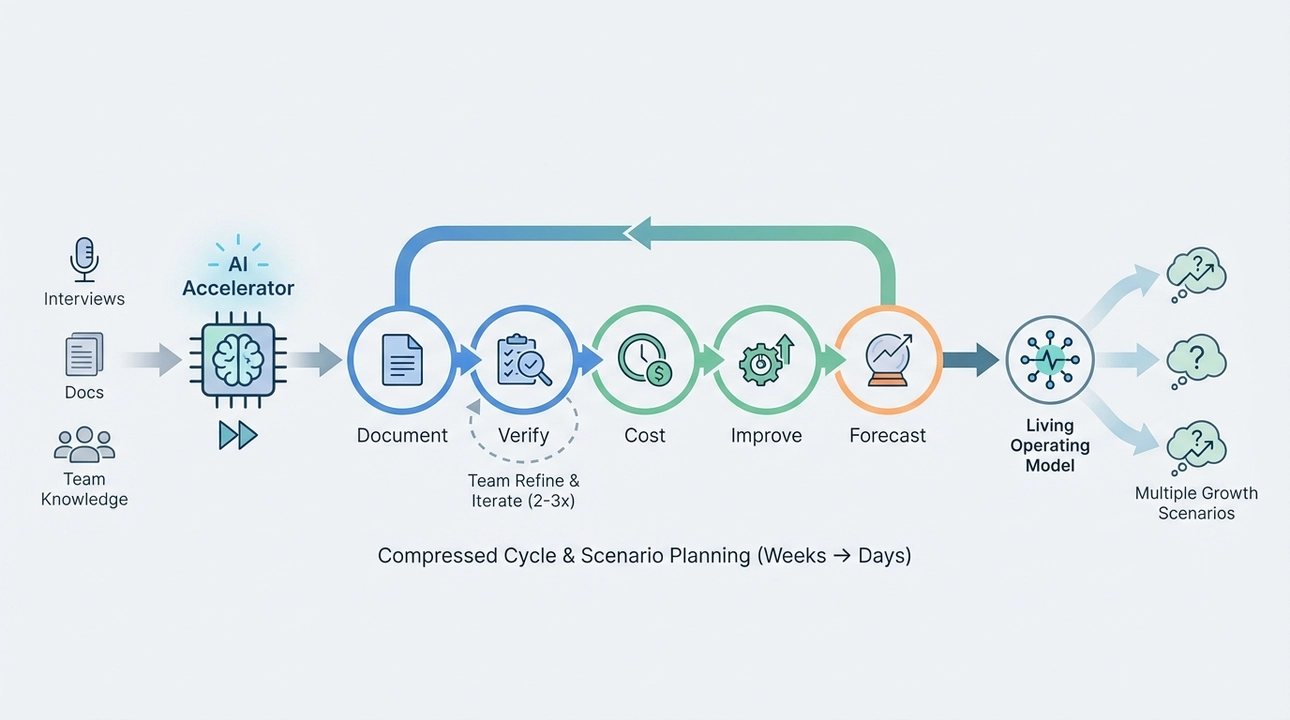
Use AI to compress the cycle: document, verify, cost, improve, forecast
AI is not the system. AI is the accelerator.
When interviews, internal documentation, and team knowledge are combined, AI can quickly synthesize and structure the information. What once took weeks can be compressed into a tighter cycle:
- Consolidate interview notes and existing documentation into coherent steps
- Generate an initial process illustration that reflects the captured reality
- Bring the illustration back to the team for verification and correction
- Assign time and money to each step, block, and hand-off to quantify cost
- Identify where automation or tooling would actually reduce friction
The verification loop matters. The first map is rarely correct. The team must review it together two or three times, refining until it matches reality and clarifies expectations.
Once the baseline model exists, AI becomes even more powerful for scenario planning. Scaling is not one future; it is multiple possible futures. AI can be used to pressure-test the process against growth scenarios:
- Where are the likely failure points as volume increases?
- What skill sets will be needed next, and in what order?
- How does the system behave when a key role is missing?
- What happens to service levels when metrics shift?
This is where systems stop being snapshots and become living, operating models.
The review cadence is the difference between a system and a fossil
Most businesses build processes once, then wonder why they stop working.
A system must evolve as the organization evolves. New hires change the culture. New customers change the workflow. Growth changes the load.
Review should be built into operations, not treated as a special project. The purpose of the review is not to create bureaucracy. It is to prevent quiet drift.
A healthy review rhythm includes:
- Regular check-ins on whether the process still matches reality
- Clear feedback channels for the people doing the work
- Updates to diagrams and communication norms when friction appears
- Reassessment of time and cost as volume changes
When processes are visual and owned by the team, review becomes easier. People can point to a step and say, “This is where it breaks.” That is progress.
A final note on scale: clarity is the culture people feel
A business can grow without systems, but it cannot grow peacefully without them.
When systems are human-centric, they do more than improve efficiency. They reduce anxiety. They make expectations visible. They help new team members contribute faster without guessing. They keep culture from becoming accidental.
The goal is not perfection. The goal is a shared map of how work moves, how communication happens, and how decisions get made.
Scale is not only a test of strategy. It is a test of whether the organization can transfer what it knows. Build systems that honour people first, and growth becomes less chaotic, more repeatable, and far easier to sustain.
The Fractional COO as Integrator and Enabler for Scalable Growth

I still remember a moment from Band of Brothers that reframed how I think about leadership. Captain Winters led his men through battle, but he rarely fired a weapon himself. His strength was in positioning, enabling, and trusting the team to act. That image is the best shorthand I know for what an effective fractional COO does for a growing business.
What most people call operations is not just process and metrics. It is the connective tissue between vision and delivery. It is the daily practice of turning strategic intent into predictable performance without losing the human element. In this piece I want to walk through why a fractional COO is more than a hire or a consultant, how I approach the integrator role, and the practical frameworks I use to build culture, speed, and resilience in scale phases.
What a fractional COO actually does
A fractional COO is a senior operator who plugs into a leadership team to accelerate execution. That definition is simple, but the function is rich. I see three core responsibilities that define the role in practice:
- Make strategy performable. You convert the CEO's vision into roadmaps, milestones, and repeatable processes.
- Build operational systems. That means the playbooks, the data flows, and the tooling that make delivery predictable.
- Develop people and culture. You coach leaders, create feedback loops, and design habits that scale.
People sometimes assume the COO role is about doing everything hands-on. Early in my career I did that too. The shift happens when you accept that your highest value is not in getting the work done alone but in enabling others to do it well and repeatedly. That shift is what turns short term fixes into sustainable growth.
The integrator role: translating vision into performance
The CEO sets the direction. They set the brand, the market ambition, and the narrative. The integrator translates that into execution. That translation includes several practical steps I use with clients:
- Map priorities to owners. Clarity is underrated. When a strategic priority lands without a named owner and a timeline it becomes wishful thinking.
- Define outcomes, not tasks. Outcomes create alignment. Tasks create busy work. I start with the end state and work backward to the minimum viable actions that produce that state.
- Create a weekly rhythm. Cadence turns strategy into habit. Weekly scorecards, quick standups with decision rules, and a rolling 90 day plan keep the leadership team focused.
An integrator also acts as the CEO's amplifier. That means filtering noise, protecting focus, and holding teams accountable to both speed and quality. It is not control for its own sake. It is creating an operating environment where the company learns faster than its competitors.
Building culture through habits, communication, and emotional intelligence
Culture does not come from posters or slogans. Culture is the sum of repeated actions, decisions, and communication patterns. As a fractional COO I focus on three levers to shape culture quickly but sustainably:
- Habits and rituals. Morning huddles, postmortems that land on learning, and consistent one on ones build predictability and trust.
- Communication flow. I design communication protocols so intent and status travel with minimal distortion. That includes defining channels for different types of information and setting expectations for response and tone.
- Coaching and development. Leaders scale by making others better. I spend time developing leaders who can hire, delegate, and run their functions autonomously.
Emotional intelligence is the glue. In an in person world EQ lets you read body language and tone. In hybrid and remote teams you must develop digital emotional intelligence. That means teaching teams to read digital cues, crafting messages with clarity and empathy, and building norms for when to escalate conversations to voice or video. If you miss this layer you will have alignment on paper and conflict in practice.
Fast and dynamic frameworks, systems, and KPIs
Speed matters. But speed without guardrails creates chaos. The solution is fast and dynamic frameworks that accept uncertainty while delivering measurable progress. My approach includes:
- Lightweight playbooks. Document the essential steps for repeatable processes, but keep them lean and editable. The goal is to accelerate onboarding and reduce variation.
- Leading KPIs, not just lagging metrics. Choose indicators that predict outcomes so the team can course correct early. For example, adopt process KPIs such as cycle time, conversion at key stages, and quality gates alongside revenue and margin.
- Dashboard hygiene. A single source of truth for KPIs reduces miscommunication. I standardize definitions and reporting cadence so teams argue about improvement, not about numbers.
A fractional COO builds these frameworks iteratively. We run short experiments, measure impact, and codify what works. After two to three years you should have a playbook that a future full time COO can inherit.
Risk management, Murphy's Law, and the communication flow
Murphy's Law is real. Stuff will go wrong. The question is how the organization responds. Risk management is not a ceremony. It is an operating habit that touches three areas:
- Protective technologies and controls. Identify the single points of failure and put simple protections in place. Backups, approvals, and escalation paths are not bureaucracy when they prevent catastrophic failures.
- Scenario planning. Run through plausible breakdowns and map who does what when they happen. These exercises reveal weak assumptions and create muscle memory.
- Transparent communication. When things go wrong, timely clarity trumps crafted perfection. I coach teams to surface problems early, own them, and propose next steps.
I also look for signals that the unknowns are multiplying. If information flow is breaking down or teams stop sharing failures, you are accumulating risk. The integrator role is to restore flow and create a culture where it is safe to fail fast and recover faster.
The playbook and the transition to sustaining
My objective with every engagement is to build a transferable system. In the scaling phase a fractional COO often leads much of the work. Over time the goal is to institutionalize practices so sustaining becomes the next phase.
A durable playbook contains:
- Documented processes and decision rights
- Standardized metrics and reporting
- Training materials and onboarding flows
- A leadership development plan and succession map
When these elements exist, the organization can move from build mode to operate mode without losing momentum. The next COO, whether internal or external, should inherit patterns instead of knowledge that lives only in one head.
Closing: the multiplier effect of enabling leadership
I believe the highest value a fractional COO offers is multiplying capacity. You create leverage by enabling people, not by doing everything yourself. That requires trust, clear communication, and a relentless focus on the few things that move the business forward.
If you are thinking about bringing a fractional COO into your leadership team, evaluate them on their ability to build playbooks, coach leaders, and design fast and dynamic frameworks that include risk controls and a clear communication flow. Ask for examples of how they turned a founder centric way of working into a team driven engine.
Leadership that learns to enable rather than execute becomes the company that scales cleanly and sustains results. That is the work I enjoy most: building the systems and the people so the business wins long after I have moved to the next challenge.
Beyond Silos: How 4D Frameworks Align People, Processes, Data and Markets to Grow Revenue and Scale Profits.

I have a simple test I run when I walk into a company that is doing well but feeling the squeeze of growth. I ask for their processes. Common answer, yes we have processes for onboarding, purchase orders, sales, fulfillment. Then I ask the next question that always reveals the truth: show me how those processes talk to each other from a client request to money received. The hesitation I get is where most scaling problems live.
The main challenge I see in manufacturing, cleantech and other people centric industries is not the absence of processes. It is the absence of an interconnected framework that treats those processes as parts of a whole. When you map the whole, you move from local optimizations to systemic outcomes. That single shift unlocks profitability, reliability and the ability to enter new markets with confidence.
Why a 4D framework is the difference between growth and chaos
Most companies build 2D processes. Sales has a manual, operations has a procedure, procurement has a checklist. Each looks fine in isolation. The flaw is the implicit assumption that deliverables, timing and information will magically transfer across handoffs.
A 4D framework adds three dimensions to those flat processes. First dimension is the vertical departmental flows. Second is the horizontal client journey, from request to payment. Third is time and sequence, so you understand lead times, wait times and decision gates. The fourth is data and metrics: what data is captured, where it lives, and how it is used to measure performance and trigger actions.
When you combine these perspectives you get a living map of how work moves through the company and how value is created and lost. For businesses with more than 10 million in revenue, that visibility is not optional. It determines whether you can scale profitably, enter a new province or country, or sustain quality while growing headcount.
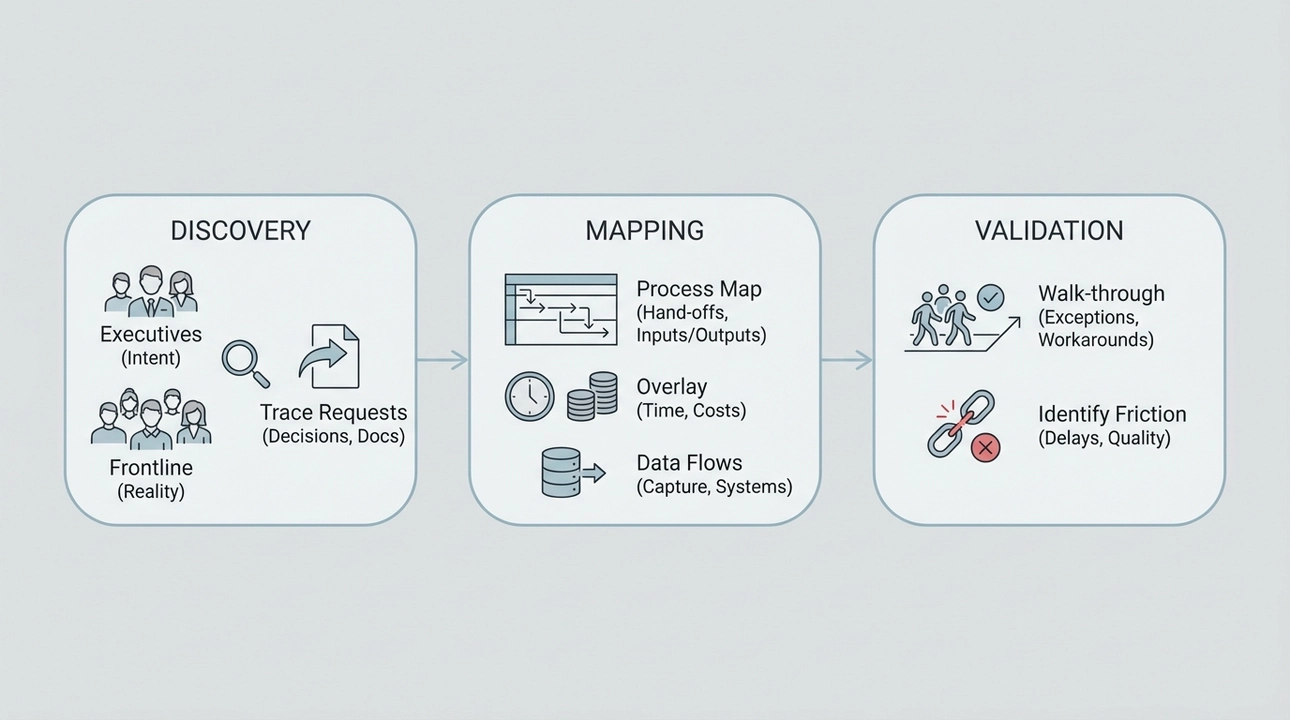
How I map processes to reveal the real flow of work
I do not start with org charts. I start with people. My practical method has three phases: discovery, mapping, and validation.
Discovery
- I spend time with executives and the people doing the work. For one engagement I interviewed 15 stakeholders across sales, marketing, fulfillment, operations, purchasing and R&D. Executives know intent. Frontline staff know reality. Both views matter.
- I ask for examples of typical client requests and trace them through the organization. Where are decisions made, what approvals are required, which documents travel with the request, and who waits for what?
Mapping
- I convert interviews into a process map with swimlanes that show each department, the handoffs, inputs and outputs. The simplest input output pair I use is request from client to money paid by client. Everything in the box is how you deliver on that.
- I overlay time estimates and costs. How long does each step take? Who is waiting? What inventory or logistics costs are invoked at particular steps?
- I map data flows. Where is client information captured? Which system owns the contract, the invoice, the delivery confirmation? What data is duplicated and where are gaps?
Validation
- I return the map to the people I interviewed and walk the process with them. This step uncovers gaps that interviews alone miss. People recall exceptions, workarounds and shadow systems only when you walk through the sequence together.
- I identify the friction points that create delays, unexpected costs or quality issues. These become the highest priority changes because they impact both client satisfaction and profitability.
Turning the map into action: three pragmatic moves
A map alone does not change outcomes. It makes change possible. I recommend three practical moves that convert visibility into traction.
1. Make handovers explicit
Too many frameworks assume handovers are obvious. They are not. Specify what needs to be transferred at each handover: documents, data fields, approvals, and expected timelines. Create checklists for complex handovers and automate confirmations where possible. When handovers are explicit the number of exceptions drops and accountability becomes measurable.
2. Quantify time and money at each step
Assign a cost and time estimate to every activity in the framework. If a step consumes unexpected labor or causes a logistics premium, that cost belongs to the framework. When you see the true cost of delivery you can decide where to invest in training, automation or supplier negotiation to protect margins.
3. Define the data heartbeat
Decide the minimum dataset that must travel with a client request so downstream teams can act without friction. Make that dataset the gating mechanism for revenue recognition. If sales cannot provide the minimum dataset, revenue is at risk. That rule reduces surprises and accelerates cash flow.
Data, KPIs and the role of technology
Frameworks expose what needs to be measured. Too often businesses measure activity rather than outcomes. The right KPIs are tied to the client journey and the financial model. Examples I track with clients include end to end lead time, cost to deliver per order, percentage of orders that required a manual escalation, and days sales outstanding by product line.
Technology is not a solution in itself, but it is an amplifier. Once you know the data you need, you can choose tools that capture it where work happens. In manufacturing and cleantech that might look like integrating CRM, ERP, shop floor systems and logistics platforms so the record of a client request persists through delivery and invoicing.
AI is useful when it automates repetitive decisions, extracts structured data from unstructured inputs, or predicts bottlenecks before they disrupt delivery. I advise clients to start with small, high value AI pilots that solve a specific handover pain point, rather than broad platform bets. The framework tells you where AI will have real impact.
Getting people to follow the framework: culture and governance
A framework only works when people follow it. That requires two things: incentives and simple governance.
Incentives
- Align KPIs to the framework so teams are rewarded for outcomes that cross departmental boundaries. If sales is rewarded solely on bookings, not on clean handovers, they will cut corners. Design incentives that reflect the health of the whole client journey.
Governance
- Create a lightweight governance rhythm. A weekly review of exceptions, a monthly cross functional forum to review trends, and a quarterly review of the framework against actual financial outcomes keeps the framework alive.
- Create a single source of truth for process ownership. Each process and handover must have a named owner responsible for updates, training, and continuous improvement.
Training and capacity planning are part of compliance. When I mapped the processes for a mid sized manufacturer I could see where teams were under staffed and where training gaps caused repeated exceptions. Filling those gaps delivered immediate improvements in on time delivery and profitability without major technology investments.
Scaling internationally means extending the framework beyond the walls
International expansion exposes hidden assumptions in your framework. Rules that work in one province or country rarely translate unchanged. Cross border logistics, regulatory compliance, tax and local supplier ecosystems introduce new handovers and new data requirements.
When preparing to enter a new market I expand the framework to include external actors: customs brokers, local distributors, compliance bodies and localized customer support. I map the additional steps and costs, the new data fields required for compliance, and the timing differences that affect cash flow.
This perspective also shows where a central model can be replicated and where local variation is required. One of the most valuable outcomes of a robust framework is the ability to say with confidence which parts of the process can be standardized across markets and which must be localized.
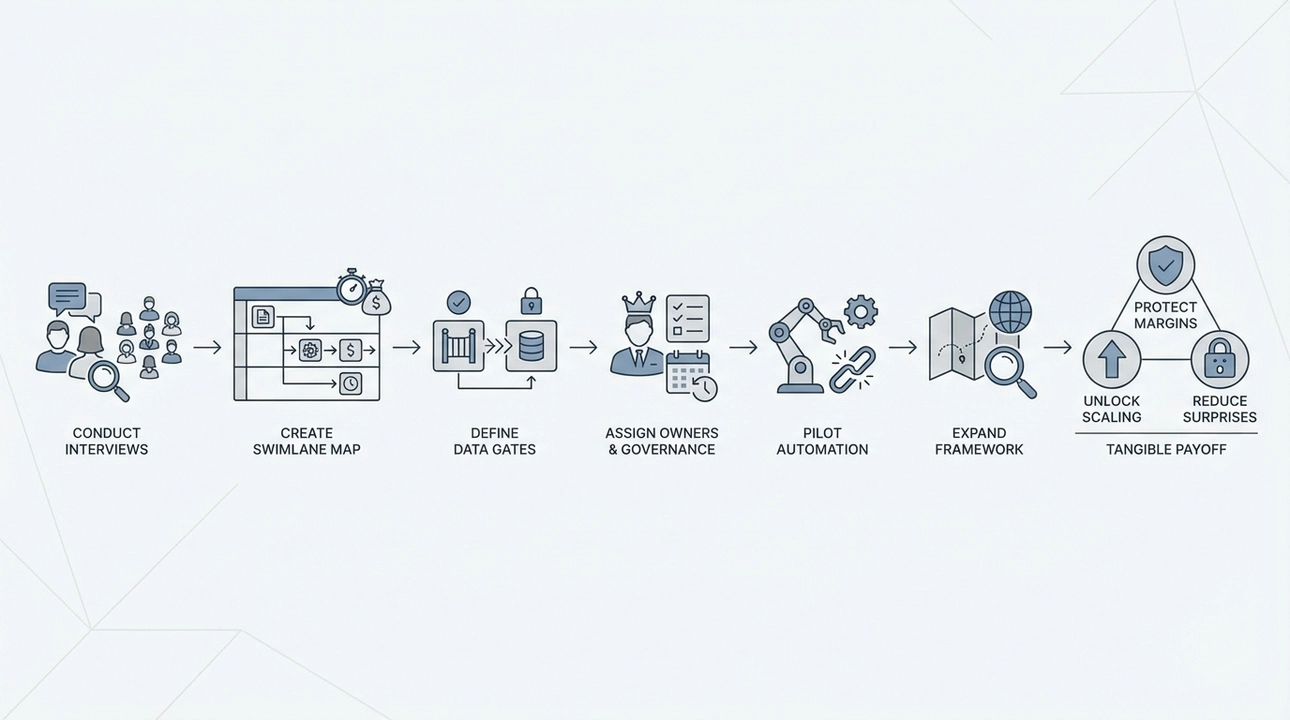
Practical checklist to get started this quarter
- Interview 10 to 20 people across functions and levels to capture reality, not just intent.
- Create a swimlane map that traces client request to payment and overlays time and cost estimates.
- Identify the minimum dataset required at each handover and make it a gating criterion for revenue recognition.
- Assign owners for each process and handover and set a governance cadence for exceptions and continuous improvement.
- Pilot one automation or AI use case that addresses a high frequency handover problem.
- Expand the framework to model one target market if you plan to go international next year.
These steps are manageable but they require discipline. The payoff is tangible. You reduce delivery surprises, protect margins, and unlock repeatable models for scaling across new territories.
Closing the loop
I have seen frameworks change the trajectory of companies I work with. Mapping a single client journey and making handovers explicit led one company to reorganize around the reality of work rather than the legacy of silos. That reorganization reduced lead times, recovered hidden margin and created a foundation for profitable expansion into adjacent provinces.
Frameworks are not an academic exercise. They are a practical tool to make complex organizations predictable and scalable. If you are leading a business that makes things and relies on people, your best leverage is to invest in seeing the whole, not just the parts.
If you take one thing from this post, let it be this: stop asking whether you have processes and start asking whether those processes are connected. The difference will determine whether your next phase of growth scales profitably or simply scales complexity.
Final thought for the leader ready to act
Start by mapping the journey of your most common client order. Follow it with curiosity, not blame. The answers you find will reveal where to invest, where to automate, and where to change incentives. That map becomes your blueprint for scaling with confidence.
Three Cups of Tea: How Patient Relationship Building Transforms Teams, Culture, and Operations

I still remember the first time I sat down for chai with a client and realized how much of leadership is not in the memos or the org chart but in the slow work of being present. In an age that celebrates speed and short wins, the Three Cups of Tea framework reminds me that the deepest value in business comes from relationships built patiently, intentionally, and repeatedly. If you want sustainable performance, reduced churn, and decisions that land, you have to invest in real human connection.
The 3 Cups of Tea is from the Balti (Northern Pakistan) proverb shared by Haji Ali (a village leader in Pakistan) to Greg Mortenson regarding building trust "The first time you share tea with a Balti, you are a stranger. The second time you take tea, you are an honored guest. The third time you share a cup of tea, you become family". The sharing and drinking together emphasize fostering deep, lasting relationships through hospitality, and this is applicable for leaders, professionals and everyone looking to create meaningful change in an organization/ecosystem.
What I mean by the Three Cups of Tea
The idea is simple and practical. Each cup marks a stage in a relationship. Each stage unlocks different kinds of understanding and influence. I use this as a mental model when I join teams as a fractional COO, when I coach founders, or when I advise boards. It shifts the objective from closing a deal to earning enough trust to make meaningful change.
First cup: this is the meeting. We talk about roles, KPIs, the problem at hand. The conversation is polite and efficient. You learn the obvious facts about the person, the org, and the challenge. You build basic rapport. This cup is necessary, but insufficient.
Second cup: with time and a second meeting, the conversation gets personal. People share frustrations, small failures, and aspirations. I start to see patterns in behaviour and culture. This is when a stranger becomes a friend or a reliable colleague. It is also when you can begin to frame solutions that respect how people actually work, not how the org chart says they should.
Third cup: now you are in the room where values and motivations are explicit. Leaders admit doubts, key contributors volunteer creative fixes, and the team begins to reveal what really blocks progress. At this stage you can design interventions that stick, because they align with people's values and lived experience.
Why this matters for scaling, culture, and operations
I have seen teams that were technically capable but culturally fragile. They had engineers who could build, managers who could plan, and leaders who could set strategy. Yet something broke repeatedly: key people left, projects stalled, or change failed to stick.
When I applied the Three Cups approach in a small manufacturing company, the immediate technical issues were easy to list. Production targets, yield loss, and unclear SOPs were the symptoms. The cause was relational. Managers and operators had different assumptions about priorities. People felt unheard. The first meeting got me the symptom list. The second meeting revealed that a production manager felt undervalued and had stopped proactively flagging machine issues. The third meeting surfaced that his motivation was tied to being recognized as an expert and to having a predictable career path.
Because I had invested in that third cup of tea, I could propose a fix that respected his values: redesigning a role to include mentorship and a small leadership stipend, paired with clearer escalation paths for machine issues. The intervention reduced turnover risk for a critical role, improved daily problem reporting, and translated into measurable gains on the floor.
This is the point most leaders miss. Operations and culture are not separate line items. Trust is an operational lever. Information flows more accurately when people feel safe. Decisions are implemented faster when they align with what drives the team. As a fractional COO, I do not fix everything by issuing directives. I fix things by earning the right to be heard and by designing interventions that people will adopt because they helped shape them.
How to practice the Three Cups of Tea deliberately
I treat relationship building like a low-cost, high-return operational initiative. Here are the steps I rely on and recommend to any leader who wants to scale culture without breaking the business.
- Block repeat time in informal settings. Don’t use the calendar only for status meetings. Schedule two or three casual touch points over weeks with the same people. Informal settings encourage openness.
- Listen with intent, not with an agenda. I take notes on feelings and values, not just facts. Who is defensive, who is protective, who gets excited about mentoring, who worries about job security. These are the patterns you use later.
- Follow up on small things. If someone mentions a kid's school event or a personal goal, remember it and ask next time. Small acts of memory build disproportionate trust.
- Translate conversations into actionable experiments. If a group worries about recognition, try a simple weekly shout out or a micro-mentorship pilot. Measure impact and iterate.
- Make the informal formal when it helps. Rituals matter. A weekly walk-and-talk, a monthly lunch with rotating invites, or a short shift-start huddle can institutionalize the safety that began over tea.
- Keep boundaries and confidentiality. Trust grows when people know things spoken in the third cup do not leak or get weaponized.
These are not warm fuzzy exercises. They are purposeful moves to gather better information, reduce friction, and design solutions that people will own.
Common pitfalls and how I avoid them
Rushing the process. I have seen leaders attempt to shortcut the second and third cups by promising immediate change. Without earned trust, those promises become brittle. My rule is: earn one cup before proposing two major changes.
Performative friendliness. Being superficially friendly without follow-through destroys credibility. I avoid performative moves by committing to next steps and reporting back on outcomes.
Mixing roles improperly. As a coach or fractional operator, I often sit between the CEO and the team. I keep clarity about my role, so people understand whether I am advocating, diagnosing, or deciding.
Failing to capture and act on insight. Conversations produce insights that must be translated into experiments. I use a short note-to-action habit: after each informal meeting, I summarize one insight and one small next step I will take or recommend.
Measuring progress and signals that the cups are connecting
Trust is hard to quantify, but you can spot signals that show the relationship is moving through the cups.
- Frequency of candid feedback without escalation. People bring problems earlier rather than waiting until they boil over.
- Voluntary suggestions. When employees propose process improvements, it shows psychological ownership.
- Reduced churn in key roles. Retention of people who were previously at risk is a powerful indicator.
- Faster decision cycles. When people trust the intent behind decisions, implementation accelerates.
- Cultural rituals that outlive any one leader. If a weekly ritual or an informal practice continues after you leave, that is a sign of deep adoption.
I track a mix of qualitative notes and a few simple metrics. The metrics keep leadership focused. The qualitative notes keep me honest about what people actually feel.
A few tactical examples I use in the field
- When I join a new client, I schedule an initial listening tour and then follow with two repeat informal visits. Each visit has a different prompt: first, understand the context; second, explore pain and aspiration; third, probe motivations and values. That cadence has saved me months of misaligned change efforts.
- At one mid-sized services firm, I introduced a monthly lunch where a junior person presents a process they would change if they could. The initiative stemmed from third cup conversations and resulted in three changes that improved throughput by double digits.
- On a manufacturing floor, I set up a 15-minute pre-shift tea period once a week where operators and the maintenance lead discuss near misses. That was born from the third cup trust and reduced unplanned downtime by giving people a safe space to flag recurring issues.
Parting cup of tea
Building trust is not an optional leadership skill. It is an operational strategy that multiplies the value of every process you create. The Three Cups of Tea is not a prescriptive ritual. It is a reminder: relationships require time, repetition, and authenticity.
When I advise leaders, I ask them two questions. How many cups have you shared with the people who will implement your plan? And what will you do differently the next time you sit down with them? Answer those honestly, and you will find your plans land with less resistance and more momentum.
If you want a takeaway to act on this week, pick one person whose opinion matters and schedule your next two informal conversations. Treat the first as listening, the second as testing a small idea, and the third as designing something together. Drink the tea. The rest follows.
Why Businesses Need an Operations Executive (& why Fractional COOs are the Secret Growth Hack)”
Let’s talk about growth — the real kind. The kind that stretches a company, exposes the cracks, tests leadership, and makes the CEO suddenly drink their coffee a little faster.
Because once your business crosses $10M+ in annual revenue, something interesting happens:
You discover the limits of “winging it.”
Processes that used to work start breaking. Teams that once moved in unison start operating like separate musical genres. And the CEO suddenly finds themselves involved in decisions like “Why do we have four different tools for project management?” or “Who owns our onboarding process? Wait, do we have one?”
This is where the COO function becomes the difference between profitable scaling and slowly sinking.
But here’s the twist:
Many companies at this stage don't need a full‑time, $300K‑plus COO. They need a Fractional COO — the architect, mentor, and operational strategist who builds the machine without blowing up your budget.
Let’s break down why.
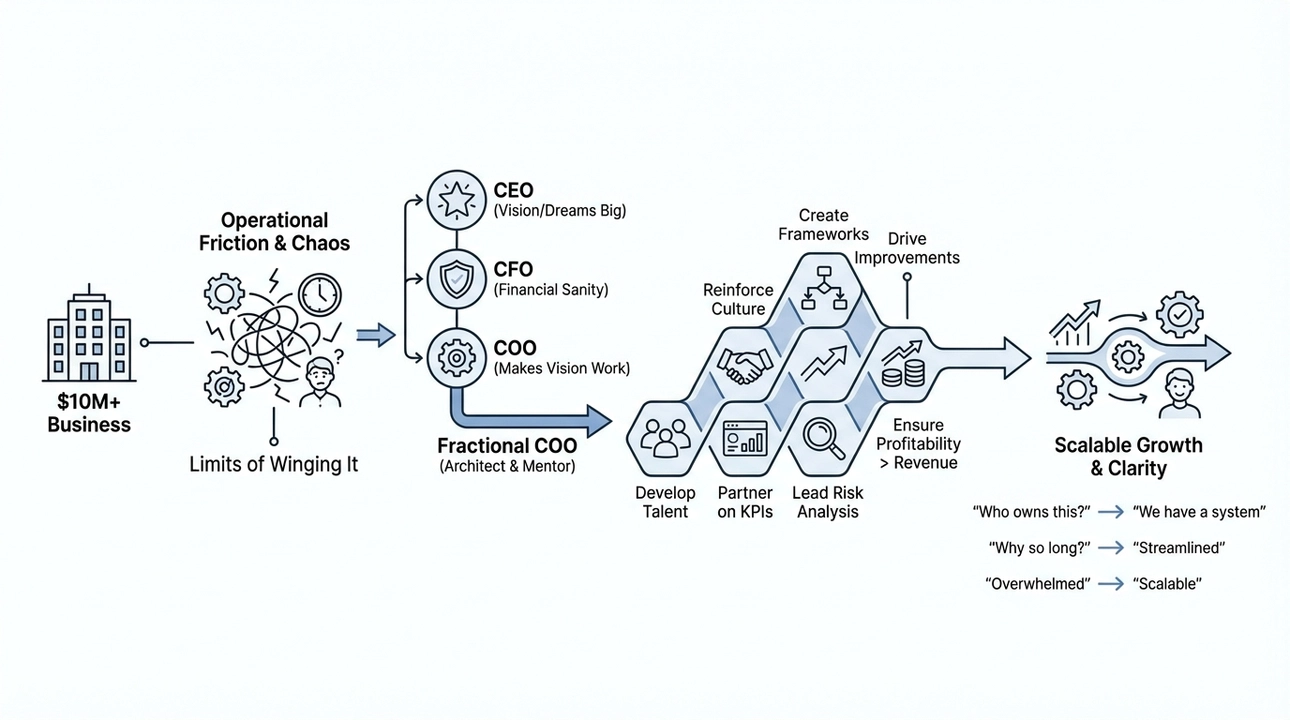
CEO vs CFO vs COO: The Real Story
Here’s the simplified — but brutally accurate — breakdown:
The CEO dreams big, motivates, sees the future, and tries (valiantly) to keep everyone inspired. They bring the vision.
The CFO ensures that vision doesn’t bankrupt the company. Budgets, forecasts, risk management — the CFO is the guardian of financial sanity.
The COO?
The COO makes the vision work in real life. They coordinate the company’s moving parts so the business doesn’t fall apart at the seams.
If the CEO says, “We’re going to Mars!”, the CFO says, “Only if the numbers work out!”, and the COO says, “Great, I’ll build the spaceship.”
What a Fractional COO Actually Does (The Part Most People Don’t Understand)
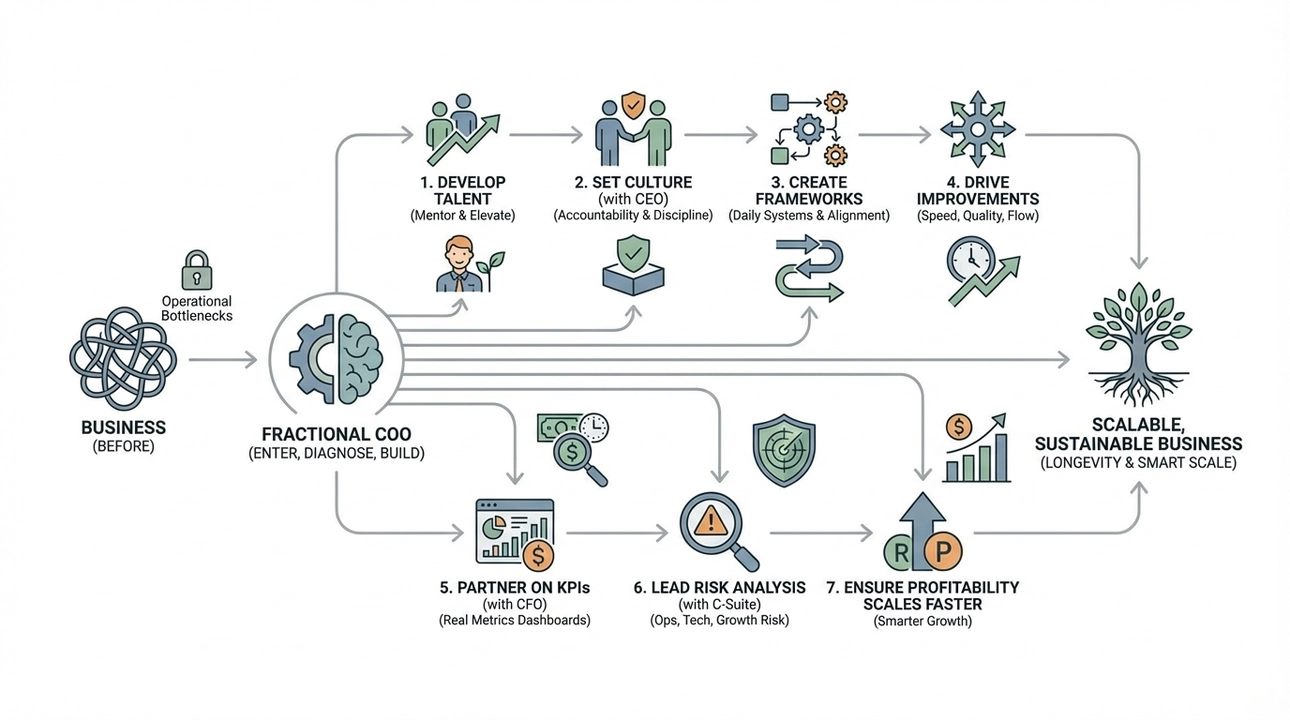
Fractional COOs aren’t part‑time band-aids. They are high‑level operators who enter your business, diagnose its operational bottlenecks, and build scalable frameworks that create longevity.
They help your company:
1. Develop talent from within: They mentor managers, elevate leaders, and create operational confidence.
People don’t just work better — they grow.
2. Set and reinforce culture (with the CEO): Not the fluffy posters-on-the-wall kind. The real culture: accountability, decision-making, operational discipline.
3. Create operational frameworks: They build the systems your teams use daily — together with your teams.
The result? Alignment, buy‑in, and processes that actually get followed.
4. Drive improvements across the entire organization: Everything gets better - Communication, Speed, Quality, Delivery, Cross-functional flow
5. Partner with the CFO on KPIs that matter: Tracking vanity metrics? Over. Fractional COOs create dashboards that show where your money, time, and effort are actually going.
6. Lead risk analysis with the entire C‑Suite: Not just financial risk — operational, cultural, delivery, tech, and growth risk.
7. Ensure profitability grows faster than revenue: This is the magic. Revenue growth is exciting. Profitability growth is sustainable. Fractional COOs build companies where the bottom line scales smarter than the top line.
Why Companies With Revenue Over $10M Need This NOW
Because you’ve reached the point where:
Hustle is no longer enough
Your CEO can't keep running operations
Your CFO can’t fix broken processes with spreadsheets
Your managers can’t scale chaos
Your growth is being limited by operational friction
A Fractional COO removes that friction — fast.
They turn:
“Who owns this process?” into “We have a system for that.”
“Why is this taking so long?” into “We’ve already streamlined it.”
“We’re overwhelmed.” into “We’re scalable.”
The Bottom Line
If you’re running a $5M ~ $50M company and operations feel like a rollercoaster with no seatbelt, you don’t have a growth problem...you have an operational architecture problem.
A Fractional COO brings clarity, mentorship, systems, accountability, and profitability discipline.
They don’t just help you scale.
They build the version of your business that can scale.
Communication Workflows That Cut Misunderstandings, Align Multi-Generational Teams, and Keep Systems Human

I have lost work to a misunderstood ask more times than I care to remember. One simple phone conversation with my boss once turned into a day of firefighting because I assumed everyone interpreted a short instruction the same way I did. That shock stuck with me. Over the years I built a different habit: I design communication workflows before I design processes. If you lead teams, run operations, or are rolling out cultural change, your systems will fail without clear rules about how people share and receive information. This is why communication is not a soft skill; it is the operational backbone that keeps work from falling into the cracks.
Why communication is the hidden failure mode
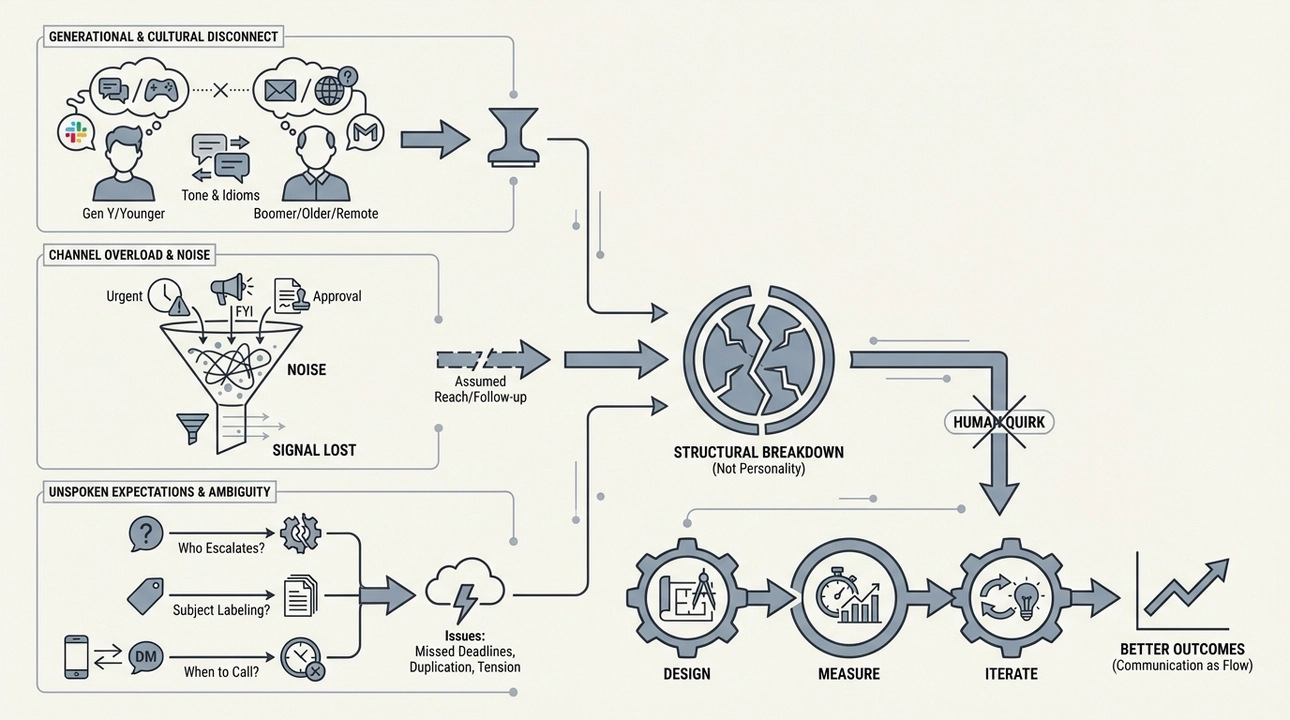
People assume others communicate the way they do. That assumption is where most breakdowns begin. I see three consistent patterns in organizations that struggle:
Generational differences shape preferred channels and tone. A Gen Y teammate may treat Slack like a live conversation, while a Boomer colleague prefers email for record keeping. Immigrants or remote hires bring regional idioms that don’t always translate, and younger staff use cultural references or game metaphors that older staff do not follow.
Channel overload creates noise. When urgent messages, FYIs, and formal approvals all arrive in the same places, people develop filters that hide the signal. The sender assumes reach; the receiver assumes follow-up.
Unspoken expectations. Teams rarely document who escalates, how to label subjects, or when to switch from DM to call. That ambiguity surfaces as missed deadlines, duplicated work, or tension in meetings.
Those issues are not about personality. They are structural. When I run operations, I stop treating communication as a human quirk and treat it as a flow to design, measure, and iterate.
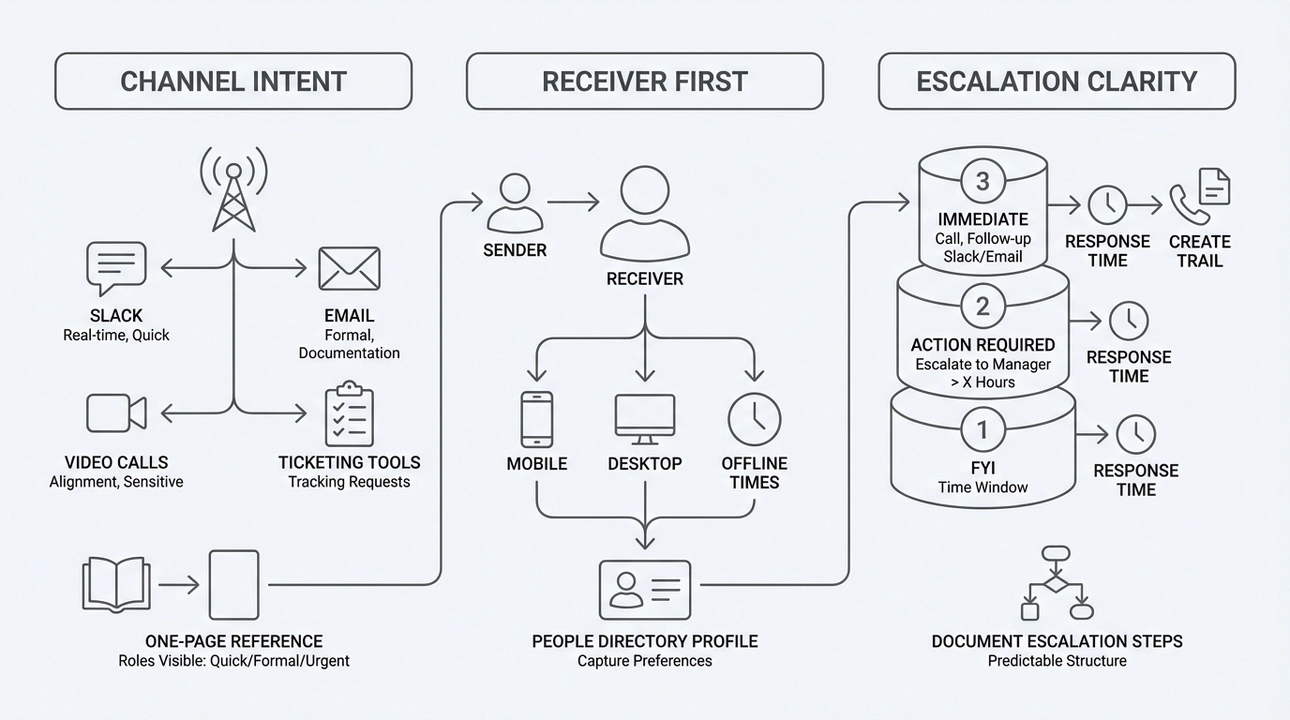
A simple framework I use to design communication workflows
I follow three pillars when I set up communication systems: Channel Intent, Receiver First, and Escalation Clarity. Each pillar maps to concrete design choices.
Channel Intent
- Define the purpose of each channel. For example: Slack for real-time coordination and quick clarifications, email for external correspondence and official documentation, video calls for alignment and sensitive topics, and ticketing tools for tracking requests.
- Make channel roles visible. Create a one page reference everyone can access that states: Slack equals quick, informal; Email equals formal and attach documents; Phone equals urgent and requires immediate attention.
Receiver First
- Decide communication for the person who needs to receive, not for the sender. Ask: how does the recipient prefer to be reached and where will they see this most reliably?
- Capture preferences in onboarding. I ask new hires how they prefer notifications, whether they use mobile or desktop, and what times they are offline. This becomes part of their profile in our people directory.
Escalation Clarity
- Define urgency levels and the action expected. I use three tiers: FYI, Action Required, and Immediate. Each tier maps to a channel and a response time window.
- Document escalation steps. If an Action Required item goes unanswered in X hours, escalate to the manager. If Immediate, call and then follow up in Slack and email to create a trail.
Implementing these pillars means designing rules, not policing personalities. It lets people work with their styles inside a predictable structure.
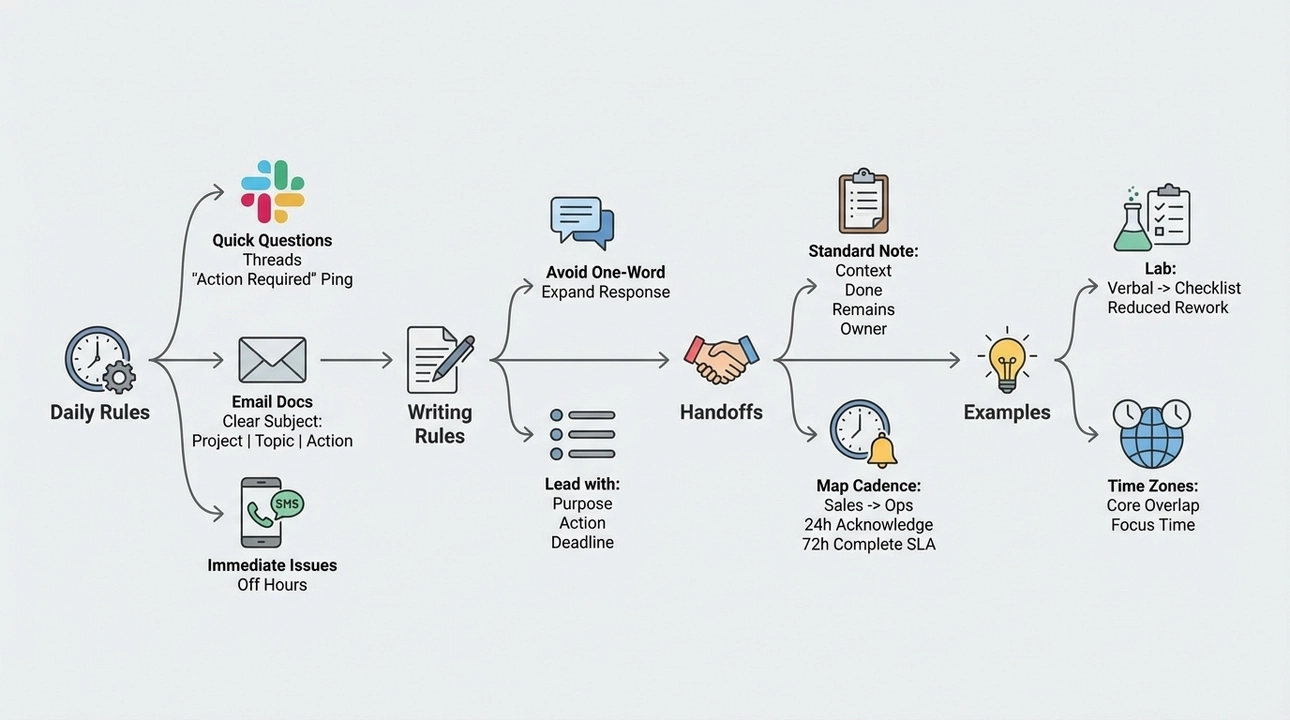
Practical rules and examples I implement with teams
When I joined teams as an operations lead, I found that small, explicit rules change behavior far faster than long manuals. Below are rules I share and enforce early in an engagement.
Daily operating rules
- Quick questions in Slack. Use threads to keep channels readable. If something needs an answer in less than two hours, mark it Action Required and ping the person directly.
- Email for documents and external communication. Always use a clear subject line structured like: ProjectName | Topic | Action Required or FYI. That format forces the sender to think about intent.
- Phone and SMS for immediate issues outside business hours. If you receive a call during off hours, treat it as Immediate unless told otherwise by the contact.
Writing rules that save time
- Avoid one word replies when the ask could be interpreted multiple ways. A short expansion stops assumptions, for example: Yes, I can do X by 3pm and will update the doc in folder Y. That simple phrase eliminates follow-up questions.
- Use the sentence at the top of emails and long messages that states purpose, action required, and deadline. Lead with: Purpose, Required action, By when.
Handling cross-team handoffs
- Standardize the handoff note. I ask teams to use a template for handoffs that includes context, what was done, what remains, and who owns the next steps. Put that as the first section of an email or ticket.
- Map a notification cadence. For example, when Sales sends a client onboarding request to Operations, tag it as Onboarding Request and route to the intake queue. Assign a 24 hour SLA for acknowledgment and a 72 hour SLA for completion.
Examples from real situations
- When a lab technician misunderstood a verbal instruction, we changed to a mandatory checklist sent via ticketing tool for all procedures. The checklist required the technician to confirm specific parameters. The result: the number of rework incidents dropped dramatically.
- When teams across time zones were missing each other, we set core hours for overlap and moved brainstorming sessions to those windows. For deep work, we blocked focus time where notifications are deferred.
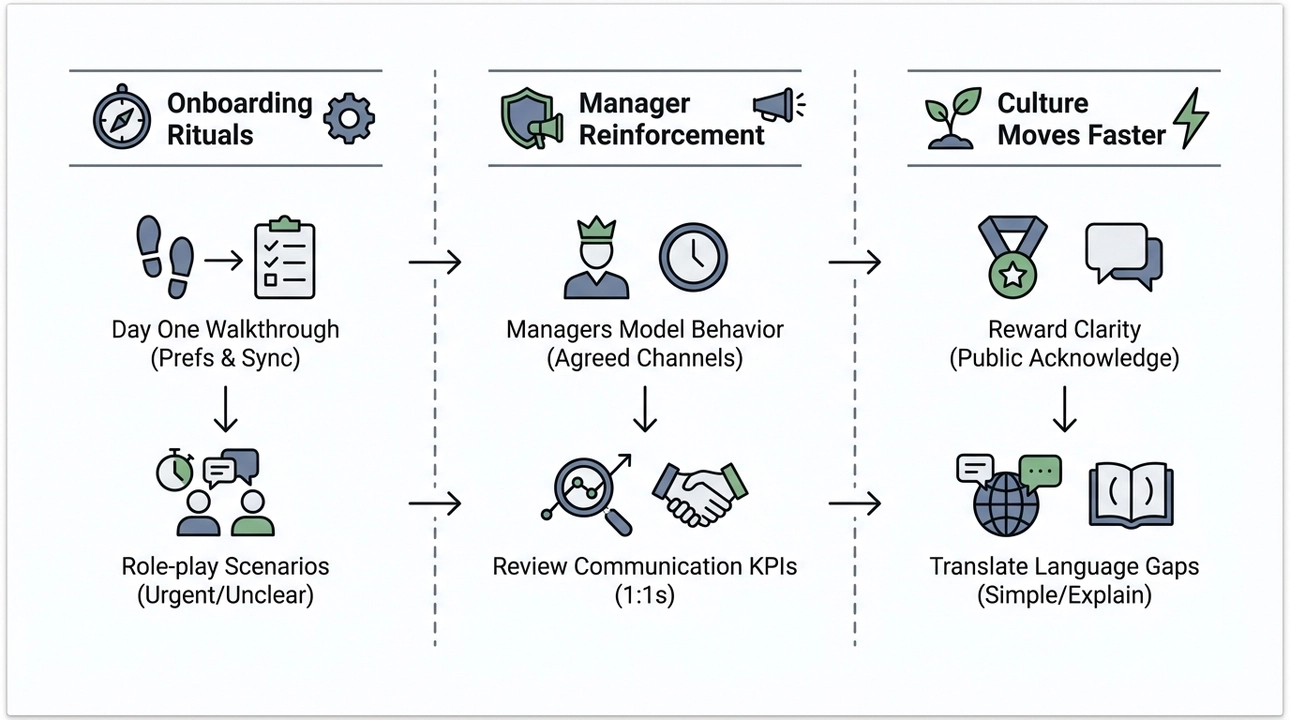
Training, onboarding and culture: making the system stick
Rules only work if people adopt them. I build three layers to make adoption practical.
Onboarding rituals
On day one I walk new hires through the communication playbook and ask them to set up preferences. I also schedule a 15 minute sync with their manager to calibrate expectations.
Role-play scenarios. I run quick scenarios for common situations, such as urgent client escalations or unclear stakeholder asks. Role-play makes the norms muscle memory.
Manager reinforcement
Managers model the behavior. If leaders reply to non-urgent Slack messages at 2 a.m., everyone learns that immediacy is expected. Leaders must use the agreed channels and subject formats.
Review communication KPIs in 1:1s. I ask how often messages are misunderstood and whether channels caused delays. This keeps conversation about communication alive.
Culture moves faster than policy
Reward clarity. Publicly acknowledge examples where someone prevented a misunderstanding by clarifying a request. That shapes behaviour faster than penalties.
Translate language gaps. For teams with diverse backgrounds, I encourage simple language and avoiding idioms. When people reference examples like a video game or TV show, add a short parenthetical explanation for others.
Measuring and iterating
Communication design needs feedback. I track a few lightweight signals:
Response time averages by channel. Are Slack DMs answered in the expected window? Is email used for things that should be Slack?
Number of follow-up clarifications per major handoff. If handoffs generate two or more clarifications, the template needs work.
Subject line compliance. Randomly sample emails and measure whether subject lines follow the guideline.
I run short retrospectives every quarter focused solely on communication. Small tweaks, like changing a subject prefix or adding a required field to a ticket, compound into fewer misunderstandings.
A practical starter checklist for your next week
Publish one page that assigns intent to your top three channels.
Pick one recurring handoff in your team and create a two sentence template for it.
Start onboarding with a 10 minute conversation about communication preferences.
Agree on three escalation levels and their channels and share them with the team.
These are small moves that pay off quickly.
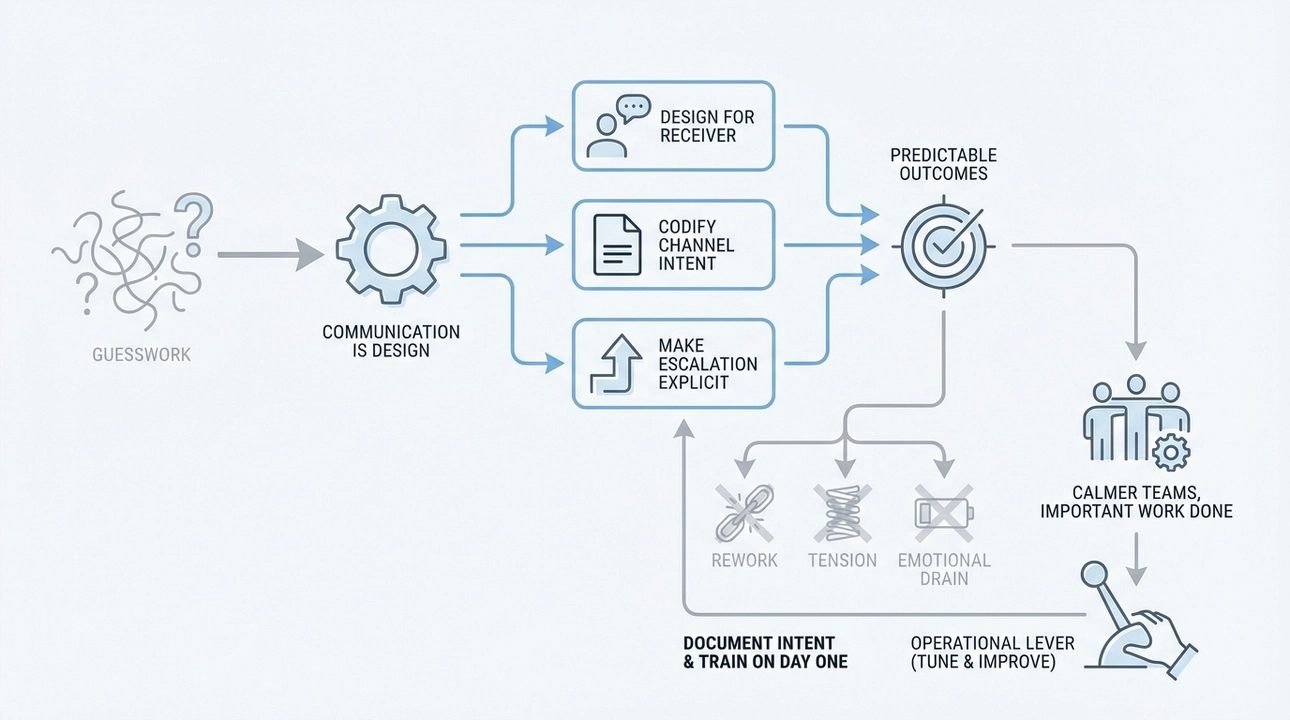
Final reflection: communication is design, not guesswork
I no longer think of communication as something people will naturally figure out. It is a design challenge with social, cultural, and technical constraints. When you design for the person receiving the message, codify channel intent, and make escalation explicit, you replace guesswork with predictable outcomes. That change reduces rework, surface-level tension, and the emotional drain of constant clarification.
If you try one thing from this article, make it documenting channel intent and training new people on it on day one. That small habit saved me hours of firefighting and created calmer teams that get important work done. Communication is not a magic skill reserved for a few leaders; it is an operational lever any team can tune and improve over time.
Creating Meaningful Connections: The Heart of Success
In the fast-paced world of business, where the pursuit of monetary success often overshadows personal connections, the true essence of achievement is frequently overlooked. Over the past several weeks, I've had the opportunity to reflect on the impact of significant moments, inspired by the book 'Power of Moments' and the recent experiences that have unfolded around me. It's opened my eyes to the fundamental truth that the connections we build, within business and beyond, significantly shape our path to success.
## The Power of Purpose Over Money
Money is, without a doubt, a critical component of business success. Yet, the relentless pursuit of financial gain can sometimes leave us staring at hollow victories. The defining metric of success, often missed, is purpose. When I look back at my career, my greatest achievements were not driven by revenue goals but by meaningful contributions and a deep-seated purpose. My interactions with startups have reinforced this belief. I am drawn to those driven by a quest for purpose, whether it's recruiting better talent, improving community well-being, or addressing urgent issues like environmental conservation.
## Valuing Community and Connection
I learned early on as a manager that human moments are invaluable. By celebrating individual milestones such as birthdays and coming together during challenging times, we create a supportive environment. This fosters a sense of belonging and propels both individual and collective growth. It is more than just acknowledging achievements. It is about understanding that both success and failure offer valuable lessons and that the relationships we build are integral to enduring success. The importance of community cannot be overstated. During trying times, it’s the collective strength that navigates us through adversity.
## Embracing Cultural Moments
Recognizing and celebrating moments has a profound effect on workplace culture. In one instance, a small gesture, like sharing a reel or a picture, can bridge physical or emotional distances, creating shared experiences and laughter. These instances of quick interaction often leave lasting impressions. They remind us of the shared humanity in our professional pursuits. Encouraging this atmosphere of shared experiences lays the foundation for an inclusive and vibrant culture. The death of my great aunt exemplified the power of community as people gathered to share stories and pictures, illuminating the legacy of moments over a lifetime.
## Cultivating Personal and Professional Growth
Ultimately, the growth of any business is tied to the growth of its people. My experiences reveal that individuals do not just work for a paycheck; they seek fulfillment. They stay where they feel connected and valued. The memories I've built with former colleagues remind me of the indelible impact of these connections. Creating an environment that nurtures growth through connection leads to more creativity, improved performance, and sustained success. As businesses evolve, the focus should shift from mere output to developing a meaningful culture that attracts, retains, and nurtures talent.
In sum, while economic metrics track success, it's people and community that drive it. Businesses that prioritize personal connections will not only elevate their culture but will distinguish themselves in a crowded marketplace. The path of purpose and community is not the easiest, but it is the most rewarding. What you put into your community, you often get back tenfold. So as we move forward, let us harness the power of meaningful connections to forge paths of enduring success.
Unlocking Potential Through Meaningful Mentorship in Diverse Business Environments

Unveiling the Power of Mentorship in Modern Business
Have you ever paused to ponder the profound impact a skilled mentor can have on your professional journey? From my own experiences and observations as a principal consultant, I believe mentorship is one of the most transformative tools in today's diverse business ecosystems. Whether formal or informal, mentorship serves as a beacon of guidance, unlocking potential and facilitating growth in ways that leave a lasting imprint.
Establishing Observable Milestones
Every successful mentorship begins with setting well-defined expectations and open communication. An effective mentor-mentee relationship thrives on clarity, wherein both parties clearly outline the objectives and touchpoints. To build lasting, impactful partnerships, it is essential to first delve into the 'why' behind each mentee's aspirations. Understanding the social, cultural, and professional background of the individual enables the mentor to tailor their guidance and strategies accurately.
Diverse business landscapes call for adaptive frameworks. That initial three-month period acts as a proving ground where initial touchpoints develop into deeper relationships. These early conversations often determine the direction and tone of future interactions, fostering an environment for mentees to broaden their horizons and acquire knowledge pivotal for their career trajectory.
Creating an Enriched Mentorship Environment
It's not just about what you do, but where you do it. The setting for mentorship is as vital as the process itself. In dynamic ecosystems, fostering an environment loaded with empathy, understanding, and mutual respect can significantly amplify the effectiveness of any mentorship program.
The community atmosphere—be it through casual meetups, shared meals, or focused sessions—plays a crucial role in nurturing these relationships. By aligning mentors with mentees based on mutual respect and shared values, companies can facilitate more authentic and understanding connections, enhancing the depth of learning exchanges.
Empathy and The Evolving Nature of Mentorship
Being an effective mentor demands more than sharing insights and experiences. It requires empathy, active listening, and the courage to challenge each other's perspectives in a nurturing way.
Critically, not everyone is cut out to be a mentor. Companies should thoughtfully identify or train individuals who possess a natural ability to empathize. They should be mentors who respect the diverse backgrounds brought in by their mentees, fostering a supportive learning space.
In a mentorship, both parties should be comfortable enough to challenge each other without compromising the relationship's integrity. A successful mentorship will organically evolve, sometimes lasting a month and sometimes spanning several years. Recognizing when the mentoring relationship has reached its natural conclusion is a crucial skill all parties should develop.
Embrace Mentorship for Growth and Progress
As I reflect on my own experiences, embracing mentorship in its varied forms and structures has proven invaluable. For those considering formal or informal mentorships, strive for transparency and depth in every mentorship interaction. Let us continue creating environments that allow us to embrace diverse perspectives and foster shared growth.
Together, we possess the potential to inspire a ripple effect of learning and empowerment that leaves lasting, positive impacts throughout our organizations. Let's connect and explore the ways mentorship can elevate our collective journeys. Reach out—I am here to support your growth and exploration in this ever-evolving business landscape.
Crafting Intentional Culture in Today's Dynamic Workplace

The Essence of Culture: An Intentional Act
Every organization’s journey is unique, yet at the core of every success story lies a strong, intentional culture. As I've delved into the complexities of culture, I've come to realize that it is not simply a byproduct of outlining vision statements or setting up catchy value punchlines. Rather, it is the intentional, daily actions—a continuous ethos—that unify people, bind them into a community, and drive them toward common goals.
To build a meaningful culture, you must step beyond surface-level assertions. It’s about showing up daily, with intention, and aligning actions with the spoken and unspoken ethos of your organization. Think of culture as the embodiment of your business’s values in action. This daily demonstration of culture forms a living tapestry, weaving together shared beliefs, values, and practices.
(Going to use the 'Ted Lasso' TV show as an example for developing and evolving culture. Coach Ted did many intentional acts to create/develop/evolve the culture in the club. One of the first things he did was to tape up the sign 'BELIEVE'...the sign was there in the first episode of season 1 and the final episode of season 3, where Coach goes back to Kansas...yes, spoilers.)
The Power of Stories and Celebrations
Stories have an unrivalled ability to connect people to a broader narrative. In my professional journey, I’ve observed how powerful storytelling can be in fostering cultural alignment. Envision storytelling not as a recounting of past exploits, but as a way to bridge past, present, and future. Share narratives that inspire, that clarify the company’s purpose, and that anchor new members into the existing fabric of the organization.
Celebrating people is another crucial element of cultural development. Recognition and celebration of achievements—be it personal milestones like birthdays or professional triumphs like project completions—fuel a positive cycle of engagement and commitment. I’ve seen firsthand how this fosters a sense of belonging and encourages people to deliver above and beyond, creating a self-sustaining culture of excellence.
(Every episode in Ted Lasso had a storytelling element to make us love AFC Richmond and everyone in the organization. For this, watch: episode 8 in season 1, episode 6 in season 2
The Role of Rituals and Community Building
One might wonder why rituals, such as shared meals or team gatherings, are significant. Drawing from historical contexts, think about how food has always served not just as sustenance but as a bridge for communication and community building. Regular, informal gatherings where food is shared have a magical way of breaking down barriers, promoting camaraderie, and strengthening the cultural fabric.
To cultivate an enduring culture, thoughtfully design these ritual interactions. Whether it’s a casual weekly breakfast meeting or a monthly team outing, such practices become the glue that holds your team together, fostering trust and collaboration. This setting allows engagement in a manner that transforms a group of individuals into a cohesive community.
(This was shown best with the 'Biscuits with the Boss' ritual introduced in season 1, episode 2 and the Diamond Dogs community, which started in season 1, episode 8, with both lasting the 3 seasons. I myself had ritual and community building in all the places I work... morning coffees & croissants, Wednesday bike rides, group lunches, the chocolate drawer, and meme group chats, to name a few.)
Adapting Culture to Evolve
Finally, to foster a culture that withstands the test of time, we must embrace its evolving nature. Just as culture everywhere evolves with language, technology, and new talent, so must the culture within your organization. Encourage a culture that is flexible, that learns from its environment and adapts to new challenges and opportunities. Celebrate the diversity of thought and be open to recalibrating the cultural compass when necessary.
By continually evolving, we enable the business to thrive, allowing it to contribute back to the community and establish its legacy. Culture, ultimately, is the heartbeat of these efforts and the key to enduring organizational success.
(Ted Lasso was about adaptation and growth, and the culture of the organization did just that. 1) Roy Kent going from angry old football star to grumpy young manager of a Premier League team, and 2) Jamie Tartt from a narcissistic, selfish football stud striker to a collaborative and caring leadership focused on team success.
Conclusion
As we navigate the complexities of modern business landscapes, the culture we cultivate within our organizations becomes paramount. When fostered intentionally, it transforms into a powerful driver of success. Let us embrace the stories, rituals, and evolving dynamics that enrich our workplaces and lead us to greater achievements.
For those who wish to learn more about crafting an intentional and impactful culture, feel free to reach out. I am here to guide you towards building a thriving, dynamic, and cohesive workplace culture.
Enhancing Business Foundations Through Culture and Systems
In today's rapidly evolving business landscape, building a robust foundation for scaling up is crucial. My journey across various roles in HR, supply chain, and marketing has underscored one simple truth: understanding your business deeply is essential for sustainable growth. Many startups focus solely on revenue, but scaling requires a more nuanced approach. It's about knowing what you're selling and having systems in place to scale effectively. A key element in this process is culture. You want a team aligned with your values, especially when you're not present. This alignment ensures uniform decision-making and fosters trust.
Creating an efficient business architecture involves integrating well-defined systems and processes. These frameworks should allow you to comprehend costs and time efficiently, helping to streamline operations and drive continuous improvement. By implementing the right technology, businesses can enhance their capabilities without unnecessarily increasing workloads.
Financial planning in this context becomes a strategic exercise, involving risk analysis, especially considering external factors. Assumptions in planning are inevitable, but understanding internal and external dynamics can mitigate risks. When challenges arise, it's about analyzing where the system bottlenecks and resolving issues collaboratively rather than assigning blame.
Scaling or introducing new projects requires a strong cultural foundation to connect diverse teams globally. Trust through shared values is critical in maintaining consistent excellence. Technology should be leveraged tactically, such as AI, to optimize and enhance efficiencies. In this dynamic environment, forecasting needs to be agile, recognizing the imperfect nature of information, and adapting as necessary.
Embrace these insights to not only prepare for growth but also steer your company's legacy in today's competitive landscape. Engage in thoughtful planning and strategic foresight, and reach out to explore these concepts further as we navigate the complexities of business growth together.
A Practical Guide to Financial Modeling and Risk Analysis for Startups and Scaling Businesses
In every growth story I coach, the model is the map and the risk analysis is the compass. If you are pre-revenue or scaling, you cannot afford a model that looks pretty but fails in execution. Here is how I build a faster, sharper financial model and pair it with a risk matrix that keeps you honest.
## Start With the Reality of Pre Revenue and Scale
Before revenue, the question is simple on paper but hard in practice. What does it cost to set up, and how long until you can sell. Map lead times in manufacturing or onboarding, supplier MOQs, logistics, and seasonality. Then define your sales forecast. Who are you selling to, at what price, and how frequently. Do market sizing both bottoms up and top down. Bottoms up means pipeline, conversion, ACV, and cycle time. Top down is total market, segment, your reachable share. Reconcile both so assumptions are clear, not convenient.
## Build the Model Drivers That Actually Move Results
Sales forecast sits on top, but COGS and supply chain dynamics shape gross margin. Early on, COGS can be high as you learn the process and optimize. Set a target gross margin by segment and show the path there through scale curves and supplier negotiations. People cost is next. Think hiring plan, ramp, compensation, and commissions for sales engineers and reps. Tie headcount to capacity and revenue, not vanity ratios. Add capex and depreciation where relevant. Then overheads. Legal, finance, marketing and sales, office, tools. Using a percent of revenue is fine if you anchor it to comparables in your industry and your go to market, B2B versus B2C. Finally, track burn rate and liquidity. How many months of runway do you have at base, upside, and downside. Tie cash needs to milestones, not calendar wishes.
## Make Assumptions Explicit and Testable
Financial modeling is assumptions. List them. Price, churn, conversion, hiring speed, lead time, discounting, payment terms. Attach data where you have it and label confidence where you do not. Define KPIs that tell you early if an assumption is breaking. Example. lead conversion, win rate by segment, gross margin by SKU, time to hire, on time delivery. Build a dashboard cadence that touches these weekly so you are not surprised quarterly.
## Turn Risk Into a System, Not a Feeling
Risk equals probability times severity. Unknown unknowns exist, but most risk can be mapped if you use a simple risk matrix. For each assumption, list threats across operations, supply chain, people, compliance, customer concentration, pricing power, and funding. Score with a weighted system so you can compare apples to apples. Decide actions. avoid, mitigate, transfer, accept. Mitigation must be concrete. backup supplier with verified lead time, approval processes for discounts, responsibility matrix so issues are raised fast, credit checks for large customers, scenario playbooks if demand drops or spikes. Keep the language of risk in time and money. How much time lost, how much cash burned, how much runway left.
## Stress Test With Scenarios and Liquidity
I build three cases. base, upper, lower. Then I shock the model. slip launch by two months, increase COGS by 5 percent, reduce win rate by 20 percent, extend DSOs by 15 days. See the effect on gross margin, burn rate, liquidity runway, and debt covenants if you have them. The point is not perfection. It is to choose the leading indicators that will trigger action and to pre decide the actions so the team moves, not debates.
### What You Can Expect Working With Me
You will leave with a model that reflects how your business really operates, clear KPIs, a risk matrix with a weighted scoring system, and a scenario pack you can present to your board or investors. We will align targets to market comparables, not wishful thinking, and we will translate unknown unknowns into monitored drivers.
If you want a fast, honest review of your current model or a working session to build your risk matrix and scenario plan, reach out and let us map it together.
Purpose First Operations Early Stage Foundations That Scale
I build companies from the ground up by treating purpose as a system, not a slogan. When your why is clear, the work you sell naturally aligns to your mission and vision, and the market hears your song. That clarity becomes your siren for clients, partners, and talent.
## Purpose is the operating system
Before anything else, I ask why you. What is the competitive advantage that gets you out of bed and keeps you showing up when it is tough. Purpose is not a poster. It is the practical filter for who you serve, what you offer, and how you decide. When founders lock this in early, they make better calls on costs, channels, culture, and growth because every decision connects back to a real outcome.
### A field story
Years ago I led a struggling unit around hydraulic fracturing in oil and gas. The tech kept failing, contracts were shaky, and the team was losing belief. I reframed the work around a community focused purpose. Done right the operation could open real jobs in places with limited opportunity, improve roads, and create pathways for students to enter the workforce. With that why in place, I built win win pricing with multiple clients, aligned with corporate expectations, secured several contracts, and held those relationships for five to six years. We hired about 75 people, other departments grew headcount, and families saw the benefit. Revenue followed because value was clear for everyone involved. Purpose created momentum, and discipline kept it running.
## Know your end client and the value chain
Foundations are simple and non negotiable. Do you understand your costs. Have you defined the end client and the path to reach them. Have you mapped your global value chain so you know where risk sits and where margin lives. Early teams often skip this and then bleed cash later. I push teams to articulate the client problem in plain terms, document the steps to win and serve that client, and test channels fast. Why you is not fluff. It is how you lock focus and speed.
## Make the numbers and documentation work
Financial modeling is not about a perfect spreadsheet. It is about options. What if we price by outcomes. What if we tier by usage. What happens if the value chain shifts. We model scenarios, define runway, and set guardrails. Then we document. Every number recorded, every process captured, so onboarding is smooth when the team grows. Documentation is culture. It reduces noise, speeds decisions, and lowers risk when you add people or enter new markets.
## Build culture with emotional intelligence in person and digital
Scaling is human. I invest in emotional intelligence and digital emotional intelligence so teams can engage, motivate, and upskill in any setting. In person you read the room and create trust. In hybrid you design rituals for virtual meetings, async updates, and feedback that actually lands. The small stuff matters. Onboarding is thoughtful. Roles are clear. People know the song we are singing and how their work hits the mission.
### What clients can expect
When I partner with a founder or an early team, we lock the why, define the end client, and map the value chain. We model costs and pricing, set clear documentation, and design onboarding so you can add people without losing culture. We build habits for emotional intelligence across in person and hybrid so the team stays motivated and accountable. The goal is simple. Make decisions faster, reduce failure points, and scale with purpose.
## Closing the loop
If you are starting, or resetting, and want a purpose driven foundation that holds for years, let us talk. I will help you clarify the why you, get the numbers right, and build a culture that can grow in any market.
Case Studies
Operations Management and Project Deployment in Mobile EV Charging
How a greenfield services contract in California was delivered on time and under budget, turning a $1.5M pilot into $3M+ in follow-on contracts.

The Business Challenge
A Vancouver-based energy startup had built a solid product track record delivering smaller 5KW power stations. But winning a multi-million dollar contract to deploy mobile EV charging stations during California’s public safety power shutdowns (PSPS) required something entirely different: a functioning services operation, built from scratch, in a market the company had never worked in before.
The contract called for six 20/30KW mobile charging systems deployed across California within six months. The company had no local infrastructure, no service team on the ground, and limited experience managing large-scale field deployments. Revenue was committed. The capability to deliver it was not yet in place.
This is a challenge familiar to any capital-intensive or field-services business scaling beyond its home market. Growing revenue is straightforward. Building the operational foundation to deliver it profitably, without blowing the budget or burning client trust, is where most companies stumble.
What Made This Hard
The project surface area was wide:
Execution in unfamiliar terrain. No prior playbook existed for deploying large-scale mobile charging systems as a service. Every process had to be designed, not inherited.
Remote operations management. Setting up a functioning team and vendor network in California, without a physical presence, required building relationships at a distance and making high-stakes decisions with incomplete information.
Supply chain volatility. The energy sector was experiencing significant disruption. Component lead times were unpredictable, and production delays threatened to cascade into delivery failures.
Client relationship management. The client had clear expectations and tight timelines. Managing confidence, especially when things went sideways, required constant, honest communication.
Budget and cash flow discipline. A project of this scale, with a startup’s capital base, left almost no margin for financial error. Every procurement decision had downstream consequences for cash flow.
The Operational Approach
Rather than improvise, the engagement was structured around three principles: a clear execution playbook, strategic local partnerships, and proactive risk management.
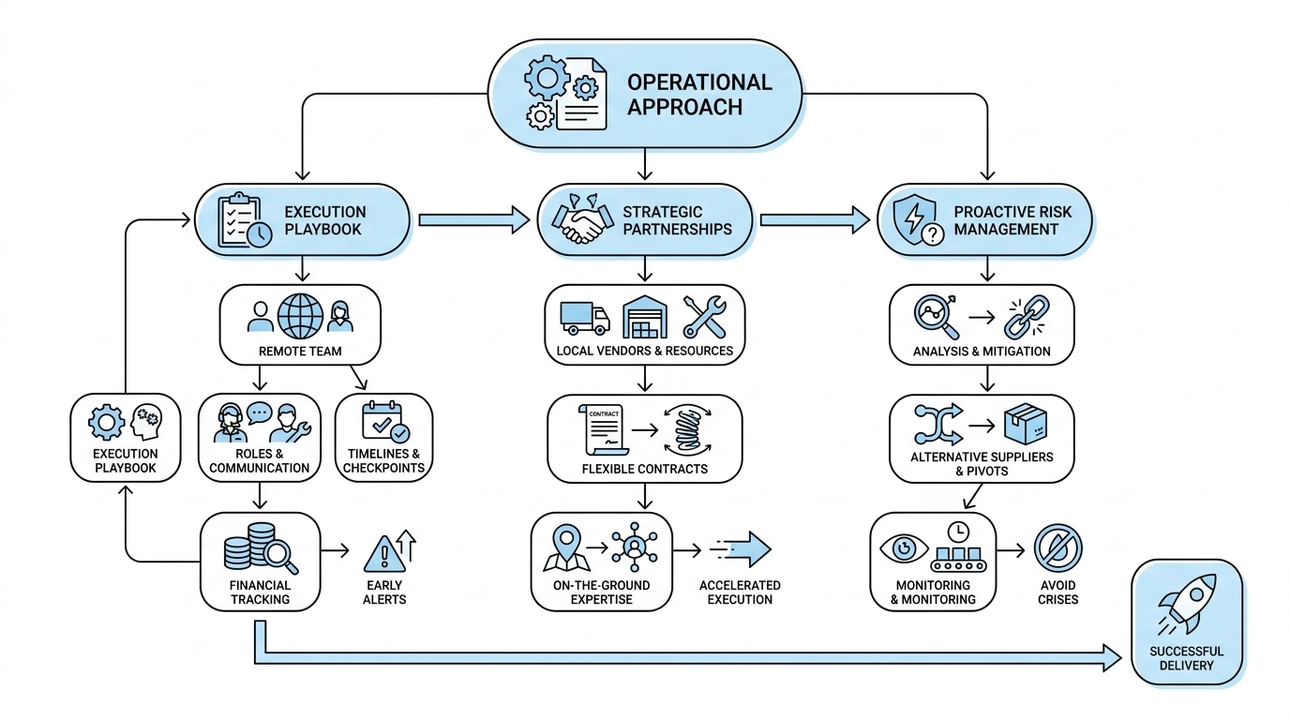
Building the execution playbook. Before a single shipment was made, a detailed deployment playbook was developed: timelines, decision checkpoints, roles and responsibilities, and escalation paths for when things went wrong. This became the operating manual for a remote team that had never worked together before. It also meant problems could be caught early, not after they’d already cost money or time.
Assembling and leading a remote team. A cross-functional team was recruited and coordinated across project management, engineering, and field support, all working remotely but aligned around the same delivery milestones. Keeping a distributed team cohesive under deadline pressure required consistent communication rhythms and clear accountability structures.
Developing California-based partnerships. Rather than trying to build everything internally, the approach focused on connecting with established local vendors, warehousing partners, and service providers. This gave the project immediate access to on-the-ground expertise and resources, reducing risk and accelerating execution. Vendor contracts were negotiated with flexibility in mind, anticipating that timelines would shift.
Proactive risk management. A comprehensive risk analysis identified the most likely failure points (supply chain delays, vendor reliability, team coordination gaps) before they materialized. Mitigation strategies were built in: alternative suppliers identified, contracts structured to allow quick pivots, and production closely monitored to catch delays before they became crises.
Rigorous financial tracking. A budgetary process was developed alongside the finance team that tracked every cost category, built in contingencies, and flagged variances early. For a startup delivering its first large-scale services contract, financial discipline wasn’t just good practice. It was existential.
Execution: What Actually Happened
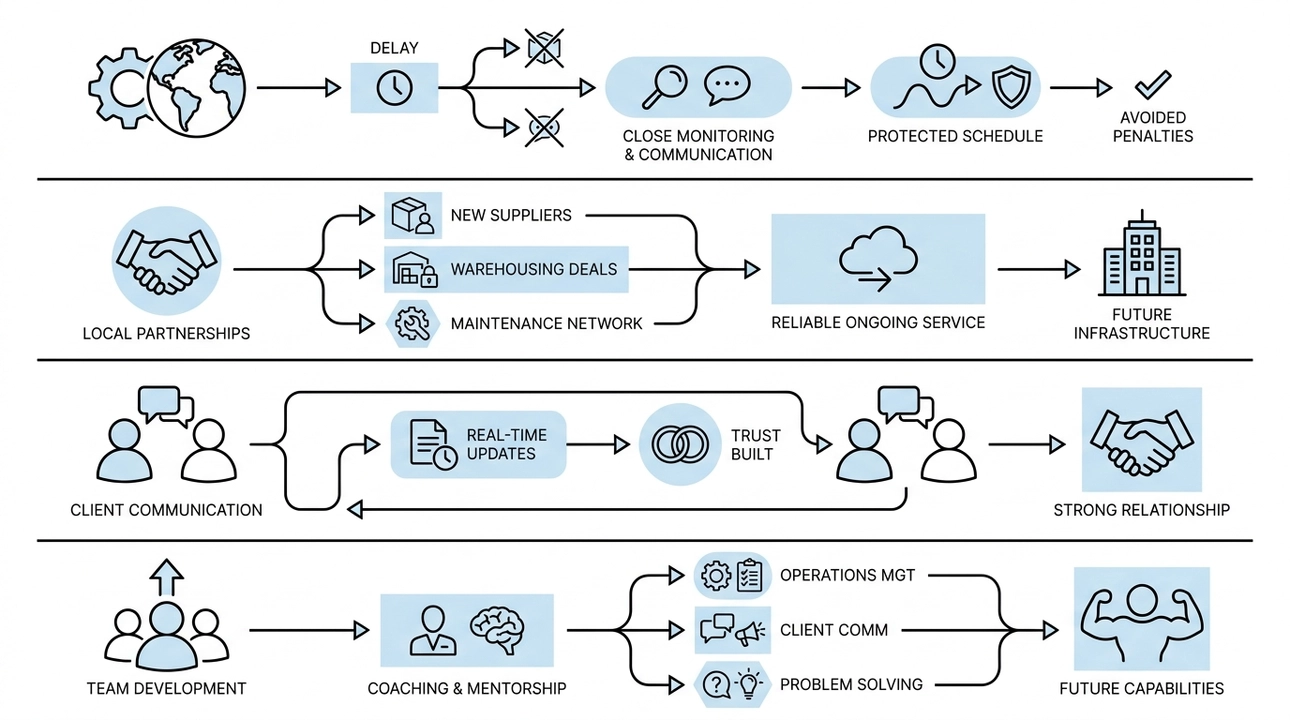
Supply chain disruptions were managed, not avoided. Production delays did occur, as expected. The difference was in how they were handled: close monitoring, direct vendor communication, and adjusted timelines that protected the overall delivery schedule without triggering client penalties.
Local vendor partnerships became a competitive advantage. Sourcing new suppliers to support a newly formed customer service team, locking in warehousing deals, and building a maintenance network meant that once the systems were deployed, ongoing service could be delivered reliably. This wasn’t just about the pilot. It was about building the infrastructure to support follow-on work.
Client communication was treated as a deliverable. Keeping the client informed of progress, challenges, and decisions in real time built the kind of trust that survives project difficulties. The relationship remained strong throughout the deployment.
The team was developed, not just managed. Throughout the project, coaching and mentorship were prioritized alongside execution. Team members were developed in operations management, client communication, and on-the-fly problem solving, building capabilities the company would need long after this contract closed.
The Outcomes
The pilot was delivered within budget and within the six-month window.
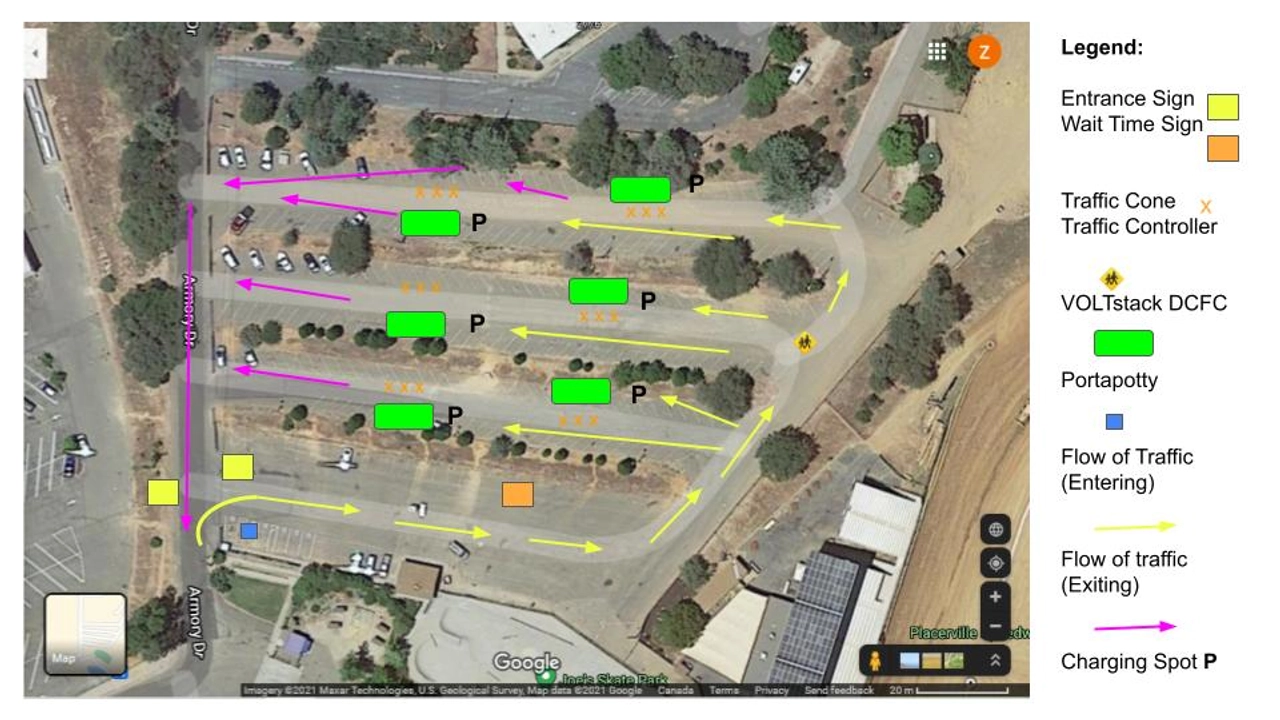
$1.5M initial contract delivered on time and within financial parameters.
$3M+ in follow-on contracts secured directly as a result of the pilot’s successful execution. The client extended the partnership because the delivery built confidence.
Long-term vendor and partner contracts established in California, giving the company a scalable operational foundation for future deployments, not just a completed project.
Customer service team expansion in California, providing ongoing maintenance and support, converting a one-time delivery into a recurring revenue relationship.
The pilot proved that a product-focused startup could build a services operation that delivered profitably in a new market. That proof unlocked the next phase of growth.
What This Illustrates for Scaling Businesses
The mobile EV charging deployment is a compressed version of a challenge many capital-intensive and field-services businesses face when they try to grow beyond their existing footprint: the gap between winning new revenue and building the operational capacity to deliver it profitably.
Revenue growth is visible. The systems, partnerships, team structures, and processes required to sustain it, without eroding margin or damaging client relationships, are not. Closing that gap is an operations problem, and operations problems require structured thinking, disciplined execution, and the willingness to build infrastructure before it’s urgently needed.
The lesson isn’t specific to EV charging or California. It applies to any business trying to move from its home market into new territory, from a product-only model into services, or from a small team into a distributed operation that has to deliver consistently at scale.
Other Case Studies:
From the Blog:
Connect:
Ecosystem Development and Process Mapping in AgTech
How a growing AgTech startup gained clarity on its operations, aligned its teams, and built the partnership infrastructure to scale internationally, without burning its runway.
The Business Challenge
Trendi had done something genuinely difficult: it had developed proprietary technology for food waste valorization and secured a partnership to pilot the project internationally, starting in Ecuador. But as the company moved from concept to execution, cracks in the operational foundation began to show.
Teams were working in silos. Opportunities were being chased without a consistent method for evaluating whether they were actually worth pursuing. Business development, marketing, and R&D were operating on different timelines with different priorities and no shared framework for how decisions got made or handed off.
For a company at this stage, past early concept and moving into real market traction, the problem wasn’t ambition or technology. It was operational cohesion. And without it, the risk was real: the company would generate activity without generating profitability.
This is a pattern common to fast-moving startups targeting international expansion. The market pull is there. The product is real. But the internal scaffolding, the systems, processes, and cross-functional discipline, hasn’t kept pace with the ambition.
What Made This Hard
No ecosystem to connect the right partners. Trendi needed to build relationships across farms, research institutions, and distribution networks in multiple regions simultaneously. None of that infrastructure existed yet.
Teams operating in silos. Business development was pursuing leads that R&D couldn’t support on the required timeline. Marketing was generating interest without a clear handoff process into delivery. The result was wasted effort and growing internal friction.
No consistent way to evaluate opportunities. Without a shared framework for assessing which partnerships and projects to pursue, the company was at risk of saying yes to everything, and executing nothing well.
No standardized process flow. There was no structure governing how decisions moved from idea to agreement to execution. Every deal was being handled differently, which made it impossible to learn, improve, or forecast reliably.
Investor pressure to demonstrate operational efficiency. As the company sought to justify its runway to investors, it needed to show not just traction but a credible path to profitability, and that required getting internal processes in order.
The Operational Approach
The engagement focused on three things: structure, alignment, and ecosystem development.
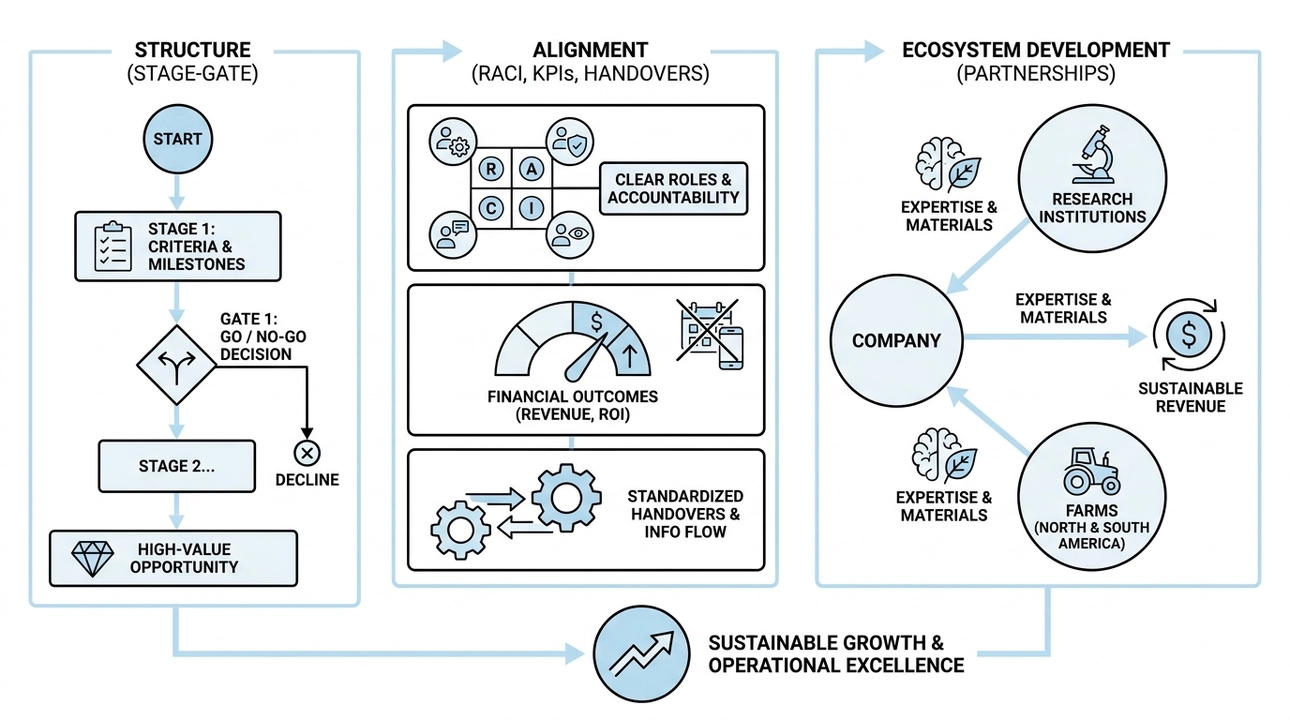
Introducing a Stage-Gate process. A formal Stage-Gate framework was implemented to ensure every opportunity was evaluated consistently before resources were committed. Each stage had clear criteria, defined milestones, and go/no-go decision points. This gave the company a way to distinguish between high-value opportunities worth pursuing and distractions worth declining, a critical capability for any team working with limited bandwidth.
Defining roles and accountability with a RACI framework. A RACI chart (Responsible, Accountable, Consulted, Informed) was developed to clarify who owned each part of the process. This eliminated the ambiguity that had been causing handoff failures between teams and created visible accountability at each stage of the pipeline.
Establishing KPIs tied to revenue and profitability. Rather than measuring activity (meetings held, deals pitched, conversations started), the teams were aligned around metrics that connected directly to financial outcomes: revenue potential, return on investment, and operational feasibility. This shifted the business development team’s focus toward high-value commodities, while giving technical and R&D teams realistic parameters to work within.
Standardizing cross-functional handovers. A communication plan was developed to govern how information moved between departments: project updates, timeline changes, and decision rationale. This sounds procedural, but in practice it was the difference between teams that trusted each other’s work and teams that constantly re-litigated decisions because they didn’t know what had already been agreed.
Building the partnership ecosystem. Strategic partnerships were developed with research institutions and local farms across North America and South America. These relationships served a dual purpose: providing the technical team with domain expertise and raw material access, while also establishing the commodity pipeline necessary to generate sustainable revenue from food waste valorization.
Execution: What Actually Happened
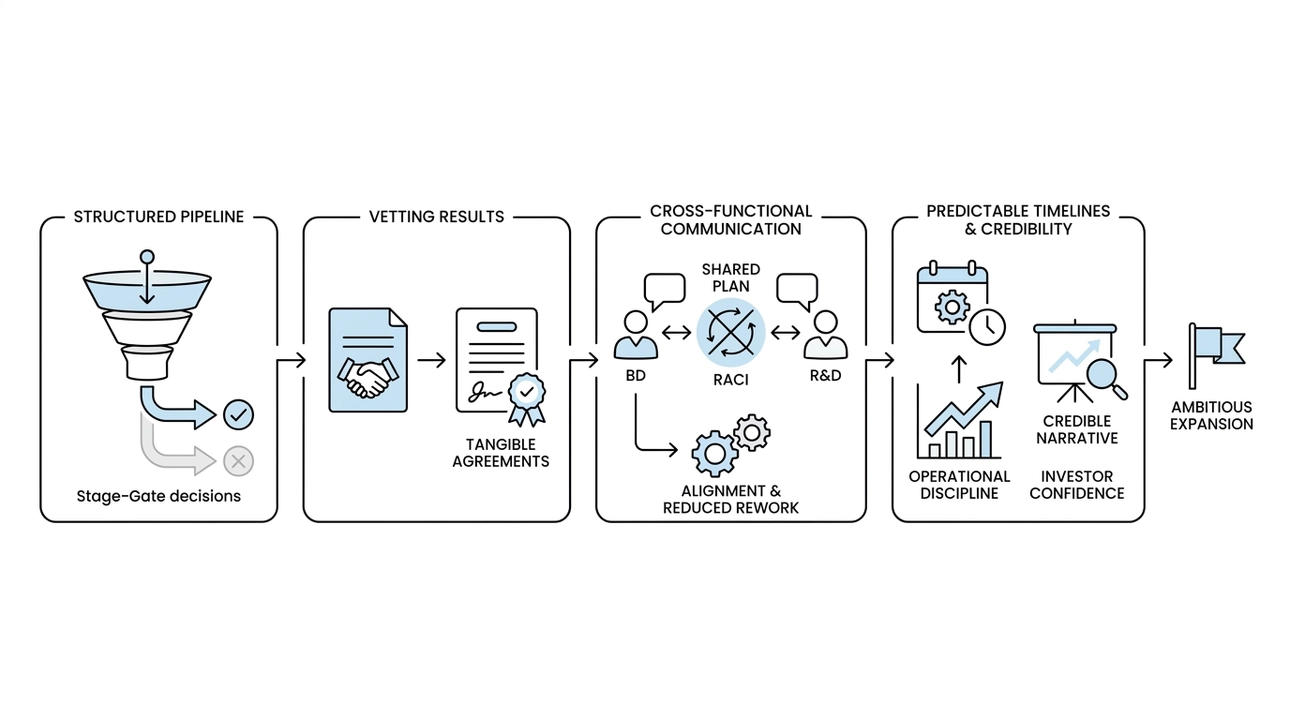
Opportunities moved through the pipeline in a structured way. With the Stage-Gate process in place, the team could track which partnerships were worth advancing and which weren’t, and make those decisions quickly, without lengthy internal debate.
Letters of Agreement were signed with high-value partners. The vetting process produced tangible results: actual agreements with the partners most aligned with Trendi’s commercial objectives.
Teams started communicating across functions. The shared communication plan and RACI structure meant that business development knew what R&D could realistically deliver, and R&D understood the commercial priorities driving inbound requests. This reduced the rework and misalignment that had been consuming significant time.
Budget and timelines became more predictable. With defined processes and clear accountability, the technical team could execute against realistic plans rather than constantly adjusting to shifting expectations. This was particularly important during periods of investor scrutiny, when demonstrating operational discipline was as important as demonstrating market traction.
The investor narrative became more credible. When the team could point to a structured opportunity pipeline, defined KPIs, and active international partnerships, the story shifted from “we’re working on it” to “here’s how we’re building this systematically.” That matters when you’re asking investors to continue backing a company with an ambitious expansion plan.
The Outcomes
Multiple high-value partnerships formalized through the Stage-Gate process, with signed Letters of Agreement establishing the commercial relationships needed to move the Ecuador pilot forward.
Improved cross-functional coordination across business development, marketing, and R&D, reducing the silos that had been slowing decision-making and creating internal friction.
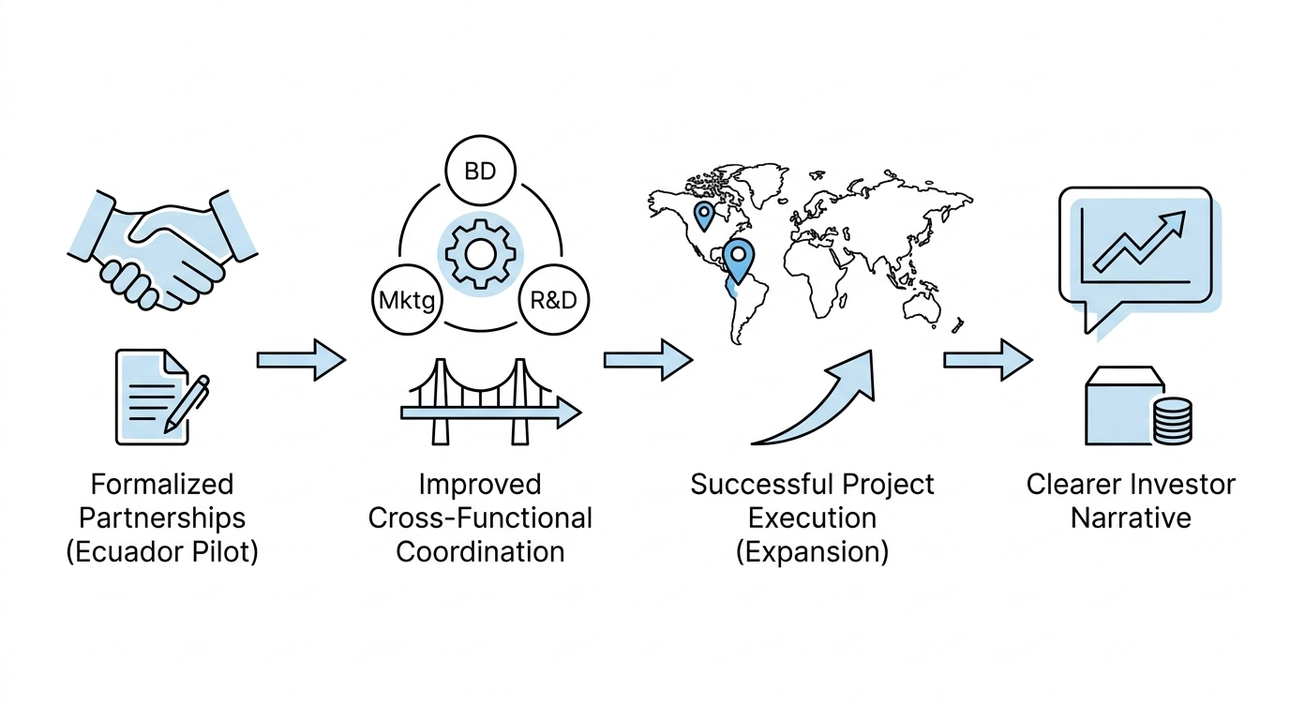
Successful project execution in Ecuador and North America, expanding the company’s operational footprint in the food waste valorization sector and validating the international expansion thesis.
A clearer investor narrative, grounded in operational structure and measurable pipeline progress rather than early-stage optimism alone.
What This Illustrates for Scaling Businesses
The Trendi engagement captures a challenge that almost every growing business faces at some point: the gap between the ambition to scale and the operational infrastructure to do so profitably.
Pursuing more markets, more partnerships, and more contracts is not the same as building a business that can deliver on all of them. In capital-intensive businesses, where deals require significant resources, specialized expertise, and multi-party coordination, saying yes to the wrong opportunity is often more damaging than passing on it.
The companies that scale well are the ones that build their decision-making infrastructure early. A Stage-Gate process isn’t bureaucracy. It’s a way of protecting the company’s most limited resources (time, capital, and team bandwidth) from being diluted across opportunities that aren’t worth pursuing.
The same principle applies to cross-functional alignment. When business development, technical delivery, and finance are working from the same playbook, the company moves faster and wastes less. When they’re not, every deal becomes a negotiation between departments rather than a coordinated push toward shared goals.
Profitable scale requires both: the right opportunities and the operational discipline to execute them well.
Other Case Studies:
From the blog:
Connect:
Supply Chain and Current Asset Optimization for a Fortune 500 Company
How a pressure-pumping operation across 30 business units reduced inventory by 30%, cut DSO by 75%, and freed up over $5M in capital, all while sustaining rapid growth.
The Business Challenge
In large enterprises, individual business units often function like independent companies. They manage their own P&L, compete internally for resources and capital, and are held accountable for delivering profitable growth, not just revenue. When a business unit’s operations are inefficient, capital gets tied up, leadership loses confidence, and resources get redirected to better-performing divisions.
That dynamic is no different from what any SMB owner faces. If your operations aren’t producing a healthy return on the capital deployed in them, growth becomes a liability rather than an asset.
This is the context for a supply chain transformation undertaken across a global pressure-pumping operation. It was a business experiencing rapid demand growth in horizontal fracturing services, while simultaneously carrying over $30 million in inventory across 30 business units from Egypt to New Zealand. The business was growing. But it wasn’t growing efficiently. And in a volatile oil market, that gap between revenue growth and financial discipline was a serious risk.
The mandate was direct: reduce current assets, optimize warehousing and procurement processes, and build the forecasting capability needed to support continued growth without the capital inefficiencies that were undermining profitability.
What Made This Hard
No reliable forecasting. With over 15,000 SKUs across 30 business units, there was no consistent method for tracking or predicting consumption. Budgeting for parts and maintenance was largely reactive, driven by what had already broken rather than what was likely to be needed.
Fragmented vendor relationships. Multiple vendors, inconsistent contracts, and no centralized procurement strategy meant that the same parts were being sourced at different prices, with different lead times, through different processes, and in different locations.
$30M+ tied up in inventory. Capital that should have been available for growth was locked in stock that wasn’t being tracked, shared, or deployed efficiently.
A disconnected supply chain. Without visibility across the full network, business units were hoarding inventory as a hedge against uncertainty, which compounded the problem rather than solving it.
A growth mandate that couldn’t wait. The business was under pressure to meet rising market demand. The optimization had to happen without disrupting operations or creating new delivery risks.
The Operational Approach
The engagement began not with systems, but with people. The first three months were spent building relationships across maintenance, operations, supply chain, and R&D, understanding the unique challenges each team faced and identifying where the highest-impact improvements could be made. This groundwork was essential. Process changes in complex, multi-site operations fail without buy-in, and buy-in starts with trust.
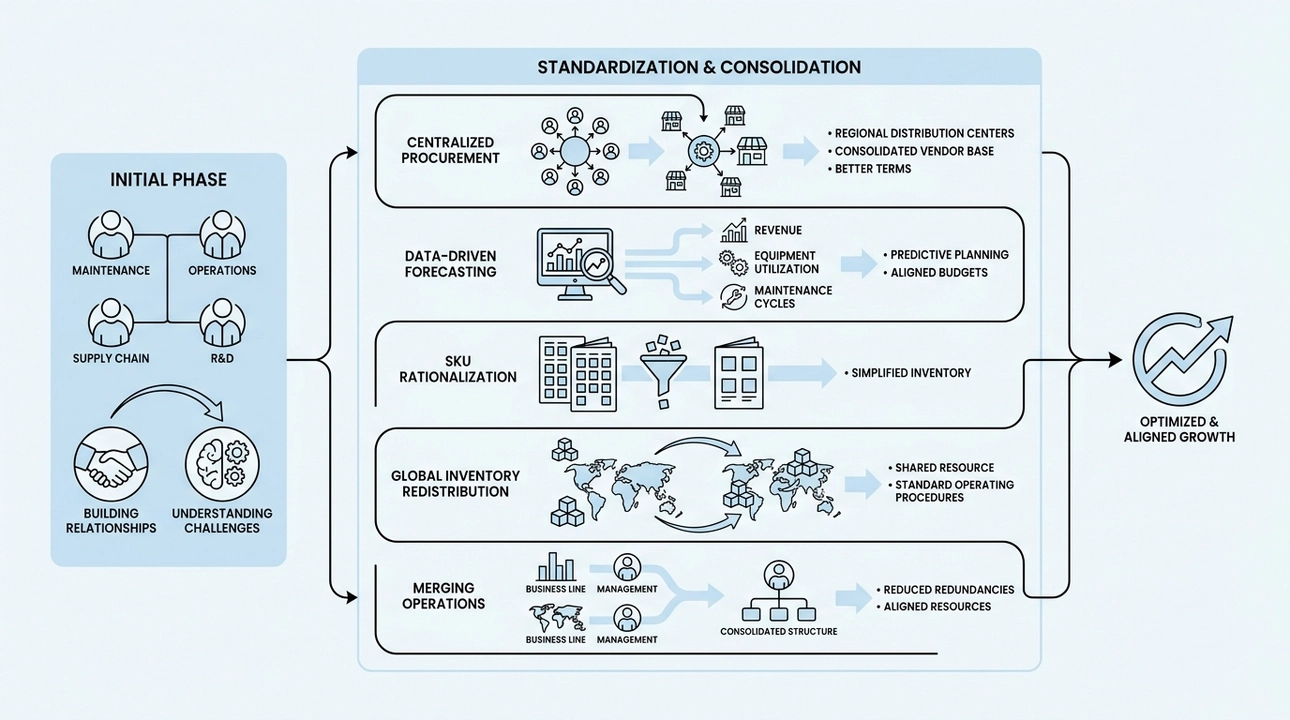
Centralizing and standardizing procurement. New purchasing processes were developed to reduce complexity and bring consistency across the network. This included finalizing regional distribution centers, consolidating the vendor base, and negotiating better terms made possible by aggregating demand across business units. Instead of 30 teams sourcing independently, procurement was coordinated centrally, with the leverage that comes from scale.
Building a data-driven forecasting system. A forecasting framework was implemented that tied demand projections directly to operational metrics: revenue, equipment utilization, and maintenance cycles. This replaced reactive purchasing with predictive planning, giving the business visibility into what it would need before it ran out, rather than after. Budgets were developed in parallel, aligned to these forecasts and to the company’s broader financial targets.
Reducing SKU complexity. The 15,000+ SKU catalog was systematically reviewed and rationalized. Non-critical, low-velocity items were eliminated. The result was a simpler, more manageable inventory that could be tracked and controlled with far greater accuracy.
Redistributing inventory globally. Rather than each business unit holding its own buffer stock independently, inventory was treated as a shared resource across the network. This unlocked significant capital. Stock that had been sitting idle in one location could be redeployed to meet active demand elsewhere. Standard Operating Procedures were developed to govern how this sharing and redistribution worked in practice.
Merging operations across business lines and regions. Two business lines and geographic regions were consolidated, reducing redundancies in management, purchasing, and warehousing. This wasn’t just an efficiency play. It was a structural change that aligned the organization’s resources more closely with where growth was actually happening.
Execution: What Actually Happened
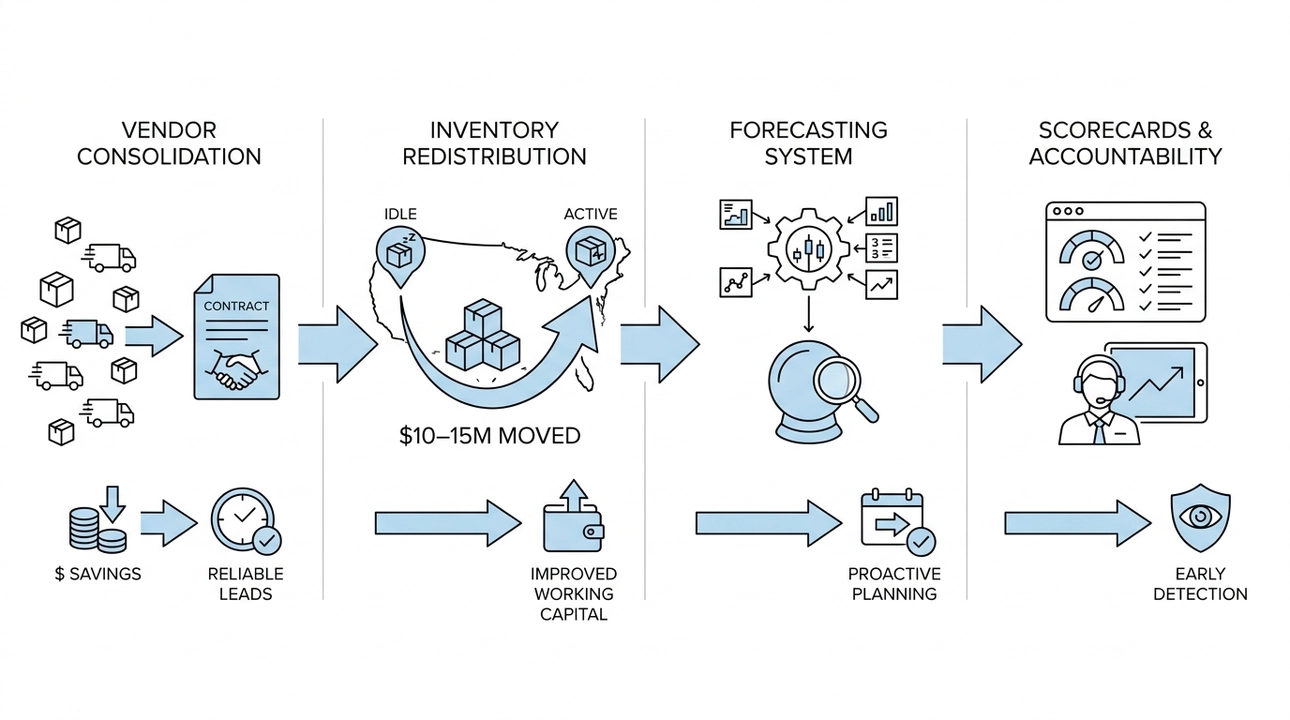
Vendor consolidation delivered immediate results. By aggregating demand across business units and negotiating centralized contracts, better pricing and more reliable lead times were secured. The reduction in procurement costs contributed directly to the cost savings achieved through the engagement.
Inventory was redistributed across regions. $10–15M in inventory was rebalanced globally, moving stock from locations where it was sitting idle to locations where it was actively needed. This alone materially improved working capital without requiring new purchasing.
The forecasting system changed decision-making. With historical data and operational metrics informing demand projections, purchasing became proactive rather than reactive. Business units could plan and budget accurately, rather than cycling between shortage and excess.
Scorecards created visibility and accountability. Performance metrics were tracked at the business unit level, giving leadership real-time visibility into how each operation was performing against targets. Problems could be caught early, before they became expensive.
The Outcomes
30% reduction in total inventory, with capital freed up from excess stock and redeployed more productively across the business.
75% reduction in Days Sales Outstanding (DSO), a dramatic improvement in cash flow that reduced working capital requirements and improved financial flexibility.
$5M+ in year-over-year cost savings, achieved through vendor consolidation, process standardization, and more accurate demand forecasting.
$10–15M in global inventory redistribution, turning idle stock into active assets across the network.
60% reduction in SKU count, simplifying inventory management and concentrating resources on the parts and spares that actually drove operational performance.
What This Illustrates for Scaling Businesses
The dynamics at work in a large enterprise’s business units are more familiar to SMB owners than most people assume. A business unit competing internally for capital and resources faces the same fundamental question any growing company does: are we generating enough return on our operational investment to justify continued backing?
The answer almost never comes down to revenue alone. Investors, whether they’re corporate headquarters or external backers, look at how efficiently a business converts its inputs into profitable output. A business unit with strong revenue but bloated inventory, high DSO, and uncontrolled costs is a business that will lose resource allocation battles. An SMB with growing top-line revenue but deteriorating margins and cash flow is a business on a path to failure, not growth.
The levers are the same regardless of scale: accurate forecasting, disciplined procurement, rationalized complexity, and operational visibility that allows problems to be caught and corrected early.
Profitable scaling is not the automatic byproduct of revenue growth. It requires the operational discipline to manage costs, capital, and systems as the business grows, so that every dollar of new revenue contributes to the bottom line rather than disappearing into operational inefficiency.
That’s the work. And it’s available to any business willing to build the infrastructure to do it.
Recommendations
Hassan is a O&G professional for +13 years, with broad knowledge on O&G business especially for Middle East and Asia regions. He also had extensive experience and knowledge on Well Services, including Supply Planning end-to-end. He had been through many different positions across different function from Technical, Sales, Management, HR and Supply Chain. Hassan is a fast learner and focus on delivering results, with managing priority as one of many strength that had been displayed over his years of professional careers. He will be a valuable asset to the team with his team work and leadership. I truly enjoy the time when Hassan was part of the team as he will deliver quality result consistently, every time.’
Denni D.
‘ have worked with Hassan for almost 2 years when he was WSV planner for Middle East and ASIA. I can attest that Hassan is a professional person with high skills in communication and excellent sense of analysis while deep diving for Root causes. Hassan as well is a problem solver, he succeeded in a short period to put in place a strategy to lower the SOH of the segment he was in charge in by finding mechanisms to better share and optimize the stock on hand. I had really appreciated working with Hassan and I have acknowledged and many time recognized his leadership skills and as well his collaboration and open mind. Hassan is a cost oriented person as well as business developer, he succeeded in few month to put in place a standard procedure for his segment and promote and implement VMI for this later. I recommend Hassan for any position in supply chain.
Mohamed S. Si A.
Case Studies:
From the blog:
Connect:
Offerings
Executive Operations Leadership
(Fractional / Interim / Embedded) (Monthly - Quarterly Rates)
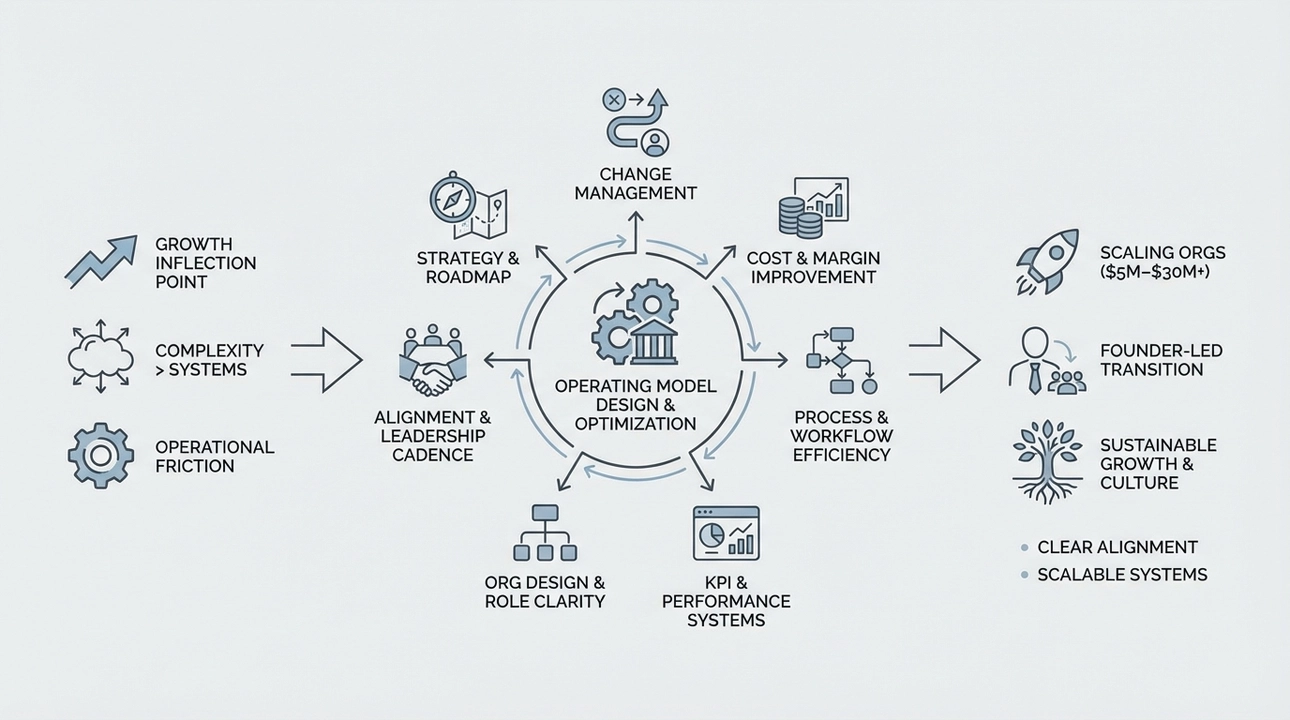
When organizations reach a growth inflection point, complexity increases faster than systems. I step in to design and strengthen the operating model that supports sustainable scale — without eroding culture or burning out teams.
Scope of Work
Operating model design and optimization
Strategic planning and execution roadmapping
Cost structure analysis and margin improvement
Process redesign and workflow efficiency
KPI dashboards and performance management systems
Organizational design and role clarity
Cross-functional alignment and decision-right frameworks
Leadership team cadence and accountability structures
Change management during growth, restructuring, or market expansion
Ideal For
Founder-led companies transitioning to structured leadership
Organizations scaling from $5M–$30M+ revenue
Businesses entering new markets or preparing for capital raises
Teams experiencing operational friction, silos, or cost pressures
Outcomes
Clear strategy-to-execution alignment
Stronger operational discipline
Optimized cost base and improved margins
Scalable systems that support sustainable growth
Workshops & Leadership Development Trainings
(Half-Day · Full-Day · Multi-Day Programs)
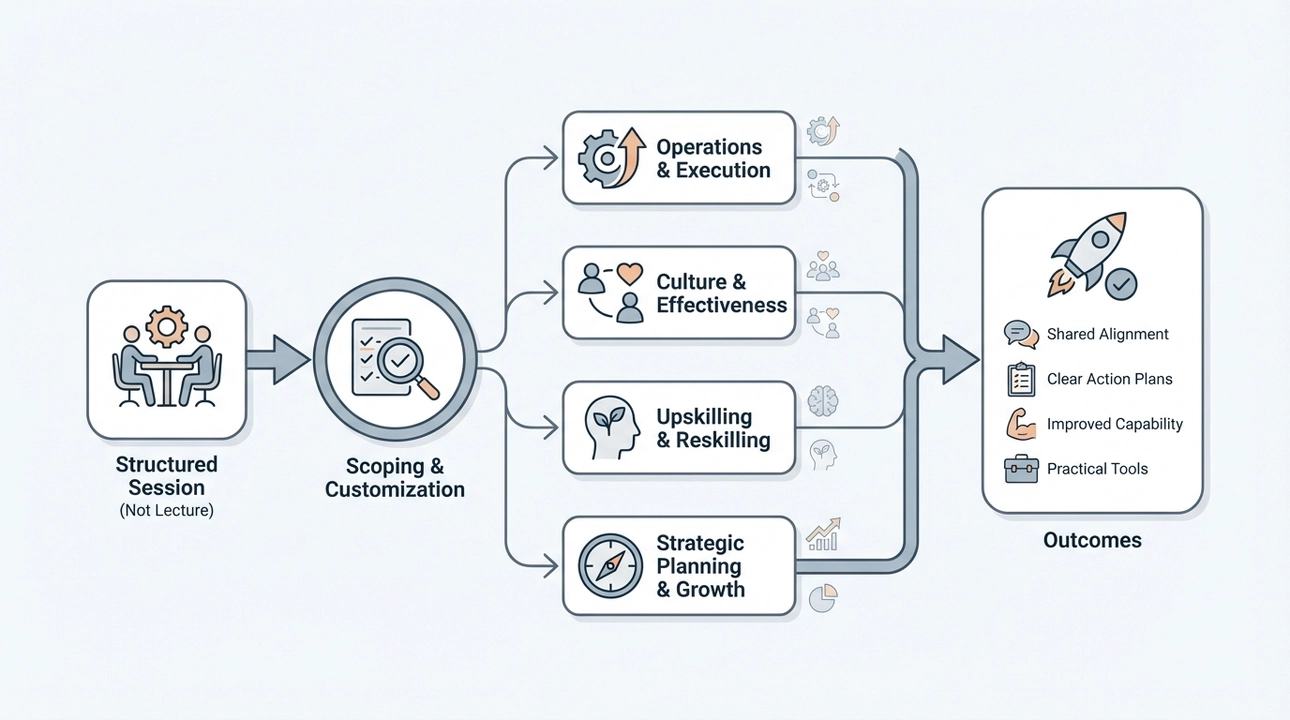
These are not lectures; they are structured working sessions designed to align teams, build capability, and translate insight into execution. Each engagement is customized and begins with a scoping session to define objectives, class size, deliverables, and curriculum design.
Focus Areas
Operations & Execution
Building scalable systems
Process improvement and efficiency
Strategic planning and OKR implementation
Culture & Organizational Effectiveness
High-performance team development
Psychological safety and accountability
Cross-functional collaboration
Upskilling & Reskilling Talent
Leadership readiness programs
First-time manager training
Strategic thinking and business acumen
Internal mentor development programs
Strategic Planning & Growth
Market expansion workshops
Scenario planning
Growth strategy intensives
Outcomes
Shared language and alignment
Clear action plans with ownership
Improved leadership capability
Practical tools teams can apply immediately
Advisory · Mentorship · Executive Coaching
(Ongoing Engagements; Hourly to Monthly Rates)
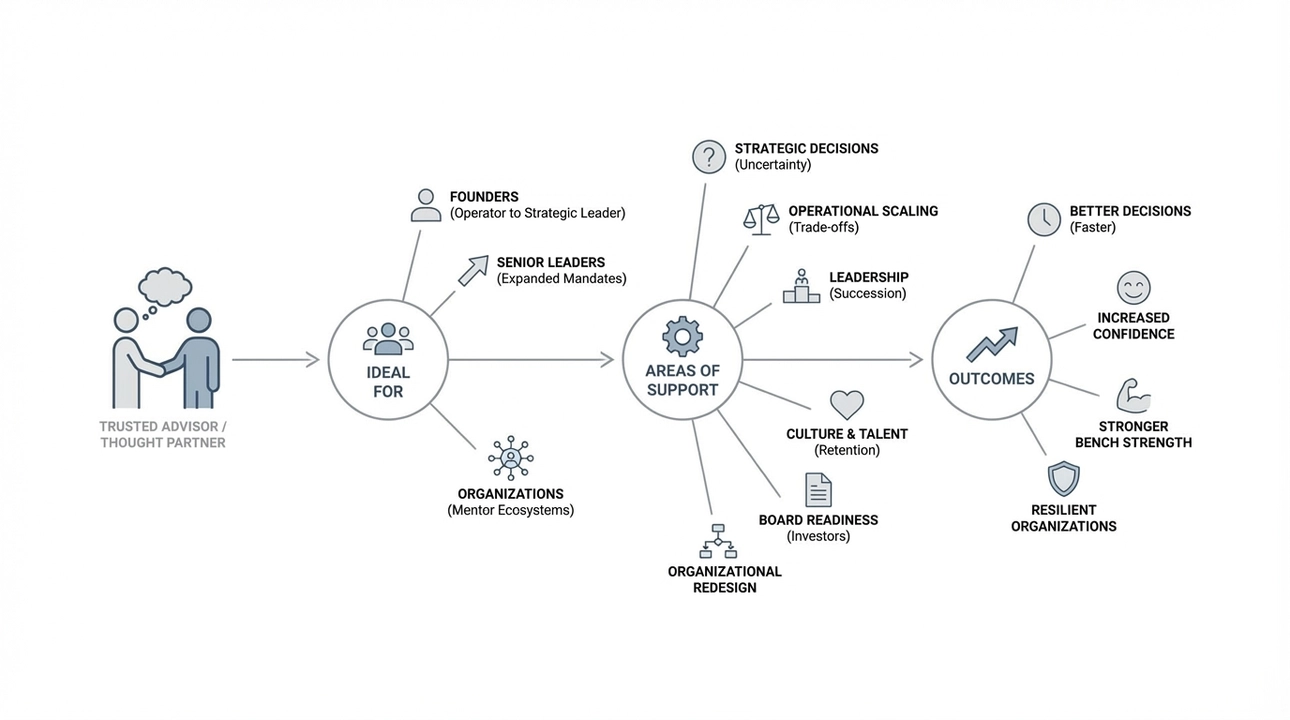
Scaling leaders often don’t need more information. They need perspective, pattern recognition, and honest conversation. I work with founders, CEOs, and senior leaders as a trusted advisor and thought partner during moments of growth, complexity, and transition.
This engagement is high-leverage and future-focused, supporting better decisions, stronger leadership presence, and organizational maturity.
Areas of Advisory Support
Strategic decision-making under uncertainty
Operational scaling trade-offs
Leadership development and succession planning
Culture shaping and talent retention
Board and investor readiness
Organizational redesign
Executive confidence and clarity
Ideal For
Founders evolving from operator to strategic leader
Senior leaders stepping into expanded mandates
Organizations building internal mentor and advisor ecosystems
Companies preparing their next layer of leadership
Outcomes
Better decisions, faster
Increased leadership confidence
Stronger executive bench strength
More resilient and adaptive organizations
Handbook: Intentional Organizational Culture
A practical, founder-friendly handbook designed to help leaders and teams build a culture that drives clarity, connection, and growth. This interactive template guides you through essential steps: from discovering your leadership “True North” and defining core values, to empowering your team, storytelling, and setting digital boundaries.
With prompts, checklists, and actionable frameworks, this resource makes culture-building accessible and authentic. Whether you’re a startup founder or scaling a team, you’ll find tools to align your values, foster collaboration, and create systems that make your culture real every day.
Ready to turn your vision into a thriving workplace? Download the handbook and start shaping a culture your team can feel.
Meet
Advisory/Mentorship/Coaching
We all need help. We all need a sounding board. We all need consigliere. We all need a trusted advisor.
Let's grab a coffee and talk about business, life and everything in between.
Operations Leadership
Looking at scaling? Let's talk and see what your business needs.
Workshops & Facilitation
Need to do a strategy workshop?
Looking to upskill your team?
Team building?
Let's chat about your need and work on a program for your business.
Discovery & Information Meeting
Hassan Pardawalla offers a unique consultation experience focused on structuring business growth strategies. With his extensive background in strategic advisory roles across various sectors, Hassan adeptly combines business architecture and strategy design to help organizations achieve sustainable growth.
During this 60-minute session, clients can expect in-depth insights into optimizing operations, effective process management, and sales planning. Hassan excels in crafting personalized solutions that align with clients' unique challenges and goals, ensuring impactful and lasting results.