Visionary. Operator. Engineer.
The Three-Act Playbook Every Scaling Company Needs.
Apple just announced its third CEO transition in 50 years. Each handoff was a masterclass in organizational evolution and a mirror for every Series A, Series B, and growth-stage SMB navigating their next plateau.
Hassan Pardawalla
Business Advisor & Fractional COO | April 20, 2026
This morning, Apple announced that Tim Cook is stepping down as CEO. His successor is John Ternus, a 25-year Apple veteran and Head of Hardware Engineering. The reaction from markets was calm. The reaction from people who build companies for a living should be anything but.
Because what Apple just did for the third time in its history is something most companies never pull off even once: a deliberate, sequenced leadership transition that matched the right type of leader to the right stage of organizational complexity.
This is not luck. It is a framework. And it applies directly to the founders and operators I work with every day.
Act One: The Visionary
Steve Jobs (1997–2011)
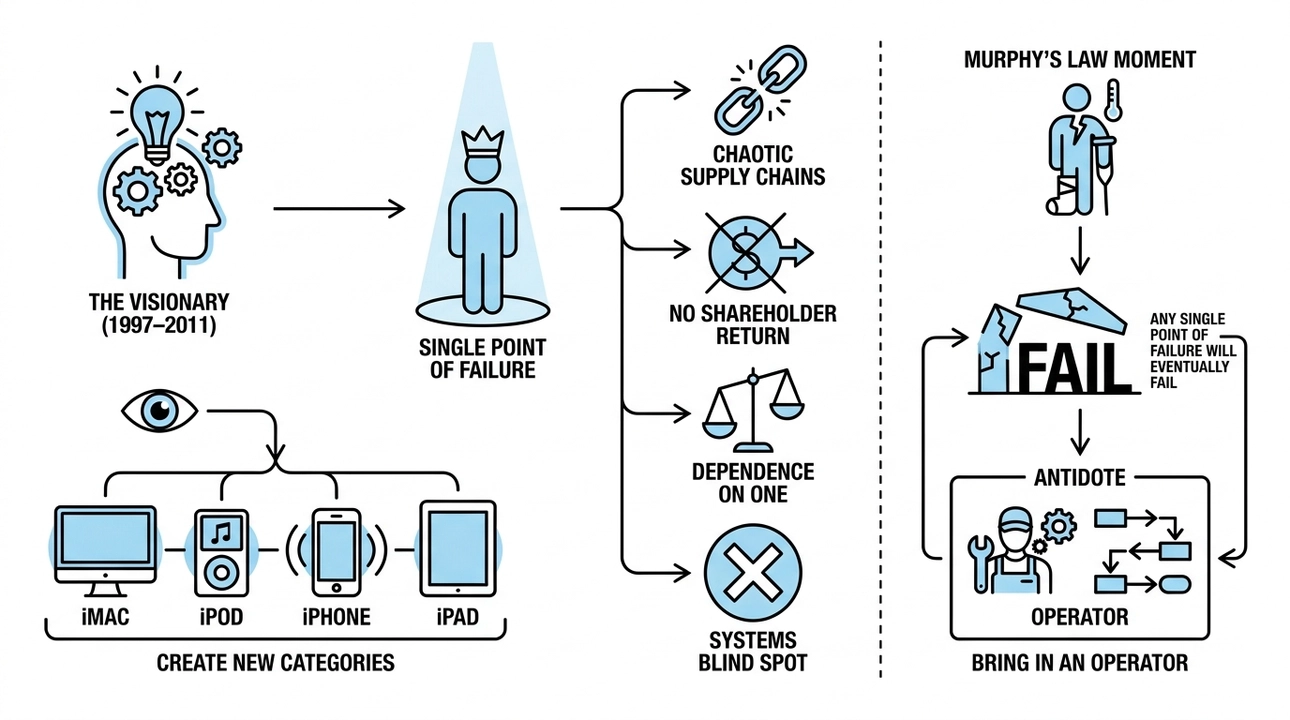
Steve did not return to Apple in 1997 to manage a company. He returned to reimagine one. His job was to create entirely new categories from nothing: the iMac, the iPod, the iPhone, the iPad. He operated on instinct, culture, and an almost irrational conviction about what people would want before they knew they wanted it.
His superpower was vision. His blind spot was systems. Apple under Jobs was a company that ran on the brilliance of one person. Supply chains were chaotic. There was no shareholder return program. The organization depended heavily, dangerously, on Jobs himself.
Murphy’s Law Moment
When Jobs fell ill and eventually stepped down in 2011, the fear was not that Apple had bad products. It was that Apple was Steve. If something could go wrong with the man, everything around him would too. This is Murphy’s Law at the organizational level: any single point of failure will eventually fail. The Visionary, by design, is a single point of failure. Another example is Elon, Tesla and X.
The antidote: you do not replace a Visionary with another Visionary. You bring in an Operator.
Act Two: The Operator
Tim Cook (2011–2026)
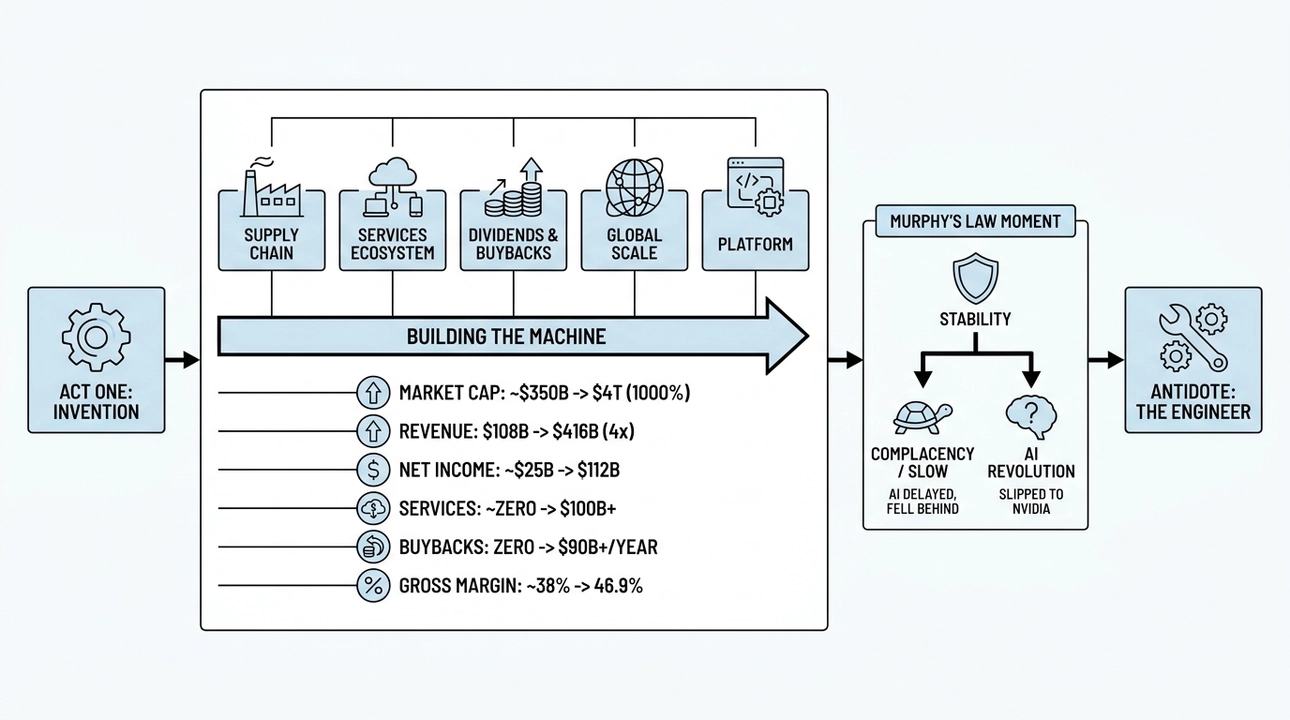
Cook’s mandate was not to invent. It was to build the machine that scales the invention. And by any KPI you care to name, he delivered one of the greatest operational runs in corporate history.
Selected outcomes during Tim’s tenure
Market cap: about $350B to $4T (about +1,000%)
Revenue: $108B/year to $416B/year (4x)
Net income: about $25B to $112B (FY2025)
Services: near zero to $100B+/year
Cash and buybacks: from no dividend program to $90B+/year in buybacks
Gross margin: about 38% to 46.9%
Tim built the supply chain. He created the services ecosystem. He launched dividends and buybacks to reward investors. He opened Apple to the world across manufacturing, retail, and policy. He turned a product company into a platform.
Cook did not out-Jobs Jobs. He out-operated everyone else. Which is precisely what the company needed.
Hassan Pardawalla, Fractional COO
But here is the honest analysis: the Operator’s job is to build the engine, optimize the margins, and create the stability that funds the next wave. Cook did all of that. What he could not do, or did not fully do, was lead Apple through the AI revolution. That is not a failure of Cook. That is the nature of Act Two.
Murphy’s Law Moment
Apple, despite having the most loyal hardware base and some of the most profitable margins in tech, fell behind in AI. They turned to Google to power Siri. Their AI rollout was delayed. Their once-dominant position as the world’s most valuable company slipped to Nvidia.
Murphy’s Law again: the very stability that the Operator creates can breed complacency. The systems that made you efficient can make you slow. When everything is optimized, the next disruption hits harder because you are not built to move fast, you are built to run smoothly.
The antidote: you do not replace an Operator with another Operator. You bring in an Engineer.
Act Three: The Engineer
John Ternus (2026–?)
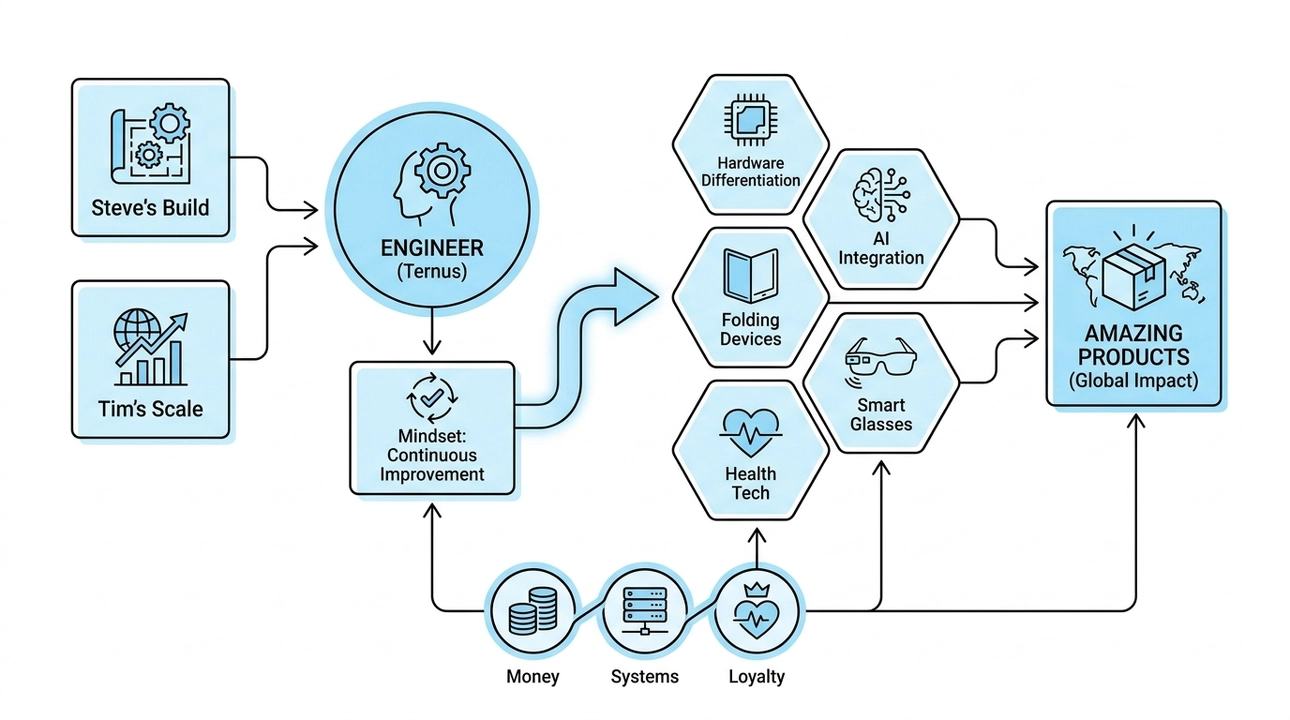
Ternus is not a Visionary conjuring new categories from thin air. He is not an Operator building financial systems and supply chains. He is something rarer at the top of a $4 trillion company: a deeply technical insider who spent 25 years absorbing everything Steve built and everything Tim scaled, and who now has the mandate to make it all excellent.
His stated philosophy: “We never think about shipping a technology. We always think about how can we leverage technology to ship amazing products.” That is the Engineer’s mindset. Not invention. Not operations. Continuous improvement: rigorous, product-first, quality-obsessed.
Analysts are already pointing to what this means: more hardware differentiation, better AI integration into physical products, a push into folding devices, smart glasses, and health technology. The money is there. The systems are there. The brand loyalty is there. Now the job is to make products so good the world cannot ignore them.
The Framework: Three Leaders, Three Stages
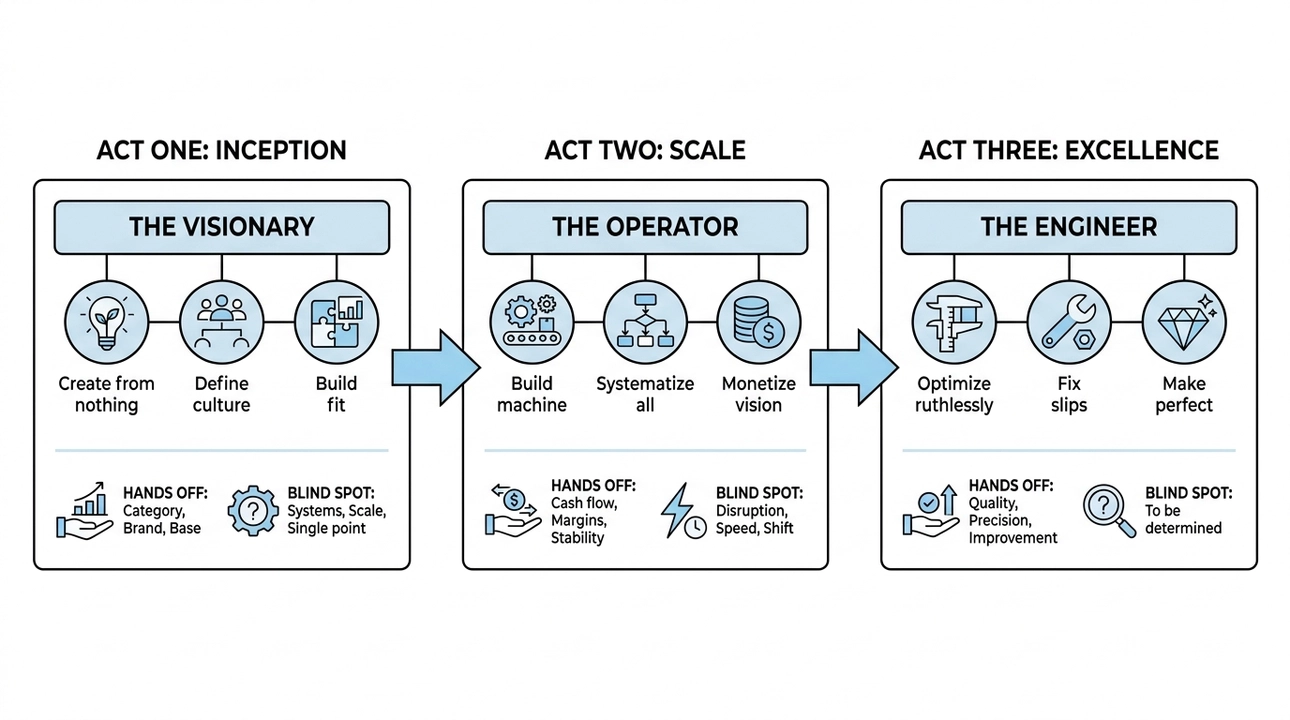
Act One (Inception): The Visionary
Primary job: Create something from nothing. Define the culture. Build product-market fit.
Hands off: A category, a brand, a loyal customer base
Blind spot: Systems, scale, single point of failureAct Two (Scale): The Operator
Primary job: Build the machine. Systematize everything. Monetize the vision.
Hands off: Cash flow, margins, ecosystems, stability
Blind spot: Disruption, speed, the next platform shiftAct Three (Excellence): The Engineer
Primary job: Optimize ruthlessly. Fix what slipped. Make the product perfect.
Hands off: Quality, precision, continuous improvement
Blind spot: To be determined, this act is just beginning
Why This Matters for Your Company
You are not Apple. But you are running the same play at a different scale.
If you are a Series A or Series B founder, or an SMB trying to cross the next revenue threshold, the question is not just “what do we need to do?” It is “what type of leader do we need right now, and what are we hiring them to hand off?”
Most companies fail at this sequencing. They keep the Visionary too long, long after the company needs systems and scale. Or they bring in a heavy Operator before the product has actually found its market. Or they optimize for efficiency before the engine is worth optimizing.
Murphy’s Law Applied
Whatever stage you skip will become your crisis. Skip the Operator and your vision dies in chaos. Skip the Engineer and your scale calcifies into mediocrity. Every stage is load-bearing.
Where I Fit
The Operator’s Role and What I Do
My work sits squarely in Act Two. I come in after the Visionary has proven something worth building and before the Engineer has something worth perfecting.
I build the operational infrastructure: KPI frameworks, financial models, investor-ready documentation, go-to-market systems, team structures, and the monitoring and evaluation scaffolding that turns a promising company into a scalable one.
Across 13+ ventures, from cleantech startups to growing SMBs, the pattern is consistent: founders have the vision, but not the systems. They have traction, but not the architecture to sustain it. They are ready to grow, but not yet ready to scale.
That is the gap I close. I build the machine, optimize the margins, and create the stability so the next leader, whether an internal operator or an engineer, inherits something worth running.
If your company is between stages, if you have proven the model but have not built the machine, that is where a fractional COO creates the most asymmetric value. You get the operator’s toolkit without the full-time overhead. You get the systems, the frameworks, the financial discipline, and the institutional knowledge transfer built in and handed off.
Because that is the real lesson of Apple’s three-act story. Every leader’s job is to make themselves replaceable by building something better than themselves.
Let’s talk about your Act Two.
If you are a founder or operator navigating a growth plateau, I would love to hear where you are stuck. This is exactly the work I do, and I am selectively taking on new engagements in 2026.
Book a conversation: