The Company That Fired Honesty Every Year. And Called It Strategy.
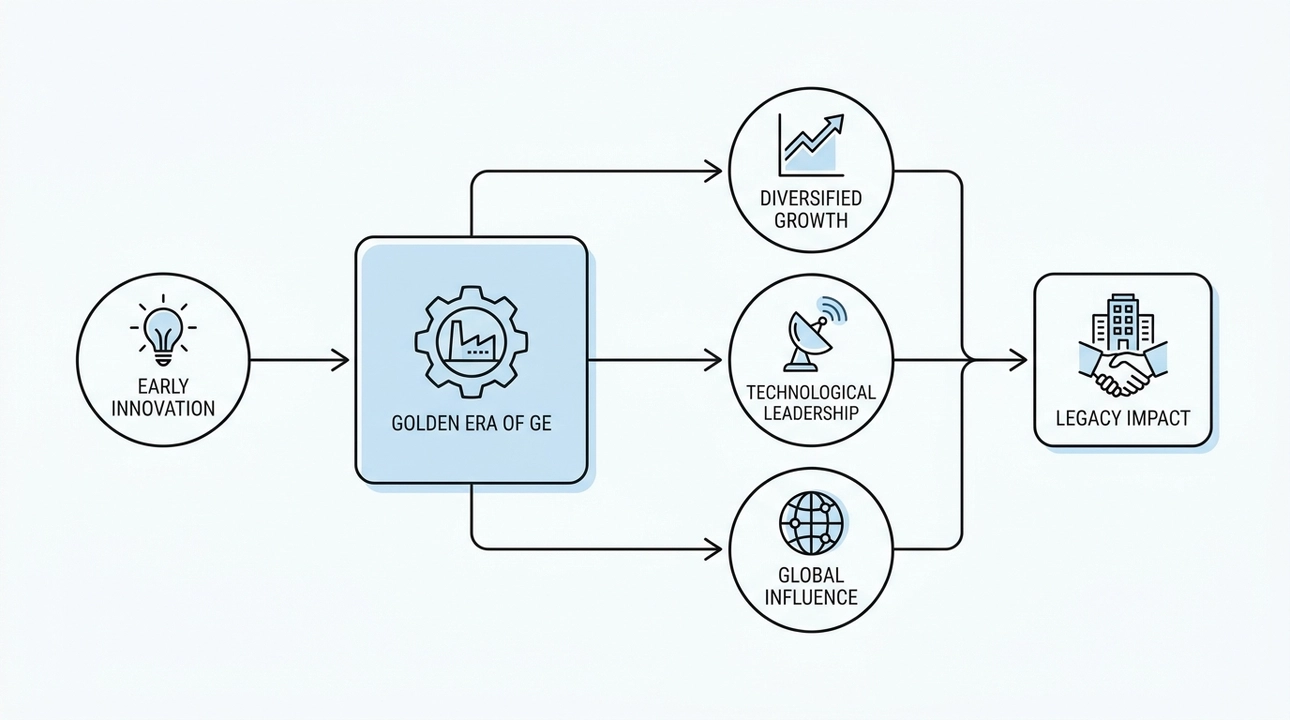
Jack Welch walked into GE in 1981 and found a company that had been sleepwalking for decades. Twenty-nine layers of management. A bureaucracy so thick that a good idea from the factory floor took years to reach anyone who could act on it. Revenue growing at exactly the rate of the American economy. Not because GE was exceptional. Because GE was everywhere, and the whole machine had been designed to avoid risk rather than create value.
THE PERSONAL WHY
Jack Welch | The Working-Class Kid Who Ran on Hunger
Jack did not come from money. Son of a railroad conductor in Peabody, Massachusetts. First in his family to earn a PhD. He grew up in a world where nothing was given and everything was earned.
When he took the chairmanship of GE in 1981, he inherited a company designed to avoid risk rather than create value. His first response: dismantle it. Jack fired 100,000 people in his first five years. Eliminated 29 layers of management. His nickname became Neutron Jack. Remove the people, keep the buildings.
The hunger that drove him out of Peabody never left. For twenty years, that hunger produced extraordinary results. The problem: he built a company that ran on fear of disappointing him. And called it a performance culture.
THE BACKGROUND
GE in 1981 | What He Walked Into
GE in 1981 was the prototypical American industrial conglomerate. Jet engines, lightbulbs, appliances, financial services, television broadcasting. Everything, everywhere. A sprawling empire growing by acquisition and inertia for decades.
Revenue grew from $25B to over $100B under Jack. [Fortune, 2001]
Market cap reached $499B at peak. The most valuable company on earth.
Fortune named GE Most Admired Company in 1998, 1999, and 2000.
But the foundation had cracks nobody wanted to see. GE Capital had been quietly drifting from its original purpose and had become the load-bearing wall of the entire building. A wall built on quicksand.
THE CULTURE
What Jack Built | The Good, The Bad, and the Structurally Broken
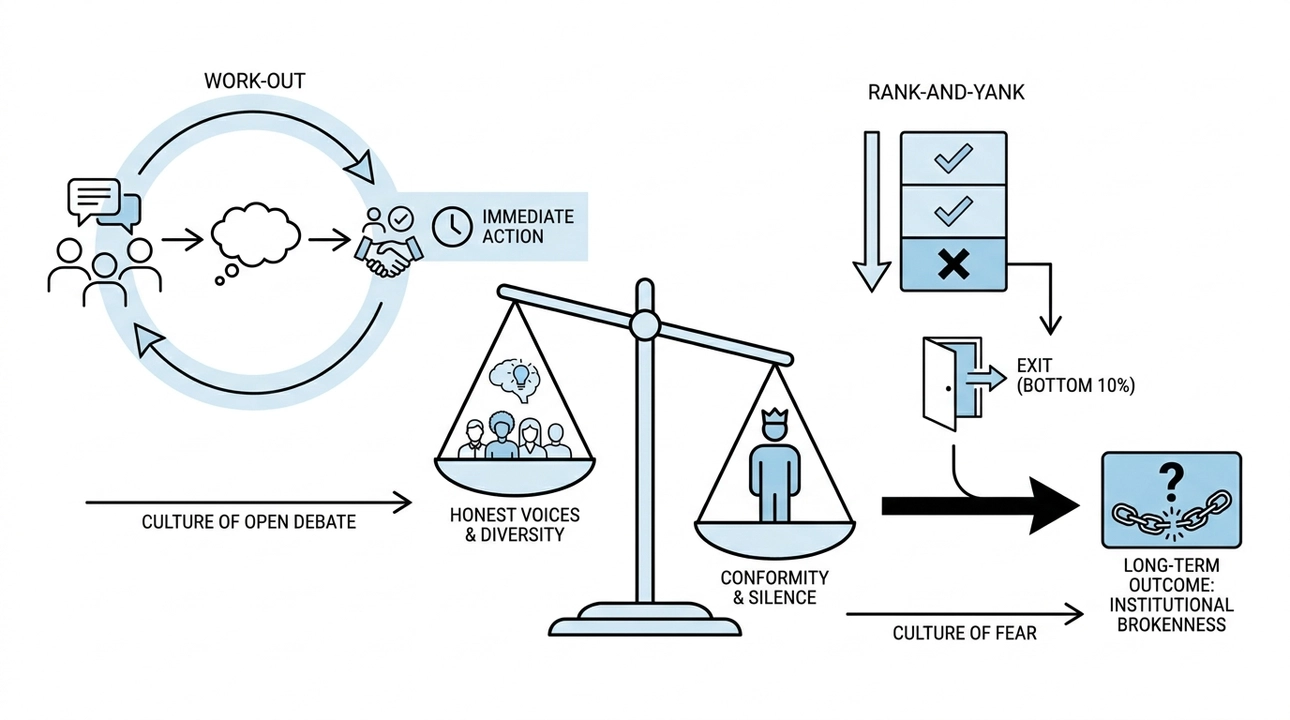
Jack genuinely believed in open debate. He created Work-Out. Groups of 20 to 100 employees, from factory floor to middle management, spent three days identifying what was broken and presenting solutions directly to managers. Managers had to respond on the spot. Yes, no, or a specific date. No deflection.
"Work-Out helped us create a culture where everyone began playing a part, everyone's ideas began to count, and leaders led rather than controlled."
Source: Jack Welch [Jack: Straight from the Gut, 2001]
By 1992, over 200,000 GE employees, two-thirds of the entire workforce, had participated in a Work-Out session. [Dave Ulrich, Steve Kerr and Ron Ashkenas, The GE Work-Out, McGraw-Hill, 2002] That is not HR. That is a knowledge transfer system that most 300,000-person organizations never build at all.
But Jack also built rank-and-yank. Every year, the bottom 10% of performers out. No exceptions. Good years. Bad years. Always. He called it the "vitality curve." It was, in practice, a firing schedule.
Work-Out said: speak up, your opinion matters. Rank-and-yank said: watch your back, because being the most inconvenient person in the room this quarter has consequences. When those two messages live in the same building, one always wins. It is not the one on the poster.
Pop Culture Reference | Peaky Blinders (BBC, 2013 to 2022):
In Peaky Blinders, Ada Shelby is the only Shelby sibling who refuses to participate in the family's criminal enterprise. She is the sharpest observer in every room. She says what nobody else will say. She names the thing the family would rather leave unnamed. She represents institutional honesty. Every organization needs an Ada. Jack's rank-and-yank fired Ada every year for twenty years. Promoted the people who knew how to look like Ada without actually being her. Then Jack retired, and the machine he left behind had no honest voices left in it.
DEI Note:
GE under Jack was notably poor on diversity. The culture rewarded aggressive, combative intellectual performance, which historically favoured specific demographics and penalized others. The vitality curve disproportionately impacted people who challenged norms. [David Gelles, The Man Who Broke Capitalism, Simon and Schuster, 2022]
THE FRAMEWORKS
What Worked, What Did Not, and What Masqueraded as Both
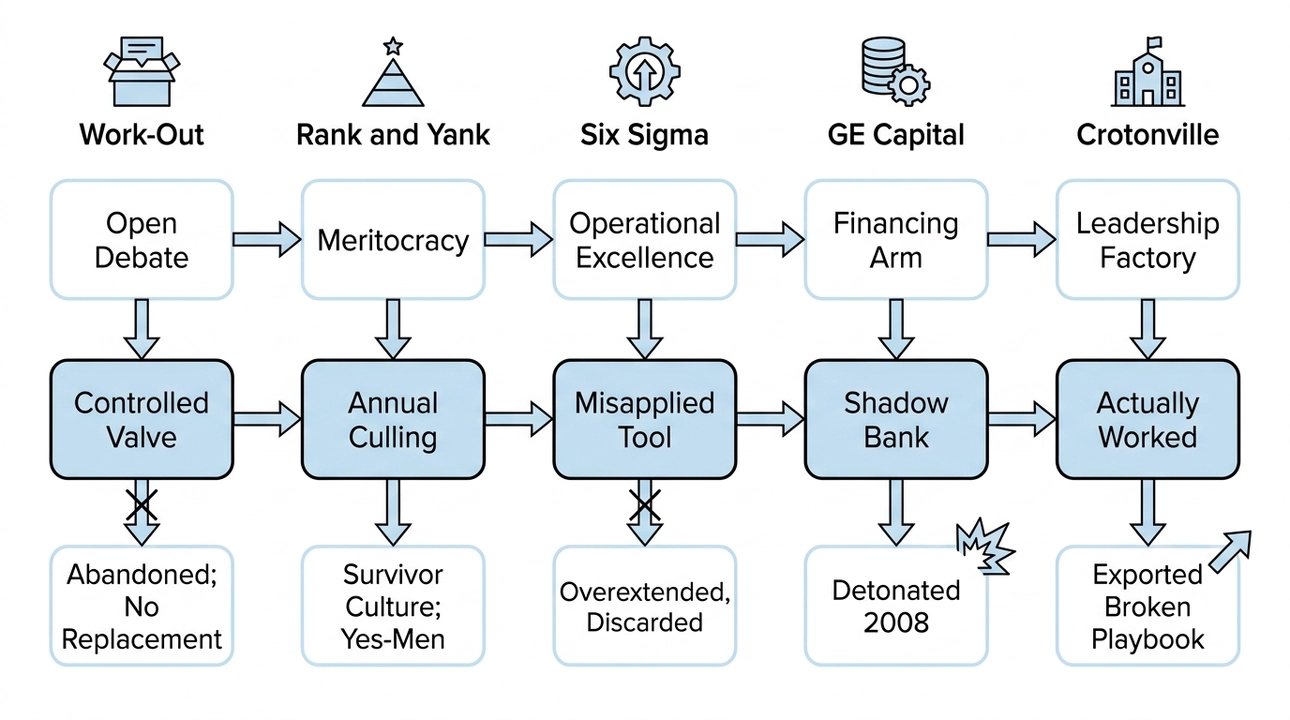
The succession horse race: Jack ran a public competition between Jeff Immelt, Jim McNerney, and Bob Nardelli. He picked Jeff. Jim went to Boeing, where his GE-trained financial discipline helped create conditions for two 737 MAX crashes that killed 346 people. [Harvard Business School Working Knowledge, 2024] Bob went to Home Depot, eliminated expert floor staff, and drove customers straight to Lowe's. Both were executing exactly what they had been trained to do. The model was the problem.
THE RESULTS
The KPIs That Tell the Real Story
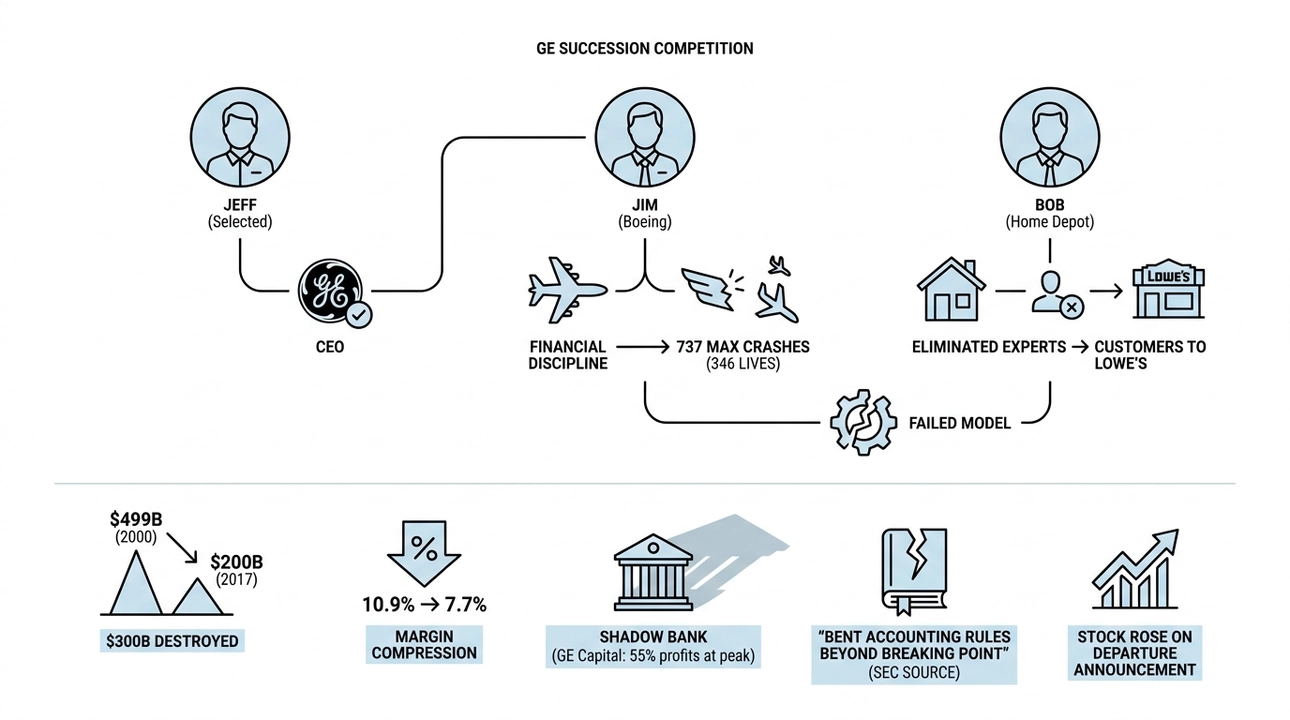
Market cap peak (2000): $499B. Jeff's exit (2017): $200B. $300B destroyed. [Bloomberg, 2017]
Net income margin: compressed from 10.9% to 7.7% while claiming transformation. [Fortune, 2017]
GE Capital share of profits: 55% at peak. Industrial company becomes shadow bank. [Yale Insights, 2021]
Stock rose on Jeff's departure announcement. The market knew before the board acted.
"GE bent the accounting rules beyond the breaking point."
Source: Head of Enforcement, US Securities and Exchange Commission [NPR, 2022]
MURPHY'S LAW
The Risk That Became the Crisis
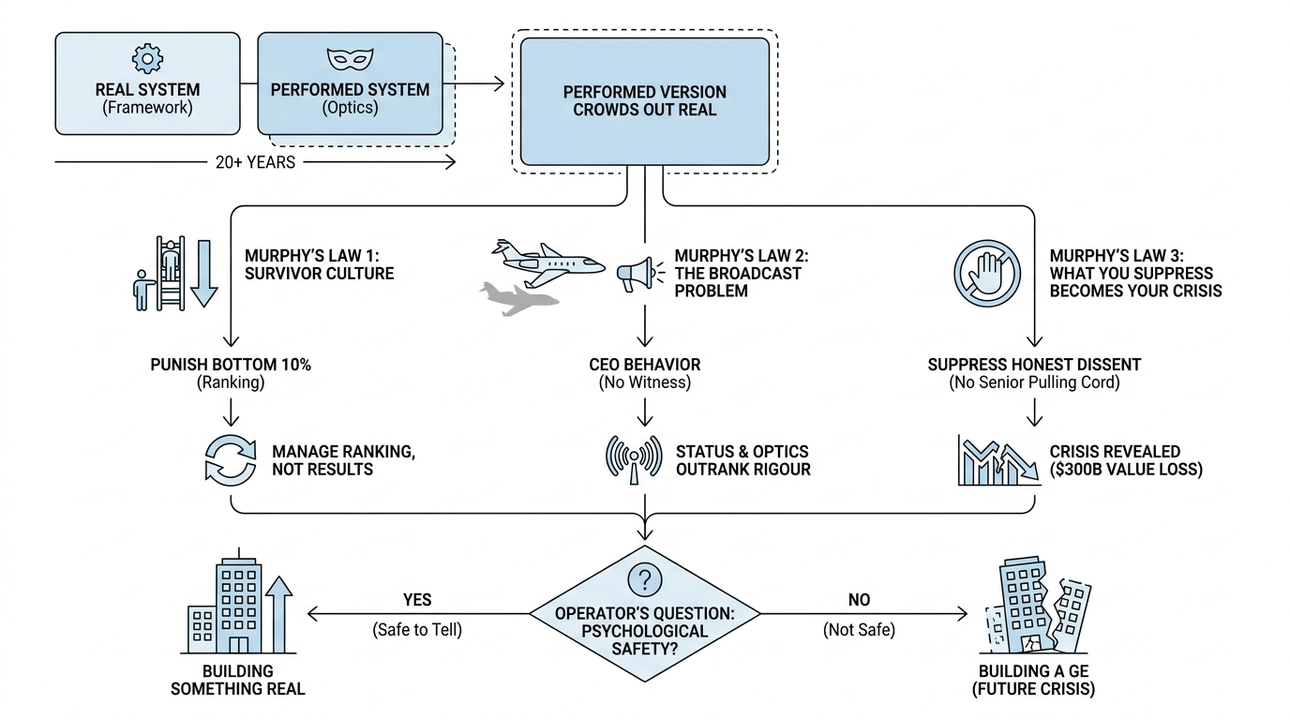
Jack built a machine optimised for one thing: looking like it was working. Every framework had a real version and a performed version. Over twenty years, the performed version crowded out the real one.
Murphy's Law 1: The Survivor Culture
When you build a system that punishes the bottom 10% regardless of absolute performance, you do not eliminate bad performers. You train everyone to manage their ranking, not their results.
Murphy's Law 2: The Broadcast Problem
Culture is not what is in the values document. Culture is what the CEO does when nobody important is watching. Jeff travelled with two private jets, a spare plane permanently tailing his aircraft. That behaviour broadcast one signal inside GE: status and optics outrank rigour. [Praemium Research, 2022]
Murphy's Law 3: What You Suppress Becomes Your Crisis
GE suppressed honest dissent for twenty years. By 2008, there was apparently nobody left in a senior position willing to pull the cord. The 2008 financial crisis did not break GE. It revealed what had already broken. And it cost shareholders $300B in value. [Yale Insights, 2021]
The operator's question for your company: does the person closest to the problem feel safe enough to tell you about it? In the room. To your face. Without it costing them their position? If yes, you are building something real. If no, you have already started building a GE. The only question is how long before the numbers show it.
____________________________________________________________
71 Hours. Three Strategies. One Clear Path Forward.
I work directly with Series A/B founders and growth-stage SMBs. 71 hours with your team and access to your data. Three strategies, three business plans, resource planning, ROI analysis, and a high-level execution roadmap. With a retainer pathway for execution.
Work with me!