Supply Chain and Current Asset Optimization for a Fortune 500 Company
How a pressure-pumping operation across 30 business units reduced inventory by 30%, cut DSO by 75%, and freed up over $5M in capital, all while sustaining rapid growth.
The Business Challenge
In large enterprises, individual business units often function like independent companies. They manage their own P&L, compete internally for resources and capital, and are held accountable for delivering profitable growth, not just revenue. When a business unit’s operations are inefficient, capital gets tied up, leadership loses confidence, and resources get redirected to better-performing divisions.
That dynamic is no different from what any SMB owner faces. If your operations aren’t producing a healthy return on the capital deployed in them, growth becomes a liability rather than an asset.
This is the context for a supply chain transformation undertaken across a global pressure-pumping operation. It was a business experiencing rapid demand growth in horizontal fracturing services, while simultaneously carrying over $30 million in inventory across 30 business units from Egypt to New Zealand. The business was growing. But it wasn’t growing efficiently. And in a volatile oil market, that gap between revenue growth and financial discipline was a serious risk.
The mandate was direct: reduce current assets, optimize warehousing and procurement processes, and build the forecasting capability needed to support continued growth without the capital inefficiencies that were undermining profitability.
What Made This Hard
No reliable forecasting. With over 15,000 SKUs across 30 business units, there was no consistent method for tracking or predicting consumption. Budgeting for parts and maintenance was largely reactive, driven by what had already broken rather than what was likely to be needed.
Fragmented vendor relationships. Multiple vendors, inconsistent contracts, and no centralized procurement strategy meant that the same parts were being sourced at different prices, with different lead times, through different processes, and in different locations.
$30M+ tied up in inventory. Capital that should have been available for growth was locked in stock that wasn’t being tracked, shared, or deployed efficiently.
A disconnected supply chain. Without visibility across the full network, business units were hoarding inventory as a hedge against uncertainty, which compounded the problem rather than solving it.
A growth mandate that couldn’t wait. The business was under pressure to meet rising market demand. The optimization had to happen without disrupting operations or creating new delivery risks.
The Operational Approach
The engagement began not with systems, but with people. The first three months were spent building relationships across maintenance, operations, supply chain, and R&D, understanding the unique challenges each team faced and identifying where the highest-impact improvements could be made. This groundwork was essential. Process changes in complex, multi-site operations fail without buy-in, and buy-in starts with trust.
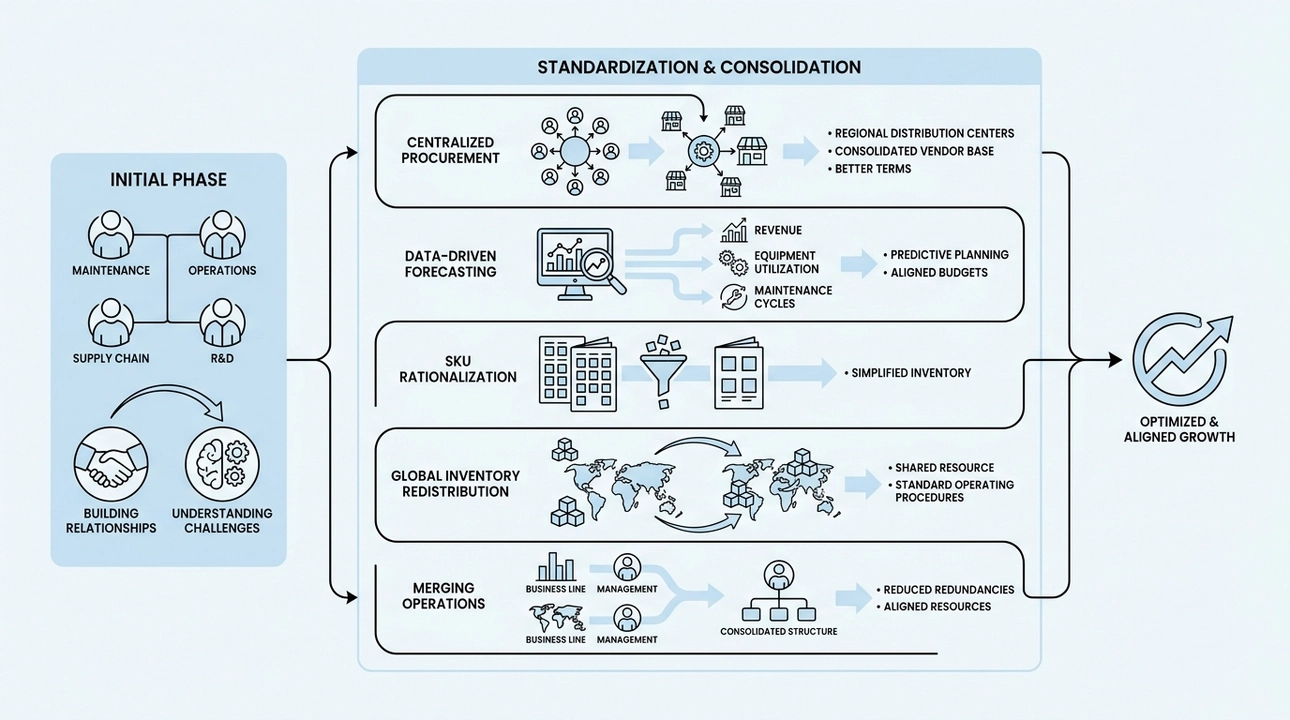
Centralizing and standardizing procurement. New purchasing processes were developed to reduce complexity and bring consistency across the network. This included finalizing regional distribution centers, consolidating the vendor base, and negotiating better terms made possible by aggregating demand across business units. Instead of 30 teams sourcing independently, procurement was coordinated centrally, with the leverage that comes from scale.
Building a data-driven forecasting system. A forecasting framework was implemented that tied demand projections directly to operational metrics: revenue, equipment utilization, and maintenance cycles. This replaced reactive purchasing with predictive planning, giving the business visibility into what it would need before it ran out, rather than after. Budgets were developed in parallel, aligned to these forecasts and to the company’s broader financial targets.
Reducing SKU complexity. The 15,000+ SKU catalog was systematically reviewed and rationalized. Non-critical, low-velocity items were eliminated. The result was a simpler, more manageable inventory that could be tracked and controlled with far greater accuracy.
Redistributing inventory globally. Rather than each business unit holding its own buffer stock independently, inventory was treated as a shared resource across the network. This unlocked significant capital. Stock that had been sitting idle in one location could be redeployed to meet active demand elsewhere. Standard Operating Procedures were developed to govern how this sharing and redistribution worked in practice.
Merging operations across business lines and regions. Two business lines and geographic regions were consolidated, reducing redundancies in management, purchasing, and warehousing. This wasn’t just an efficiency play. It was a structural change that aligned the organization’s resources more closely with where growth was actually happening.
Execution: What Actually Happened
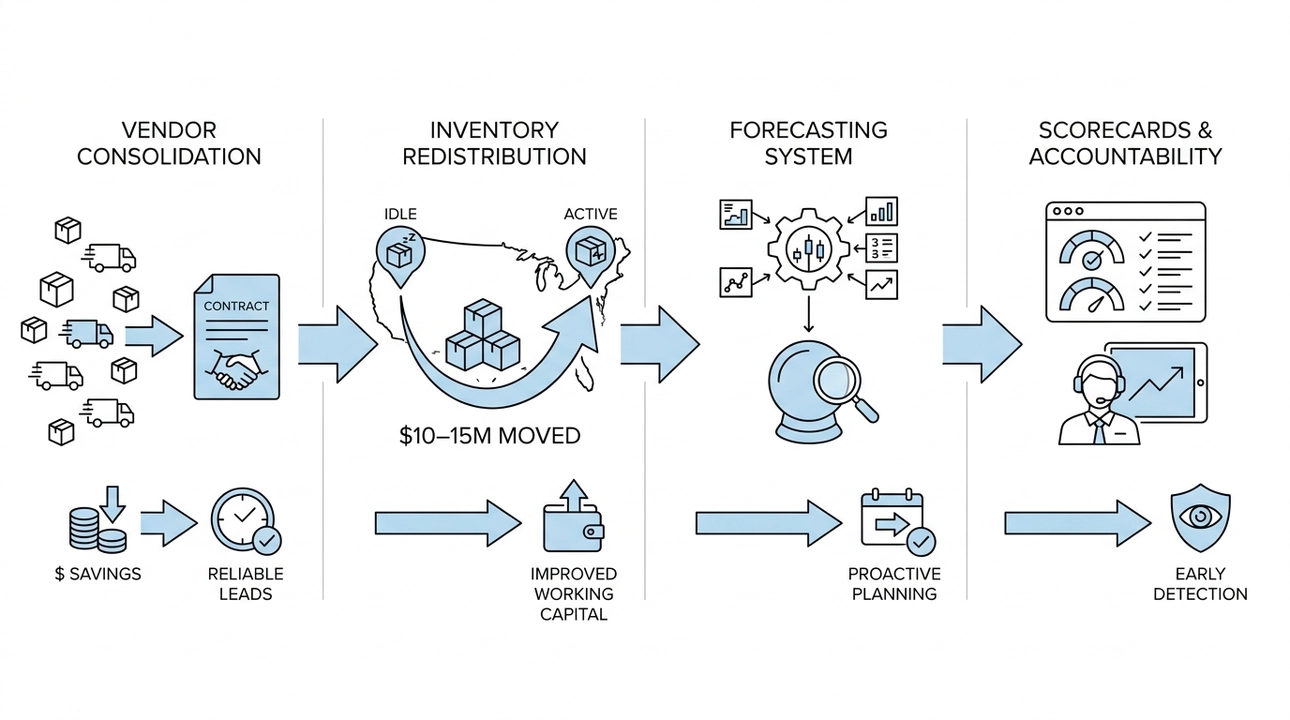
Vendor consolidation delivered immediate results. By aggregating demand across business units and negotiating centralized contracts, better pricing and more reliable lead times were secured. The reduction in procurement costs contributed directly to the cost savings achieved through the engagement.
Inventory was redistributed across regions. $10–15M in inventory was rebalanced globally, moving stock from locations where it was sitting idle to locations where it was actively needed. This alone materially improved working capital without requiring new purchasing.
The forecasting system changed decision-making. With historical data and operational metrics informing demand projections, purchasing became proactive rather than reactive. Business units could plan and budget accurately, rather than cycling between shortage and excess.
Scorecards created visibility and accountability. Performance metrics were tracked at the business unit level, giving leadership real-time visibility into how each operation was performing against targets. Problems could be caught early, before they became expensive.
The Outcomes
30% reduction in total inventory, with capital freed up from excess stock and redeployed more productively across the business.
75% reduction in Days Sales Outstanding (DSO), a dramatic improvement in cash flow that reduced working capital requirements and improved financial flexibility.
$5M+ in year-over-year cost savings, achieved through vendor consolidation, process standardization, and more accurate demand forecasting.
$10–15M in global inventory redistribution, turning idle stock into active assets across the network.
60% reduction in SKU count, simplifying inventory management and concentrating resources on the parts and spares that actually drove operational performance.
What This Illustrates for Scaling Businesses
The dynamics at work in a large enterprise’s business units are more familiar to SMB owners than most people assume. A business unit competing internally for capital and resources faces the same fundamental question any growing company does: are we generating enough return on our operational investment to justify continued backing?
The answer almost never comes down to revenue alone. Investors, whether they’re corporate headquarters or external backers, look at how efficiently a business converts its inputs into profitable output. A business unit with strong revenue but bloated inventory, high DSO, and uncontrolled costs is a business that will lose resource allocation battles. An SMB with growing top-line revenue but deteriorating margins and cash flow is a business on a path to failure, not growth.
The levers are the same regardless of scale: accurate forecasting, disciplined procurement, rationalized complexity, and operational visibility that allows problems to be caught and corrected early.
Profitable scaling is not the automatic byproduct of revenue growth. It requires the operational discipline to manage costs, capital, and systems as the business grows, so that every dollar of new revenue contributes to the bottom line rather than disappearing into operational inefficiency.
That’s the work. And it’s available to any business willing to build the infrastructure to do it.
Recommendations
Hassan is a O&G professional for +13 years, with broad knowledge on O&G business especially for Middle East and Asia regions. He also had extensive experience and knowledge on Well Services, including Supply Planning end-to-end. He had been through many different positions across different function from Technical, Sales, Management, HR and Supply Chain. Hassan is a fast learner and focus on delivering results, with managing priority as one of many strength that had been displayed over his years of professional careers. He will be a valuable asset to the team with his team work and leadership. I truly enjoy the time when Hassan was part of the team as he will deliver quality result consistently, every time.’
Denni D.
‘ have worked with Hassan for almost 2 years when he was WSV planner for Middle East and ASIA. I can attest that Hassan is a professional person with high skills in communication and excellent sense of analysis while deep diving for Root causes. Hassan as well is a problem solver, he succeeded in a short period to put in place a strategy to lower the SOH of the segment he was in charge in by finding mechanisms to better share and optimize the stock on hand. I had really appreciated working with Hassan and I have acknowledged and many time recognized his leadership skills and as well his collaboration and open mind. Hassan is a cost oriented person as well as business developer, he succeeded in few month to put in place a standard procedure for his segment and promote and implement VMI for this later. I recommend Hassan for any position in supply chain.
Mohamed S. Si A.
Case Studies:
From the blog:
Connect: