Operations Management and Project Deployment in Mobile EV Charging
How a greenfield services contract in California was delivered on time and under budget, turning a $1.5M pilot into $3M+ in follow-on contracts.

The Business Challenge
A Vancouver-based energy startup had built a solid product track record delivering smaller 5KW power stations. But winning a multi-million dollar contract to deploy mobile EV charging stations during California’s public safety power shutdowns (PSPS) required something entirely different: a functioning services operation, built from scratch, in a market the company had never worked in before.
The contract called for six 20/30KW mobile charging systems deployed across California within six months. The company had no local infrastructure, no service team on the ground, and limited experience managing large-scale field deployments. Revenue was committed. The capability to deliver it was not yet in place.
This is a challenge familiar to any capital-intensive or field-services business scaling beyond its home market. Growing revenue is straightforward. Building the operational foundation to deliver it profitably, without blowing the budget or burning client trust, is where most companies stumble.
What Made This Hard
The project surface area was wide:
Execution in unfamiliar terrain. No prior playbook existed for deploying large-scale mobile charging systems as a service. Every process had to be designed, not inherited.
Remote operations management. Setting up a functioning team and vendor network in California, without a physical presence, required building relationships at a distance and making high-stakes decisions with incomplete information.
Supply chain volatility. The energy sector was experiencing significant disruption. Component lead times were unpredictable, and production delays threatened to cascade into delivery failures.
Client relationship management. The client had clear expectations and tight timelines. Managing confidence, especially when things went sideways, required constant, honest communication.
Budget and cash flow discipline. A project of this scale, with a startup’s capital base, left almost no margin for financial error. Every procurement decision had downstream consequences for cash flow.
The Operational Approach
Rather than improvise, the engagement was structured around three principles: a clear execution playbook, strategic local partnerships, and proactive risk management.
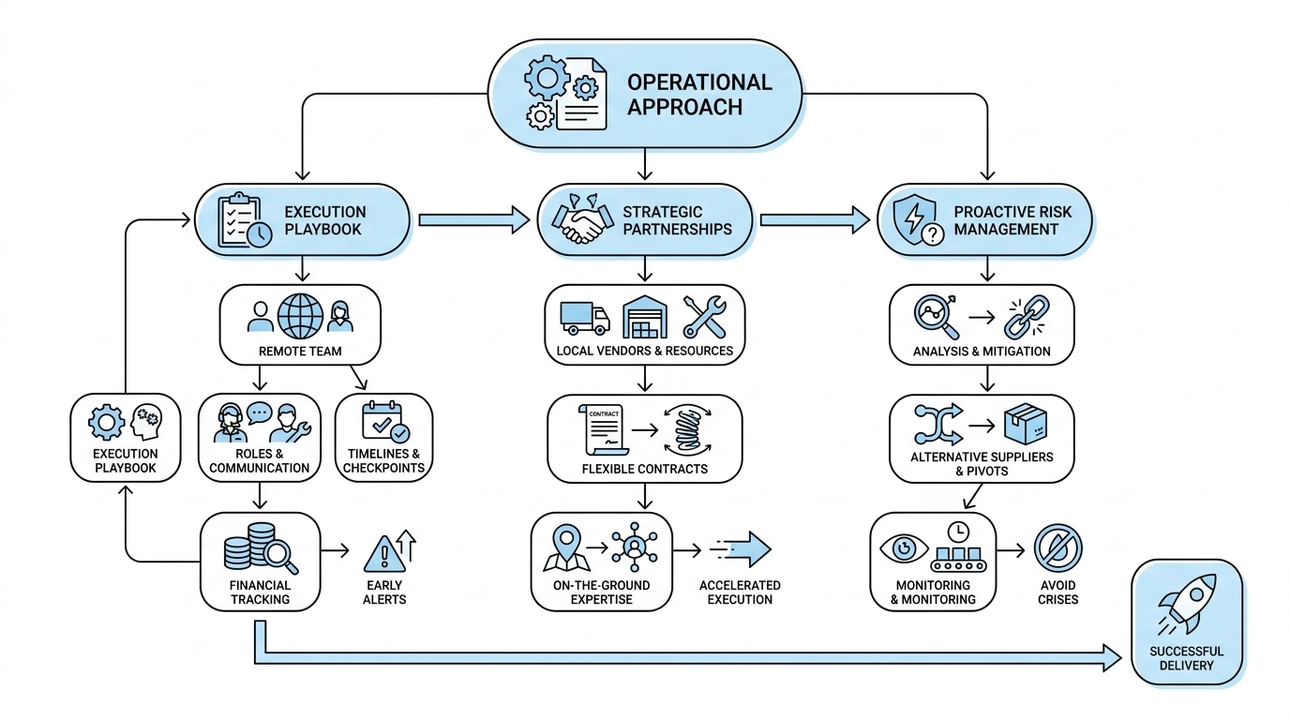
Building the execution playbook. Before a single shipment was made, a detailed deployment playbook was developed: timelines, decision checkpoints, roles and responsibilities, and escalation paths for when things went wrong. This became the operating manual for a remote team that had never worked together before. It also meant problems could be caught early, not after they’d already cost money or time.
Assembling and leading a remote team. A cross-functional team was recruited and coordinated across project management, engineering, and field support, all working remotely but aligned around the same delivery milestones. Keeping a distributed team cohesive under deadline pressure required consistent communication rhythms and clear accountability structures.
Developing California-based partnerships. Rather than trying to build everything internally, the approach focused on connecting with established local vendors, warehousing partners, and service providers. This gave the project immediate access to on-the-ground expertise and resources, reducing risk and accelerating execution. Vendor contracts were negotiated with flexibility in mind, anticipating that timelines would shift.
Proactive risk management. A comprehensive risk analysis identified the most likely failure points (supply chain delays, vendor reliability, team coordination gaps) before they materialized. Mitigation strategies were built in: alternative suppliers identified, contracts structured to allow quick pivots, and production closely monitored to catch delays before they became crises.
Rigorous financial tracking. A budgetary process was developed alongside the finance team that tracked every cost category, built in contingencies, and flagged variances early. For a startup delivering its first large-scale services contract, financial discipline wasn’t just good practice. It was existential.
Execution: What Actually Happened
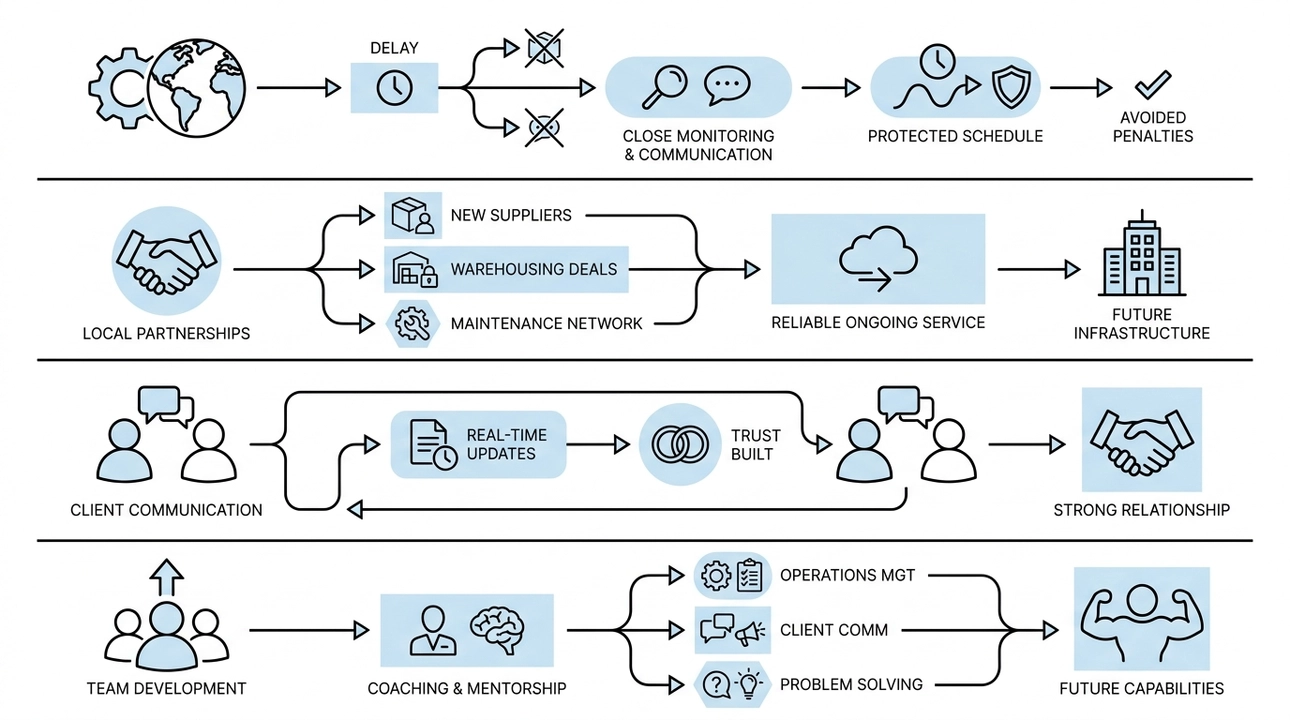
Supply chain disruptions were managed, not avoided. Production delays did occur, as expected. The difference was in how they were handled: close monitoring, direct vendor communication, and adjusted timelines that protected the overall delivery schedule without triggering client penalties.
Local vendor partnerships became a competitive advantage. Sourcing new suppliers to support a newly formed customer service team, locking in warehousing deals, and building a maintenance network meant that once the systems were deployed, ongoing service could be delivered reliably. This wasn’t just about the pilot. It was about building the infrastructure to support follow-on work.
Client communication was treated as a deliverable. Keeping the client informed of progress, challenges, and decisions in real time built the kind of trust that survives project difficulties. The relationship remained strong throughout the deployment.
The team was developed, not just managed. Throughout the project, coaching and mentorship were prioritized alongside execution. Team members were developed in operations management, client communication, and on-the-fly problem solving, building capabilities the company would need long after this contract closed.
The Outcomes
The pilot was delivered within budget and within the six-month window.
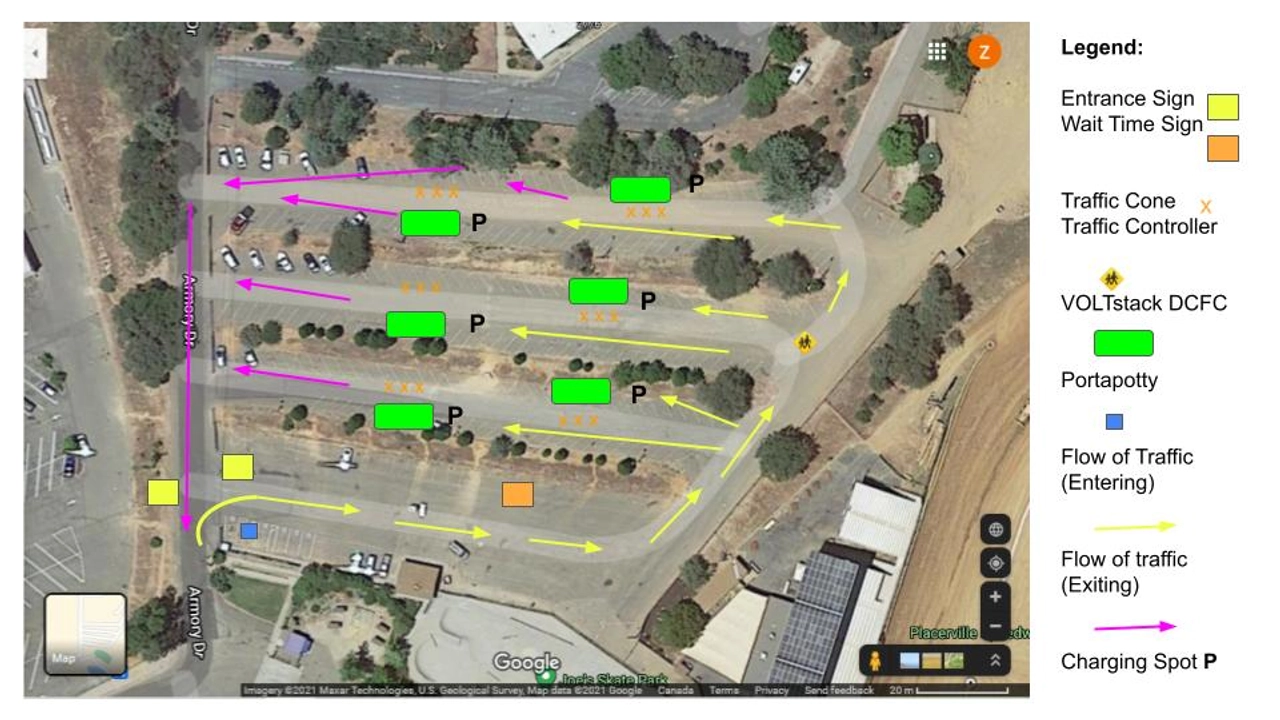
$1.5M initial contract delivered on time and within financial parameters.
$3M+ in follow-on contracts secured directly as a result of the pilot’s successful execution. The client extended the partnership because the delivery built confidence.
Long-term vendor and partner contracts established in California, giving the company a scalable operational foundation for future deployments, not just a completed project.
Customer service team expansion in California, providing ongoing maintenance and support, converting a one-time delivery into a recurring revenue relationship.
The pilot proved that a product-focused startup could build a services operation that delivered profitably in a new market. That proof unlocked the next phase of growth.
What This Illustrates for Scaling Businesses
The mobile EV charging deployment is a compressed version of a challenge many capital-intensive and field-services businesses face when they try to grow beyond their existing footprint: the gap between winning new revenue and building the operational capacity to deliver it profitably.
Revenue growth is visible. The systems, partnerships, team structures, and processes required to sustain it, without eroding margin or damaging client relationships, are not. Closing that gap is an operations problem, and operations problems require structured thinking, disciplined execution, and the willingness to build infrastructure before it’s urgently needed.
The lesson isn’t specific to EV charging or California. It applies to any business trying to move from its home market into new territory, from a product-only model into services, or from a small team into a distributed operation that has to deliver consistently at scale.
Other Case Studies:
From the Blog:
Connect: