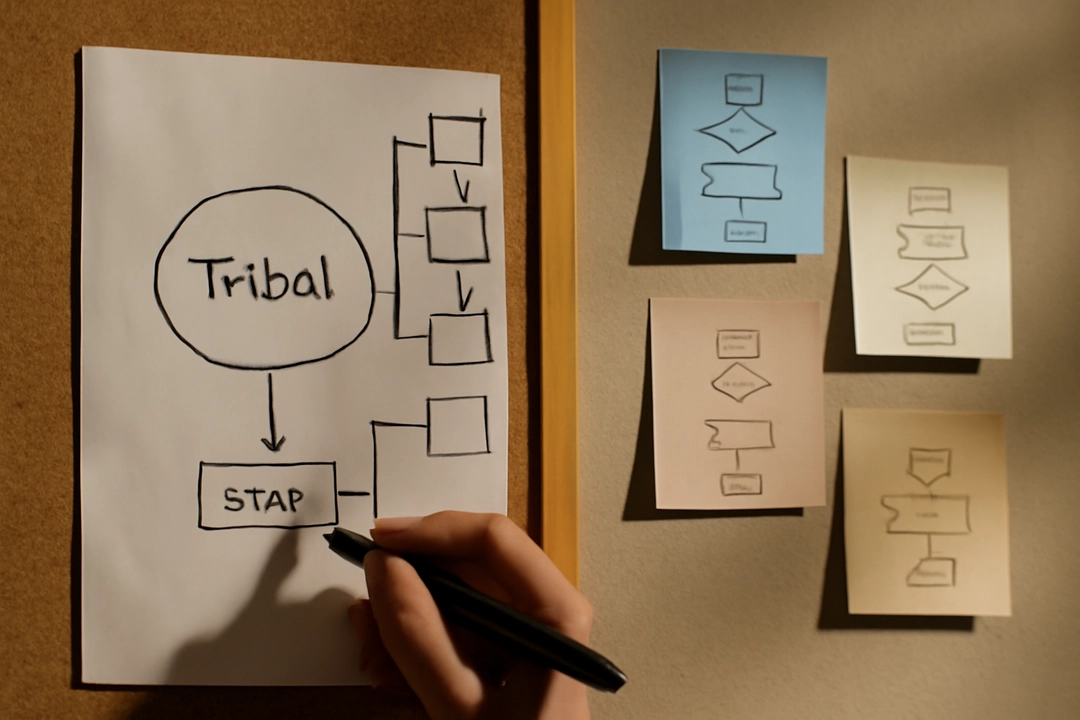
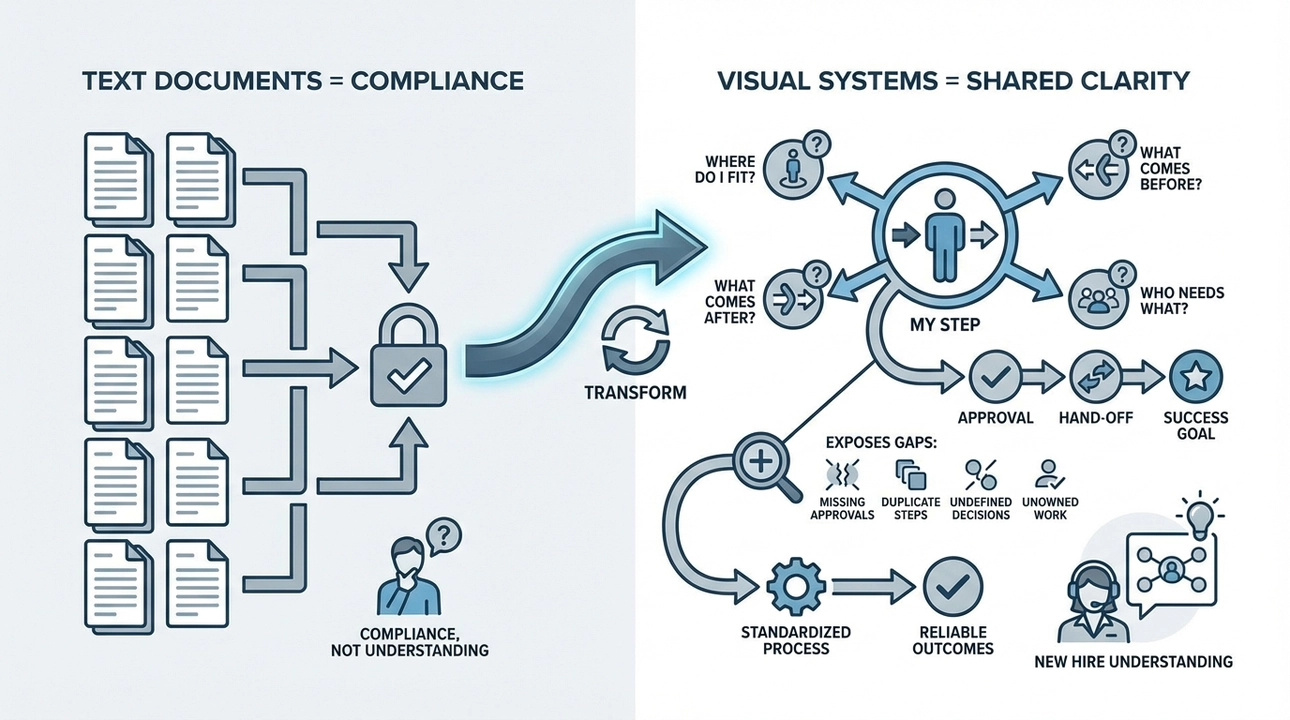
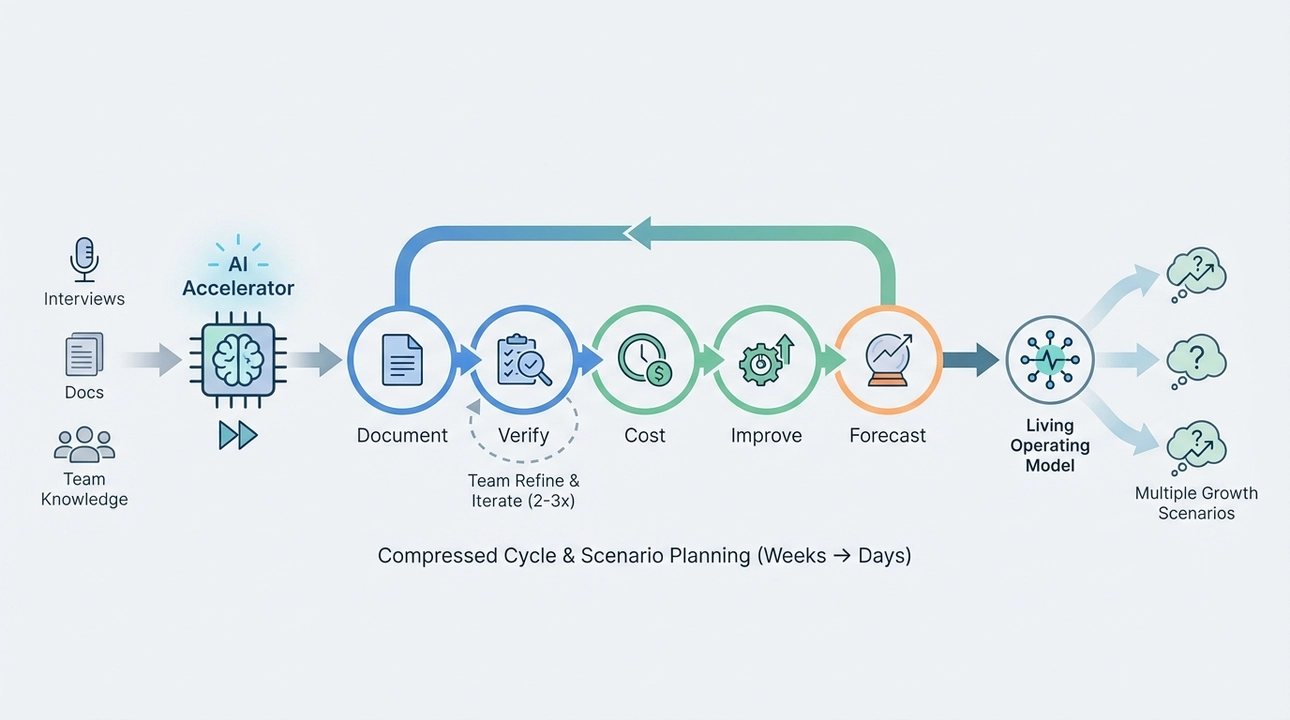
{"json":{"type":"doc","content":[{"type":"paragraph","content":[{"type":"image","attrs":{"src":"https://server.onli.bio/files/onliweb/2320d36b75e6c5ef7da361ba3b1e21a2_post-1775530947846.png","alt":null,"title":null,"caption":"","thumbnail":null}}]},{"type":"paragraph","content":[{"type":"text","text":"Scaling rarely breaks because of ambition. It breaks because the work lives in people’s heads."}]},{"type":"paragraph","content":[{"type":"text","text":"Early-stage teams run on shared context. Everyone knows where the files are, who owns what, and how decisions get made. When something gets dropped, someone else picks it up. That scrappy rhythm feels like culture, but it is often just proximity."}]},{"type":"paragraph","content":[{"type":"text","text":"Then growth hits. Headcount doubles or triples. New people arrive without the lived history that made the early days work. Hand-offs get messy. Expectations become implied instead of explicit. Leaders start “helping” by taking work back, and the organization quietly trains itself to depend on a few veterans."}]},{"type":"paragraph","content":[{"type":"text","text":"That is the moment systems are needed. Not generic software workflows. Not an off-the-shelf playbook. Human-centric systems: process and communication designed around how the team actually works, how culture is actually formed, and how knowledge is actually transferred."}]},{"type":"paragraph"},{"type":"heading","attrs":{"level":2},"content":[{"type":"text","text":"The real scaling problem is knowledge transfer, not tools"}]},{"type":"paragraph","content":[{"type":"text","text":"Most companies do not fail to scale because they lack technology. They fail because the organization cannot reliably reproduce outcomes when new people join."}]},{"type":"paragraph","content":[{"type":"text","text":"In the earliest phase, ownership is obvious because the team is small. People improvise, fill gaps, and coordinate in real time. Once the team grows, that same approach becomes expensive. It creates:"}]},{"type":"paragraph","content":[{"type":"text","text":"- Passive knowledge locked inside a few people"}]},{"type":"paragraph","content":[{"type":"text","text":"- Inconsistent delivery because “the way” is not documented"}]},{"type":"paragraph","content":[{"type":"text","text":"- Bottlenecks around founders or operators who become the default problem-solver"}]},{"type":"paragraph","content":[{"type":"text","text":"- Confusion about how to communicate and when to escalate"}]},{"type":"paragraph","content":[{"type":"text","text":"The painful part is that the work is still getting done, so the dysfunction stays hidden. It shows up later as delays, avoidable mistakes, and a culture that feels different than intended."}]},{"type":"paragraph","content":[{"type":"text","text":"A scalable system is not a set of rules. It is a shared understanding of how work moves through the business."}]},{"type":"paragraph"},{"type":"heading","attrs":{"level":2},"content":[{"type":"text","text":"Culture changes with every hire, whether it is managed or not"}]},{"type":"paragraph","content":[{"type":"text","text":"Culture is often treated like a set of statements. Values on a wall. A page in a handbook. A few stories shared at onboarding."}]},{"type":"paragraph","content":[{"type":"text","text":"But culture is built through actions first, then stories. What gets rewarded? What gets tolerated. How decisions are made when nobody is watching."}]},{"type":"paragraph","content":[{"type":"text","text":"When new people join, they bring new habits, assumptions, and ways of working. If the business is not intentional, culture drifts. Misalignment grows quietly:"}]},{"type":"paragraph","content":[{"type":"text","text":"- A new hire optimizes for speed while leadership expects precision"}]},{"type":"paragraph","content":[{"type":"text","text":"- One team communicates primarily by text, while another expects email and documentation"}]},{"type":"paragraph","content":[{"type":"text","text":"- Different interpretations of “ownership” create friction and rework"}]},{"type":"paragraph","content":[{"type":"text","text":"Managing culture during scale is not about controlling people. It is about defining the operating story through consistent behaviour."}]},{"type":"paragraph","content":[{"type":"text","text":"That means clarifying what the organization wants to foster, then training new team members on how those values show up in day-to-day work. It also means recognizing that culture will evolve and choosing its direction rather than inheriting it."}]},{"type":"paragraph"},{"type":"heading","attrs":{"level":2},"content":[{"type":"text","text":"Start with trust, then interrogate the day-to-day until the truth appears"}]},{"type":"paragraph","content":[{"type":"text","text":"Process work fails when it is treated as a documentation project. People will not reveal how work truly happens unless there is trust. And even when they try, most cannot accurately describe their own routines without structured prompts."}]},{"type":"paragraph","content":[{"type":"text","text":"A practical starting point is simple: talk to everyone, deeply."}]},{"type":"paragraph","content":[{"type":"text","text":"The most reliable approach is in-depth interviews that unpack the entire day:"}]},{"type":"paragraph","content":[{"type":"text","text":"1. Have team members walk through what happens, from the first task to last"}]},{"type":"paragraph","content":[{"type":"text","text":"2. Record the conversations to reduce loss and misinterpretation"}]},{"type":"paragraph","content":[{"type":"text","text":"3. Repeat interviews at least twice to confirm, clarify, and capture what was missed"}]},{"type":"paragraph","content":[{"type":"text","text":"4. Validate not just actions, but why those actions were taken and what felt difficult"}]},{"type":"paragraph","content":[{"type":"text","text":"This is where passive knowledge surfaces. The small choices that make things work. The shortcuts that exist for a reason. The hidden dependencies nobody mentions because “everybody knows that.”"}]},{"type":"paragraph","content":[{"type":"text","text":"Without this step, systems become fictional. They describe how leadership wishes work happened, not how it actually happens."}]},{"type":"paragraph"},{"type":"diagramImageNode","attrs":{"src":"https://server.onli.bio/files/onliweb/6e2670fe8ff83456e9edb7b893cac51e_image-1775530946092.png","prompt":"Make systems visual so humans can actually use them","caption":"Visual systems: Clarity, understanding, and reliable outcomes.","styleType":"custom","status":"success","thumbnail":null}},{"type":"heading","attrs":{"level":2},"content":[{"type":"text","text":"Make systems visual so humans can actually use them"}]},{"type":"paragraph","content":[{"type":"text","text":"Text documents do not scale understanding. They scale compliance. The goal is not to create more reading. The goal is to create shared clarity."}]},{"type":"paragraph","content":[{"type":"text","text":"Visual process maps work because they match how people think. A diagram shows flow, ownership, and hand-offs instantly. It helps a new team member answer the questions that matter most:"}]},{"type":"paragraph","content":[{"type":"text","text":"- Where do I fit?"}]},{"type":"paragraph","content":[{"type":"text","text":"- What comes before my step?"}]},{"type":"paragraph","content":[{"type":"text","text":"- What does success look like after my step?"}]},{"type":"paragraph","content":[{"type":"text","text":"- Who needs what from me, and when?"}]},{"type":"paragraph","content":[{"type":"text","text":"A visual system also exposes gaps that written instructions often hide. Missing approvals. Duplicate steps. Undefined decisions. Unowned work."}]},{"type":"paragraph","content":[{"type":"text","text":"Once a process is mapped, it becomes easier to standardize. Not to make work rigid, but to make outcomes reliable."}]},{"type":"paragraph","content":[{"type":"text","text":"A useful test: if a new hire cannot understand the process in a short review of a diagram, the system is not ready."}]},{"type":"paragraph"},{"type":"diagramImageNode","attrs":{"src":"https://server.onli.bio/files/onliweb/0124c191f1d85a7dd1354eeb1e78a053_image-1775530947626.png","prompt":"Use AI to compress the cycle: document, verify, cost, improve, forecast","caption":"AI accelerates process: document, verify, cost, improve, forecast.","styleType":"custom","status":"success","thumbnail":null}},{"type":"heading","attrs":{"level":2},"content":[{"type":"text","text":"Use AI to compress the cycle: document, verify, cost, improve, forecast"}]},{"type":"paragraph","content":[{"type":"text","text":"AI is not the system. AI is the accelerator."}]},{"type":"paragraph","content":[{"type":"text","text":"When interviews, internal documentation, and team knowledge are combined, AI can quickly synthesize and structure the information. What once took weeks can be compressed into a tighter cycle:"}]},{"type":"paragraph","content":[{"type":"text","text":"- Consolidate interview notes and existing documentation into coherent steps"}]},{"type":"paragraph","content":[{"type":"text","text":"- Generate an initial process illustration that reflects the captured reality"}]},{"type":"paragraph","content":[{"type":"text","text":"- Bring the illustration back to the team for verification and correction"}]},{"type":"paragraph","content":[{"type":"text","text":"- Assign time and money to each step, block, and hand-off to quantify cost"}]},{"type":"paragraph","content":[{"type":"text","text":"- Identify where automation or tooling would actually reduce friction"}]},{"type":"paragraph","content":[{"type":"text","text":"The verification loop matters. The first map is rarely correct. The team must review it together two or three times, refining until it matches reality and clarifies expectations."}]},{"type":"paragraph","content":[{"type":"text","text":"Once the baseline model exists, AI becomes even more powerful for scenario planning. Scaling is not one future; it is multiple possible futures. AI can be used to pressure-test the process against growth scenarios:"}]},{"type":"paragraph","content":[{"type":"text","text":"- Where are the likely failure points as volume increases?"}]},{"type":"paragraph","content":[{"type":"text","text":"- What skill sets will be needed next, and in what order?"}]},{"type":"paragraph","content":[{"type":"text","text":"- How does the system behave when a key role is missing?"}]},{"type":"paragraph","content":[{"type":"text","text":"- What happens to service levels when metrics shift?"}]},{"type":"paragraph","content":[{"type":"text","text":"This is where systems stop being snapshots and become living, operating models."}]},{"type":"paragraph"},{"type":"heading","attrs":{"level":2},"content":[{"type":"text","text":"The review cadence is the difference between a system and a fossil"}]},{"type":"paragraph","content":[{"type":"text","text":"Most businesses build processes once, then wonder why they stop working."}]},{"type":"paragraph","content":[{"type":"text","text":"A system must evolve as the organization evolves. New hires change the culture. New customers change the workflow. Growth changes the load."}]},{"type":"paragraph","content":[{"type":"text","text":"Review should be built into operations, not treated as a special project. The purpose of the review is not to create bureaucracy. It is to prevent quiet drift."}]},{"type":"paragraph","content":[{"type":"text","text":"A healthy review rhythm includes:"}]},{"type":"paragraph","content":[{"type":"text","text":"- Regular check-ins on whether the process still matches reality"}]},{"type":"paragraph","content":[{"type":"text","text":"- Clear feedback channels for the people doing the work"}]},{"type":"paragraph","content":[{"type":"text","text":"- Updates to diagrams and communication norms when friction appears"}]},{"type":"paragraph","content":[{"type":"text","text":"- Reassessment of time and cost as volume changes"}]},{"type":"paragraph","content":[{"type":"text","text":"When processes are visual and owned by the team, review becomes easier. People can point to a step and say, “This is where it breaks.” That is progress."}]},{"type":"paragraph"},{"type":"heading","attrs":{"level":2},"content":[{"type":"text","text":"A final note on scale: clarity is the culture people feel"}]},{"type":"paragraph","content":[{"type":"text","text":"A business can grow without systems, but it cannot grow peacefully without them."}]},{"type":"paragraph","content":[{"type":"text","text":"When systems are human-centric, they do more than improve efficiency. They reduce anxiety. They make expectations visible. They help new team members contribute faster without guessing. They keep culture from becoming accidental."}]},{"type":"paragraph","content":[{"type":"text","text":"The goal is not perfection. The goal is a shared map of how work moves, how communication happens, and how decisions get made."}]},{"type":"paragraph","content":[{"type":"text","text":"Scale is not only a test of strategy. It is a test of whether the organization can transfer what it knows. Build systems that honour people first, and growth becomes less chaotic, more repeatable, and far easier to sustain."}]}]},"len":7854,"title":"Human-Centric Systems for Scaling Teams: Turning Tribal Knowledge Into Visual, Repeatable Operations","slug":"human-centric-systems-for-scaling-teams-turning-tribal-knowledge-into-visual-repeatable-operations","lastSave":1775594040565,"shere":true,"showPublishedDate":true,"showShareOptions":true,"showCollaborators":true,"selectedChannels":[],"linkedinDraftIncludeLink":true,"twitterDraftIncludeLink":true,"twitterDraftIsThread":false,"twitterDraftThreadTexts":[],"newsletterDraftAudienceTypes":[],"newsletterDraftRecipientIds":[],"text":"\n\n\n\nScaling rarely breaks because of ambition. It breaks because the work lives in people’s heads.\n\nEarly-stage teams run on shared context. Everyone knows where the files are, who owns what, and how decisions get made. When something gets dropped, someone else picks it up. That scrappy rhythm feels like culture, but it is often just proximity.\n\nThen growth hits. Headcount doubles or triples. New people arrive without the lived history that made the early days work. Hand-offs get messy. Expectations become implied instead of explicit. Leaders start “helping” by taking work back, and the organization quietly trains itself to depend on a few veterans.\n\nThat is the moment systems are needed. Not generic software workflows. Not an off-the-shelf playbook. Human-centric systems: process and communication designed around how the team actually works, how culture is actually formed, and how knowledge is actually transferred.\n\n\n\nThe real scaling problem is knowledge transfer, not tools\n\nMost companies do not fail to scale because they lack technology. They fail because the organization cannot reliably reproduce outcomes when new people join.\n\nIn the earliest phase, ownership is obvious because the team is small. People improvise, fill gaps, and coordinate in real time. Once the team grows, that same approach becomes expensive. It creates:\n\n- Passive knowledge locked inside a few people\n\n- Inconsistent delivery because “the way” is not documented\n\n- Bottlenecks around founders or operators who become the default problem-solver\n\n- Confusion about how to communicate and when to escalate\n\nThe painful part is that the work is still getting done, so the dysfunction stays hidden. It shows up later as delays, avoidable mistakes, and a culture that feels different than intended.\n\nA scalable system is not a set of rules. It is a shared understanding of how work moves through the business.\n\n\n\nCulture changes with every hire, whether it is managed or not\n\nCulture is often treated like a set of statements. Values on a wall. A page in a handbook. A few stories shared at onboarding.\n\nBut culture is built through actions first, then stories. What gets rewarded? What gets tolerated. How decisions are made when nobody is watching.\n\nWhen new people join, they bring new habits, assumptions, and ways of working. If the business is not intentional, culture drifts. Misalignment grows quietly:\n\n- A new hire optimizes for speed while leadership expects precision\n\n- One team communicates primarily by text, while another expects email and documentation\n\n- Different interpretations of “ownership” create friction and rework\n\nManaging culture during scale is not about controlling people. It is about defining the operating story through consistent behaviour.\n\nThat means clarifying what the organization wants to foster, then training new team members on how those values show up in day-to-day work. It also means recognizing that culture will evolve and choosing its direction rather than inheriting it.\n\n\n\nStart with trust, then interrogate the day-to-day until the truth appears\n\nProcess work fails when it is treated as a documentation project. People will not reveal how work truly happens unless there is trust. And even when they try, most cannot accurately describe their own routines without structured prompts.\n\nA practical starting point is simple: talk to everyone, deeply.\n\nThe most reliable approach is in-depth interviews that unpack the entire day:\n\n1. Have team members walk through what happens, from the first task to last\n\n2. Record the conversations to reduce loss and misinterpretation\n\n3. Repeat interviews at least twice to confirm, clarify, and capture what was missed\n\n4. Validate not just actions, but why those actions were taken and what felt difficult\n\nThis is where passive knowledge surfaces. The small choices that make things work. The shortcuts that exist for a reason. The hidden dependencies nobody mentions because “everybody knows that.”\n\nWithout this step, systems become fictional. They describe how leadership wishes work happened, not how it actually happens.\n\n\n\n\n\nMake systems visual so humans can actually use them\n\nText documents do not scale understanding. They scale compliance. The goal is not to create more reading. The goal is to create shared clarity.\n\nVisual process maps work because they match how people think. A diagram shows flow, ownership, and hand-offs instantly. It helps a new team member answer the questions that matter most:\n\n- Where do I fit?\n\n- What comes before my step?\n\n- What does success look like after my step?\n\n- Who needs what from me, and when?\n\nA visual system also exposes gaps that written instructions often hide. Missing approvals. Duplicate steps. Undefined decisions. Unowned work.\n\nOnce a process is mapped, it becomes easier to standardize. Not to make work rigid, but to make outcomes reliable.\n\nA useful test: if a new hire cannot understand the process in a short review of a diagram, the system is not ready.\n\n\n\n\n\nUse AI to compress the cycle: document, verify, cost, improve, forecast\n\nAI is not the system. AI is the accelerator.\n\nWhen interviews, internal documentation, and team knowledge are combined, AI can quickly synthesize and structure the information. What once took weeks can be compressed into a tighter cycle:\n\n- Consolidate interview notes and existing documentation into coherent steps\n\n- Generate an initial process illustration that reflects the captured reality\n\n- Bring the illustration back to the team for verification and correction\n\n- Assign time and money to each step, block, and hand-off to quantify cost\n\n- Identify where automation or tooling would actually reduce friction\n\nThe verification loop matters. The first map is rarely correct. The team must review it together two or three times, refining until it matches reality and clarifies expectations.\n\nOnce the baseline model exists, AI becomes even more powerful for scenario planning. Scaling is not one future; it is multiple possible futures. AI can be used to pressure-test the process against growth scenarios:\n\n- Where are the likely failure points as volume increases?\n\n- What skill sets will be needed next, and in what order?\n\n- How does the system behave when a key role is missing?\n\n- What happens to service levels when metrics shift?\n\nThis is where systems stop being snapshots and become living, operating models.\n\n\n\nThe review cadence is the difference between a system and a fossil\n\nMost businesses build processes once, then wonder why they stop working.\n\nA system must evolve as the organization evolves. New hires change the culture. New customers change the workflow. Growth changes the load.\n\nReview should be built into operations, not treated as a special project. The purpose of the review is not to create bureaucracy. It is to prevent quiet drift.\n\nA healthy review rhythm includes:\n\n- Regular check-ins on whether the process still matches reality\n\n- Clear feedback channels for the people doing the work\n\n- Updates to diagrams and communication norms when friction appears\n\n- Reassessment of time and cost as volume changes\n\nWhen processes are visual and owned by the team, review becomes easier. People can point to a step and say, “This is where it breaks.” That is progress.\n\n\n\nA final note on scale: clarity is the culture people feel\n\nA business can grow without systems, but it cannot grow peacefully without them.\n\nWhen systems are human-centric, they do more than improve efficiency. They reduce anxiety. They make expectations visible. They help new team members contribute faster without guessing. They keep culture from becoming accidental.\n\nThe goal is not perfection. The goal is a shared map of how work moves, how communication happens, and how decisions get made.\n\nScale is not only a test of strategy. It is a test of whether the organization can transfer what it knows. Build systems that honour people first, and growth becomes less chaotic, more repeatable, and far easier to sustain.","html":"<p class=\"text-sm font-normal leading-normal mt-1 mb-2\"><img src=\"https://server.onli.bio/files/onliweb/2320d36b75e6c5ef7da361ba3b1e21a2_post-1775530947846.lg.webp\" data-caption=\"\"></p><p class=\"text-sm font-normal leading-normal mt-1 mb-2\">Scaling rarely breaks because of ambition. It breaks because the work lives in people’s heads.</p><p class=\"text-sm font-normal leading-normal mt-1 mb-2\">Early-stage teams run on shared context. Everyone knows where the files are, who owns what, and how decisions get made. When something gets dropped, someone else picks it up. That scrappy rhythm feels like culture, but it is often just proximity.</p><p class=\"text-sm font-normal leading-normal mt-1 mb-2\">Then growth hits. Headcount doubles or triples. New people arrive without the lived history that made the early days work. Hand-offs get messy. Expectations become implied instead of explicit. Leaders start “helping” by taking work back, and the organization quietly trains itself to depend on a few veterans.</p><p class=\"text-sm font-normal leading-normal mt-1 mb-2\">That is the moment systems are needed. Not generic software workflows. Not an off-the-shelf playbook. Human-centric systems: process and communication designed around how the team actually works, how culture is actually formed, and how knowledge is actually transferred.</p><p class=\"text-sm font-normal leading-normal mt-1 mb-2\"></p><h2>The real scaling problem is knowledge transfer, not tools</h2><p class=\"text-sm font-normal leading-normal mt-1 mb-2\">Most companies do not fail to scale because they lack technology. They fail because the organization cannot reliably reproduce outcomes when new people join.</p><p class=\"text-sm font-normal leading-normal mt-1 mb-2\">In the earliest phase, ownership is obvious because the team is small. People improvise, fill gaps, and coordinate in real time. Once the team grows, that same approach becomes expensive. It creates:</p><p class=\"text-sm font-normal leading-normal mt-1 mb-2\">- Passive knowledge locked inside a few people</p><p class=\"text-sm font-normal leading-normal mt-1 mb-2\">- Inconsistent delivery because “the way” is not documented</p><p class=\"text-sm font-normal leading-normal mt-1 mb-2\">- Bottlenecks around founders or operators who become the default problem-solver</p><p class=\"text-sm font-normal leading-normal mt-1 mb-2\">- Confusion about how to communicate and when to escalate</p><p class=\"text-sm font-normal leading-normal mt-1 mb-2\">The painful part is that the work is still getting done, so the dysfunction stays hidden. It shows up later as delays, avoidable mistakes, and a culture that feels different than intended.</p><p class=\"text-sm font-normal leading-normal mt-1 mb-2\">A scalable system is not a set of rules. It is a shared understanding of how work moves through the business.</p><p class=\"text-sm font-normal leading-normal mt-1 mb-2\"></p><h2>Culture changes with every hire, whether it is managed or not</h2><p class=\"text-sm font-normal leading-normal mt-1 mb-2\">Culture is often treated like a set of statements. Values on a wall. A page in a handbook. A few stories shared at onboarding.</p><p class=\"text-sm font-normal leading-normal mt-1 mb-2\">But culture is built through actions first, then stories. What gets rewarded? What gets tolerated. How decisions are made when nobody is watching.</p><p class=\"text-sm font-normal leading-normal mt-1 mb-2\">When new people join, they bring new habits, assumptions, and ways of working. If the business is not intentional, culture drifts. Misalignment grows quietly:</p><p class=\"text-sm font-normal leading-normal mt-1 mb-2\">- A new hire optimizes for speed while leadership expects precision</p><p class=\"text-sm font-normal leading-normal mt-1 mb-2\">- One team communicates primarily by text, while another expects email and documentation</p><p class=\"text-sm font-normal leading-normal mt-1 mb-2\">- Different interpretations of “ownership” create friction and rework</p><p class=\"text-sm font-normal leading-normal mt-1 mb-2\">Managing culture during scale is not about controlling people. It is about defining the operating story through consistent behaviour.</p><p class=\"text-sm font-normal leading-normal mt-1 mb-2\">That means clarifying what the organization wants to foster, then training new team members on how those values show up in day-to-day work. It also means recognizing that culture will evolve and choosing its direction rather than inheriting it.</p><p class=\"text-sm font-normal leading-normal mt-1 mb-2\"></p><h2>Start with trust, then interrogate the day-to-day until the truth appears</h2><p class=\"text-sm font-normal leading-normal mt-1 mb-2\">Process work fails when it is treated as a documentation project. People will not reveal how work truly happens unless there is trust. And even when they try, most cannot accurately describe their own routines without structured prompts.</p><p class=\"text-sm font-normal leading-normal mt-1 mb-2\">A practical starting point is simple: talk to everyone, deeply.</p><p class=\"text-sm font-normal leading-normal mt-1 mb-2\">The most reliable approach is in-depth interviews that unpack the entire day:</p><p class=\"text-sm font-normal leading-normal mt-1 mb-2\">1. Have team members walk through what happens, from the first task to last</p><p class=\"text-sm font-normal leading-normal mt-1 mb-2\">2. Record the conversations to reduce loss and misinterpretation</p><p class=\"text-sm font-normal leading-normal mt-1 mb-2\">3. Repeat interviews at least twice to confirm, clarify, and capture what was missed</p><p class=\"text-sm font-normal leading-normal mt-1 mb-2\">4. Validate not just actions, but why those actions were taken and what felt difficult</p><p class=\"text-sm font-normal leading-normal mt-1 mb-2\">This is where passive knowledge surfaces. The small choices that make things work. The shortcuts that exist for a reason. The hidden dependencies nobody mentions because “everybody knows that.”</p><p class=\"text-sm font-normal leading-normal mt-1 mb-2\">Without this step, systems become fictional. They describe how leadership wishes work happened, not how it actually happens.</p><p class=\"text-sm font-normal leading-normal mt-1 mb-2\"></p><div data-diagram-image-node=\"\" data-prompt=\"Make systems visual so humans can actually use them\" data-caption=\"Visual systems: Clarity, understanding, and reliable outcomes.\" data-style-type=\"custom\" data-status=\"success\" src=\"https://server.onli.bio/files/onliweb/6e2670fe8ff83456e9edb7b893cac51e_image-1775530946092.png\" prompt=\"Make systems visual so humans can actually use them\" caption=\"Visual systems: Clarity, understanding, and reliable outcomes.\" styletype=\"custom\" status=\"success\"><img src=\"https://server.onli.bio/files/onliweb/6e2670fe8ff83456e9edb7b893cac51e_image-1775530946092.lg.webp\" alt=\"Visual systems: Clarity, understanding, and reliable outcomes.\" class=\"w-full rounded-lg\"></div><h2>Make systems visual so humans can actually use them</h2><p class=\"text-sm font-normal leading-normal mt-1 mb-2\">Text documents do not scale understanding. They scale compliance. The goal is not to create more reading. The goal is to create shared clarity.</p><p class=\"text-sm font-normal leading-normal mt-1 mb-2\">Visual process maps work because they match how people think. A diagram shows flow, ownership, and hand-offs instantly. It helps a new team member answer the questions that matter most:</p><p class=\"text-sm font-normal leading-normal mt-1 mb-2\">- Where do I fit?</p><p class=\"text-sm font-normal leading-normal mt-1 mb-2\">- What comes before my step?</p><p class=\"text-sm font-normal leading-normal mt-1 mb-2\">- What does success look like after my step?</p><p class=\"text-sm font-normal leading-normal mt-1 mb-2\">- Who needs what from me, and when?</p><p class=\"text-sm font-normal leading-normal mt-1 mb-2\">A visual system also exposes gaps that written instructions often hide. Missing approvals. Duplicate steps. Undefined decisions. Unowned work.</p><p class=\"text-sm font-normal leading-normal mt-1 mb-2\">Once a process is mapped, it becomes easier to standardize. Not to make work rigid, but to make outcomes reliable.</p><p class=\"text-sm font-normal leading-normal mt-1 mb-2\">A useful test: if a new hire cannot understand the process in a short review of a diagram, the system is not ready.</p><p class=\"text-sm font-normal leading-normal mt-1 mb-2\"></p><div data-diagram-image-node=\"\" data-prompt=\"Use AI to compress the cycle: document, verify, cost, improve, forecast\" data-caption=\"AI accelerates process: document, verify, cost, improve, forecast.\" data-style-type=\"custom\" data-status=\"success\" src=\"https://server.onli.bio/files/onliweb/0124c191f1d85a7dd1354eeb1e78a053_image-1775530947626.png\" prompt=\"Use AI to compress the cycle: document, verify, cost, improve, forecast\" caption=\"AI accelerates process: document, verify, cost, improve, forecast.\" styletype=\"custom\" status=\"success\"><img src=\"https://server.onli.bio/files/onliweb/0124c191f1d85a7dd1354eeb1e78a053_image-1775530947626.lg.webp\" alt=\"AI accelerates process: document, verify, cost, improve, forecast.\" class=\"w-full rounded-lg\"></div><h2>Use AI to compress the cycle: document, verify, cost, improve, forecast</h2><p class=\"text-sm font-normal leading-normal mt-1 mb-2\">AI is not the system. AI is the accelerator.</p><p class=\"text-sm font-normal leading-normal mt-1 mb-2\">When interviews, internal documentation, and team knowledge are combined, AI can quickly synthesize and structure the information. What once took weeks can be compressed into a tighter cycle:</p><p class=\"text-sm font-normal leading-normal mt-1 mb-2\">- Consolidate interview notes and existing documentation into coherent steps</p><p class=\"text-sm font-normal leading-normal mt-1 mb-2\">- Generate an initial process illustration that reflects the captured reality</p><p class=\"text-sm font-normal leading-normal mt-1 mb-2\">- Bring the illustration back to the team for verification and correction</p><p class=\"text-sm font-normal leading-normal mt-1 mb-2\">- Assign time and money to each step, block, and hand-off to quantify cost</p><p class=\"text-sm font-normal leading-normal mt-1 mb-2\">- Identify where automation or tooling would actually reduce friction</p><p class=\"text-sm font-normal leading-normal mt-1 mb-2\">The verification loop matters. The first map is rarely correct. The team must review it together two or three times, refining until it matches reality and clarifies expectations.</p><p class=\"text-sm font-normal leading-normal mt-1 mb-2\">Once the baseline model exists, AI becomes even more powerful for scenario planning. Scaling is not one future; it is multiple possible futures. AI can be used to pressure-test the process against growth scenarios:</p><p class=\"text-sm font-normal leading-normal mt-1 mb-2\">- Where are the likely failure points as volume increases?</p><p class=\"text-sm font-normal leading-normal mt-1 mb-2\">- What skill sets will be needed next, and in what order?</p><p class=\"text-sm font-normal leading-normal mt-1 mb-2\">- How does the system behave when a key role is missing?</p><p class=\"text-sm font-normal leading-normal mt-1 mb-2\">- What happens to service levels when metrics shift?</p><p class=\"text-sm font-normal leading-normal mt-1 mb-2\">This is where systems stop being snapshots and become living, operating models.</p><p class=\"text-sm font-normal leading-normal mt-1 mb-2\"></p><h2>The review cadence is the difference between a system and a fossil</h2><p class=\"text-sm font-normal leading-normal mt-1 mb-2\">Most businesses build processes once, then wonder why they stop working.</p><p class=\"text-sm font-normal leading-normal mt-1 mb-2\">A system must evolve as the organization evolves. New hires change the culture. New customers change the workflow. Growth changes the load.</p><p class=\"text-sm font-normal leading-normal mt-1 mb-2\">Review should be built into operations, not treated as a special project. The purpose of the review is not to create bureaucracy. It is to prevent quiet drift.</p><p class=\"text-sm font-normal leading-normal mt-1 mb-2\">A healthy review rhythm includes:</p><p class=\"text-sm font-normal leading-normal mt-1 mb-2\">- Regular check-ins on whether the process still matches reality</p><p class=\"text-sm font-normal leading-normal mt-1 mb-2\">- Clear feedback channels for the people doing the work</p><p class=\"text-sm font-normal leading-normal mt-1 mb-2\">- Updates to diagrams and communication norms when friction appears</p><p class=\"text-sm font-normal leading-normal mt-1 mb-2\">- Reassessment of time and cost as volume changes</p><p class=\"text-sm font-normal leading-normal mt-1 mb-2\">When processes are visual and owned by the team, review becomes easier. People can point to a step and say, “This is where it breaks.” That is progress.</p><p class=\"text-sm font-normal leading-normal mt-1 mb-2\"></p><h2>A final note on scale: clarity is the culture people feel</h2><p class=\"text-sm font-normal leading-normal mt-1 mb-2\">A business can grow without systems, but it cannot grow peacefully without them.</p><p class=\"text-sm font-normal leading-normal mt-1 mb-2\">When systems are human-centric, they do more than improve efficiency. They reduce anxiety. They make expectations visible. They help new team members contribute faster without guessing. They keep culture from becoming accidental.</p><p class=\"text-sm font-normal leading-normal mt-1 mb-2\">The goal is not perfection. The goal is a shared map of how work moves, how communication happens, and how decisions get made.</p><p class=\"text-sm font-normal leading-normal mt-1 mb-2\">Scale is not only a test of strategy. It is a test of whether the organization can transfer what it knows. Build systems that honour people first, and growth becomes less chaotic, more repeatable, and far easier to sustain.</p>","style":"preview","access":"public"}