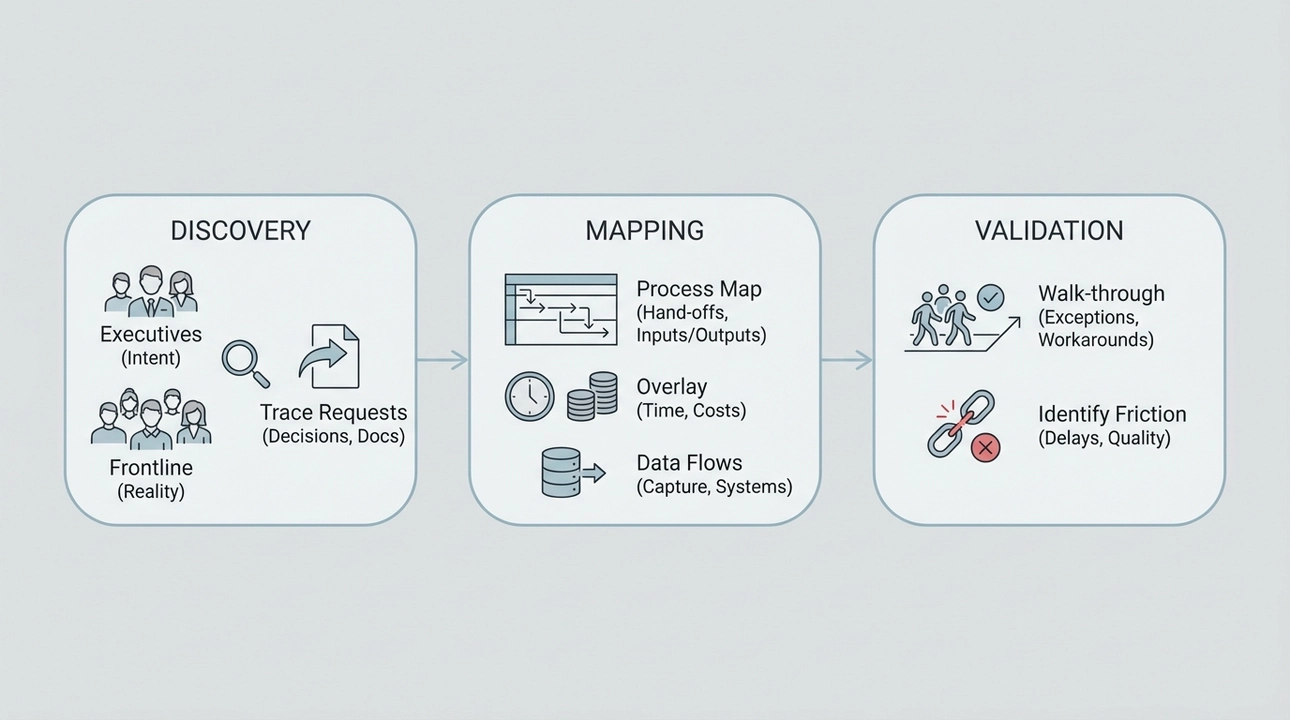
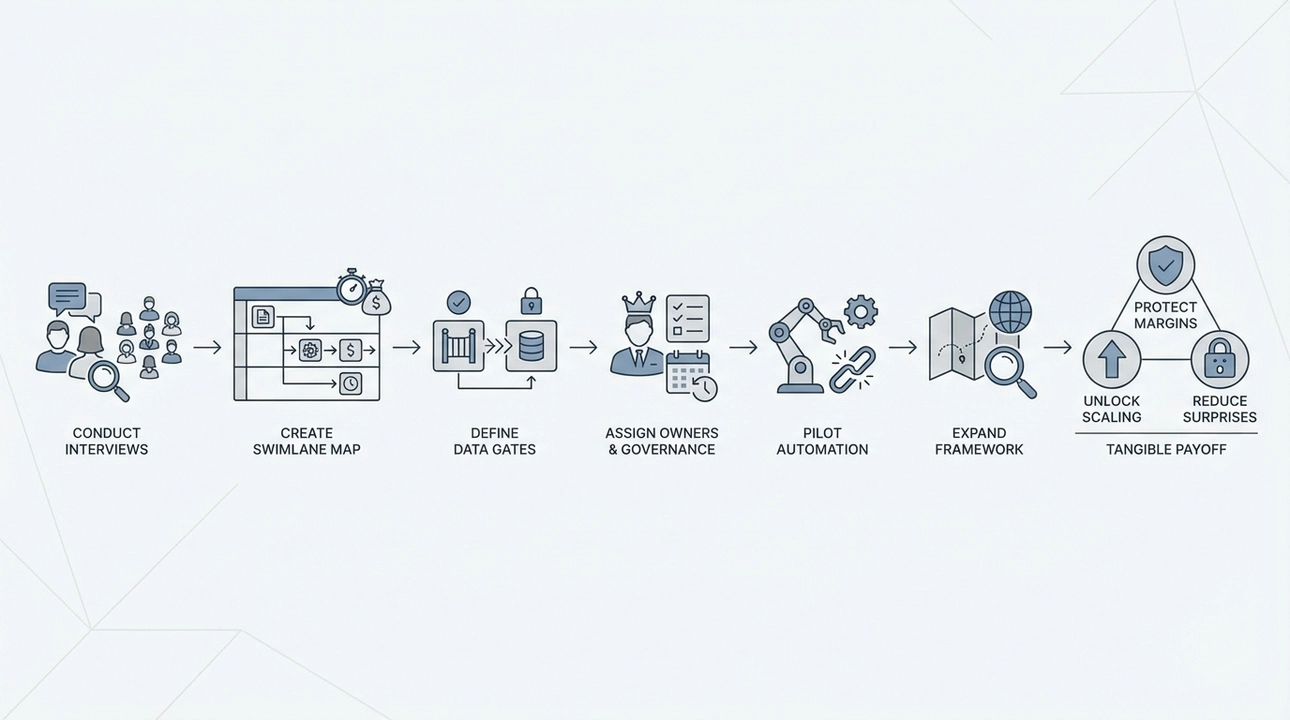
{"json":{"type":"doc","content":[{"type":"paragraph","content":[{"type":"image","attrs":{"src":"https://server.onli.bio/files/onliweb/28bef65336565c3fa629e0f4f9252c56_post-1771365165632.png","alt":null,"title":null,"caption":"","thumbnail":null}}]},{"type":"paragraph","content":[{"type":"text","text":"I have a simple test I run when I walk into a company that is doing well but feeling the squeeze of growth. I ask for their processes. Common answer, yes we have processes for onboarding, purchase orders, sales, fulfillment. Then I ask the next question that always reveals the truth: show me how those processes talk to each other from a client request to money received. The hesitation I get is where most scaling problems live."}]},{"type":"paragraph","content":[{"type":"text","text":"The main challenge I see in manufacturing, cleantech and other people centric industries is not the absence of processes. It is the absence of an interconnected framework that treats those processes as parts of a whole. When you map the whole, you move from local optimizations to systemic outcomes. That single shift unlocks profitability, reliability and the ability to enter new markets with confidence."}]},{"type":"paragraph"},{"type":"heading","attrs":{"level":2},"content":[{"type":"text","text":"Why a 4D framework is the difference between growth and chaos"}]},{"type":"paragraph","content":[{"type":"text","text":"Most companies build 2D processes. Sales has a manual, operations has a procedure, procurement has a checklist. Each looks fine in isolation. The flaw is the implicit assumption that deliverables, timing and information will magically transfer across handoffs."}]},{"type":"paragraph","content":[{"type":"text","text":"A 4D framework adds three dimensions to those flat processes. First dimension is the vertical departmental flows. Second is the horizontal client journey, from request to payment. Third is time and sequence, so you understand lead times, wait times and decision gates. The fourth is data and metrics: what data is captured, where it lives, and how it is used to measure performance and trigger actions."}]},{"type":"paragraph","content":[{"type":"text","text":"When you combine these perspectives you get a living map of how work moves through the company and how value is created and lost. For businesses with more than 10 million in revenue, that visibility is not optional. It determines whether you can scale profitably, enter a new province or country, or sustain quality while growing headcount."}]},{"type":"paragraph"},{"type":"diagramImageNode","attrs":{"src":"https://server.onli.bio/files/onliweb/63847f09a6b2d76ebe648906458b4d08_diagram-1771365342750.png","prompt":"How I map processes to reveal the real flow of work I do not start with org charts. I start with people. My practical method has three phases: discovery, mapping, and validation. Discovery - I spend time with executives and the people doing the work. For one engagement I interviewed 15 stakeholders across sales, marketing, fulfillment, operations, purchasing and R&D. Executives know intent. Frontline staff know reality. Both views matter. - I ask for examples of typical client requests and trace them through the organization. Where are decisions made, what approvals are required, which documents travel with the request, and who waits for what? Mapping - I convert interviews into a process map with swimlanes that show each department, the handoffs, inputs and outputs. The simplest input output pair I use is request from client to money paid by client. Everything in the box is how you deliver on that. - I overlay time estimates and costs. How long does each step take? Who is waiting? What inventory or logistics costs are invoked at particular steps? - I map data flows. Where is client information captured? Which system owns the contract, the invoice, the delivery confirmation? What data is duplicated and where are gaps? Validation - I return the map to the people I interviewed and walk the process with them. This step uncovers gaps that interviews alone miss. People recall exceptions, workarounds and shadow systems only when you walk through the sequence together. - I identify the friction points that create delays, unexpected costs or quality issues. These become the highest priority changes because they impact both client satisfaction and profitability.","caption":"Mapping work processes: Discovery, mapping, and validation reveal real workflows.","styleType":"custom","status":"success","thumbnail":null}},{"type":"heading","attrs":{"level":2},"content":[{"type":"text","text":"How I map processes to reveal the real flow of work"}]},{"type":"paragraph","content":[{"type":"text","text":"I do not start with org charts. I start with people. My practical method has three phases: discovery, mapping, and validation."}]},{"type":"paragraph","content":[{"type":"text","text":"Discovery"}]},{"type":"paragraph","content":[{"type":"text","text":"- I spend time with executives and the people doing the work. For one engagement I interviewed 15 stakeholders across sales, marketing, fulfillment, operations, purchasing and R&D. Executives know intent. Frontline staff know reality. Both views matter."}]},{"type":"paragraph","content":[{"type":"text","text":"- I ask for examples of typical client requests and trace them through the organization. Where are decisions made, what approvals are required, which documents travel with the request, and who waits for what?"}]},{"type":"paragraph","content":[{"type":"text","text":"Mapping"}]},{"type":"paragraph","content":[{"type":"text","text":"- I convert interviews into a process map with swimlanes that show each department, the handoffs, inputs and outputs. The simplest input output pair I use is request from client to money paid by client. Everything in the box is how you deliver on that."}]},{"type":"paragraph","content":[{"type":"text","text":"- I overlay time estimates and costs. How long does each step take? Who is waiting? What inventory or logistics costs are invoked at particular steps?"}]},{"type":"paragraph","content":[{"type":"text","text":"- I map data flows. Where is client information captured? Which system owns the contract, the invoice, the delivery confirmation? What data is duplicated and where are gaps?"}]},{"type":"paragraph","content":[{"type":"text","text":"Validation"}]},{"type":"paragraph","content":[{"type":"text","text":"- I return the map to the people I interviewed and walk the process with them. This step uncovers gaps that interviews alone miss. People recall exceptions, workarounds and shadow systems only when you walk through the sequence together."}]},{"type":"paragraph","content":[{"type":"text","text":"- I identify the friction points that create delays, unexpected costs or quality issues. These become the highest priority changes because they impact both client satisfaction and profitability."}]},{"type":"paragraph"},{"type":"heading","attrs":{"level":2},"content":[{"type":"text","text":"Turning the map into action: three pragmatic moves"}]},{"type":"paragraph","content":[{"type":"text","text":"A map alone does not change outcomes. It makes change possible. I recommend three practical moves that convert visibility into traction."}]},{"type":"paragraph","content":[{"type":"text","text":"1. Make handovers explicit"}]},{"type":"paragraph","content":[{"type":"text","text":"Too many frameworks assume handovers are obvious. They are not. Specify what needs to be transferred at each handover: documents, data fields, approvals, and expected timelines. Create checklists for complex handovers and automate confirmations where possible. When handovers are explicit the number of exceptions drops and accountability becomes measurable."}]},{"type":"paragraph","content":[{"type":"text","text":"2. Quantify time and money at each step"}]},{"type":"paragraph","content":[{"type":"text","text":"Assign a cost and time estimate to every activity in the framework. If a step consumes unexpected labor or causes a logistics premium, that cost belongs to the framework. When you see the true cost of delivery you can decide where to invest in training, automation or supplier negotiation to protect margins."}]},{"type":"paragraph","content":[{"type":"text","text":"3. Define the data heartbeat"}]},{"type":"paragraph","content":[{"type":"text","text":"Decide the minimum dataset that must travel with a client request so downstream teams can act without friction. Make that dataset the gating mechanism for revenue recognition. If sales cannot provide the minimum dataset, revenue is at risk. That rule reduces surprises and accelerates cash flow."}]},{"type":"paragraph"},{"type":"heading","attrs":{"level":2},"content":[{"type":"text","text":"Data, KPIs and the role of technology"}]},{"type":"paragraph","content":[{"type":"text","text":"Frameworks expose what needs to be measured. Too often businesses measure activity rather than outcomes. The right KPIs are tied to the client journey and the financial model. Examples I track with clients include end to end lead time, cost to deliver per order, percentage of orders that required a manual escalation, and days sales outstanding by product line."}]},{"type":"paragraph","content":[{"type":"text","text":"Technology is not a solution in itself, but it is an amplifier. Once you know the data you need, you can choose tools that capture it where work happens. In manufacturing and cleantech that might look like integrating CRM, ERP, shop floor systems and logistics platforms so the record of a client request persists through delivery and invoicing."}]},{"type":"paragraph","content":[{"type":"text","text":"AI is useful when it automates repetitive decisions, extracts structured data from unstructured inputs, or predicts bottlenecks before they disrupt delivery. I advise clients to start with small, high value AI pilots that solve a specific handover pain point, rather than broad platform bets. The framework tells you where AI will have real impact."}]},{"type":"paragraph"},{"type":"heading","attrs":{"level":2},"content":[{"type":"text","text":"Getting people to follow the framework: culture and governance"}]},{"type":"paragraph","content":[{"type":"text","text":"A framework only works when people follow it. That requires two things: incentives and simple governance."}]},{"type":"paragraph","content":[{"type":"text","text":"Incentives"}]},{"type":"paragraph","content":[{"type":"text","text":"- Align KPIs to the framework so teams are rewarded for outcomes that cross departmental boundaries. If sales is rewarded solely on bookings, not on clean handovers, they will cut corners. Design incentives that reflect the health of the whole client journey."}]},{"type":"paragraph","content":[{"type":"text","text":"Governance"}]},{"type":"paragraph","content":[{"type":"text","text":"- Create a lightweight governance rhythm. A weekly review of exceptions, a monthly cross functional forum to review trends, and a quarterly review of the framework against actual financial outcomes keeps the framework alive."}]},{"type":"paragraph","content":[{"type":"text","text":"- Create a single source of truth for process ownership. Each process and handover must have a named owner responsible for updates, training, and continuous improvement."}]},{"type":"paragraph","content":[{"type":"text","text":"Training and capacity planning are part of compliance. When I mapped the processes for a mid sized manufacturer I could see where teams were under staffed and where training gaps caused repeated exceptions. Filling those gaps delivered immediate improvements in on time delivery and profitability without major technology investments."}]},{"type":"paragraph"},{"type":"heading","attrs":{"level":2},"content":[{"type":"text","text":"Scaling internationally means extending the framework beyond the walls"}]},{"type":"paragraph","content":[{"type":"text","text":"International expansion exposes hidden assumptions in your framework. Rules that work in one province or country rarely translate unchanged. Cross border logistics, regulatory compliance, tax and local supplier ecosystems introduce new handovers and new data requirements."}]},{"type":"paragraph","content":[{"type":"text","text":"When preparing to enter a new market I expand the framework to include external actors: customs brokers, local distributors, compliance bodies and localized customer support. I map the additional steps and costs, the new data fields required for compliance, and the timing differences that affect cash flow."}]},{"type":"paragraph","content":[{"type":"text","text":"This perspective also shows where a central model can be replicated and where local variation is required. One of the most valuable outcomes of a robust framework is the ability to say with confidence which parts of the process can be standardized across markets and which must be localized."}]},{"type":"paragraph"},{"type":"diagramImageNode","attrs":{"src":"https://server.onli.bio/files/onliweb/fb0e76065e9438c832f452094fc612d0_diagram-1771365417314.png","prompt":"Practical checklist to get started this quarter - Interview 10 to 20 people across functions and levels to capture reality, not just intent. - Create a swimlane map that traces client request to payment and overlays time and cost estimates. - Identify the minimum dataset required at each handover and make it a gating criterion for revenue recognition. - Assign owners for each process and handover and set a governance cadence for exceptions and continuous improvement. - Pilot one automation or AI use case that addresses a high frequency handover problem. - Expand the framework to model one target market if you plan to go international next year. These steps are manageable but they require discipline. The payoff is tangible. You reduce delivery surprises, protect margins, and unlock repeatable models for scaling across new territories.","caption":"Quarterly checklist: Streamline processes, boost revenue, and scale.","styleType":"custom","status":"success","thumbnail":null}},{"type":"heading","attrs":{"level":2},"content":[{"type":"text","text":"Practical checklist to get started this quarter"}]},{"type":"paragraph","content":[{"type":"text","text":"- Interview 10 to 20 people across functions and levels to capture reality, not just intent."}]},{"type":"paragraph","content":[{"type":"text","text":"- Create a swimlane map that traces client request to payment and overlays time and cost estimates."}]},{"type":"paragraph","content":[{"type":"text","text":"- Identify the minimum dataset required at each handover and make it a gating criterion for revenue recognition."}]},{"type":"paragraph","content":[{"type":"text","text":"- Assign owners for each process and handover and set a governance cadence for exceptions and continuous improvement."}]},{"type":"paragraph","content":[{"type":"text","text":"- Pilot one automation or AI use case that addresses a high frequency handover problem."}]},{"type":"paragraph","content":[{"type":"text","text":"- Expand the framework to model one target market if you plan to go international next year."}]},{"type":"paragraph","content":[{"type":"text","text":"These steps are manageable but they require discipline. The payoff is tangible. You reduce delivery surprises, protect margins, and unlock repeatable models for scaling across new territories."}]},{"type":"paragraph"},{"type":"heading","attrs":{"level":2},"content":[{"type":"text","text":"Closing the loop"}]},{"type":"paragraph","content":[{"type":"text","text":"I have seen frameworks change the trajectory of companies I work with. Mapping a single client journey and making handovers explicit led one company to reorganize around the reality of work rather than the legacy of silos. That reorganization reduced lead times, recovered hidden margin and created a foundation for profitable expansion into adjacent provinces."}]},{"type":"paragraph","content":[{"type":"text","text":"Frameworks are not an academic exercise. They are a practical tool to make complex organizations predictable and scalable. If you are leading a business that makes things and relies on people, your best leverage is to invest in seeing the whole, not just the parts."}]},{"type":"paragraph","content":[{"type":"text","text":"If you take one thing from this post, let it be this: stop asking whether you have processes and start asking whether those processes are connected. The difference will determine whether your next phase of growth scales profitably or simply scales complexity."}]},{"type":"paragraph","content":[{"type":"text","text":"Final thought for the leader ready to act"}]},{"type":"paragraph","content":[{"type":"text","text":"Start by mapping the journey of your most common client order. Follow it with curiosity, not blame. The answers you find will reveal where to invest, where to automate, and where to change incentives. That map becomes your blueprint for scaling with confidence."}]}]},"len":10056,"title":"Beyond Silos: How 4D Frameworks Align People, Processes, Data and Markets to Grow Revenue and Scale Profits. ","slug":"beyond-silos-how-4d-frameworks-align-people-processes-data-and-markets-to-scale-manufacturing-and-cleantech-firms","lastSave":1771365419796,"shere":false,"showPublishedDate":true,"showShareOptions":true,"text":"\n\n\n\nI have a simple test I run when I walk into a company that is doing well but feeling the squeeze of growth. I ask for their processes. Common answer, yes we have processes for onboarding, purchase orders, sales, fulfillment. Then I ask the next question that always reveals the truth: show me how those processes talk to each other from a client request to money received. The hesitation I get is where most scaling problems live.\n\nThe main challenge I see in manufacturing, cleantech and other people centric industries is not the absence of processes. It is the absence of an interconnected framework that treats those processes as parts of a whole. When you map the whole, you move from local optimizations to systemic outcomes. That single shift unlocks profitability, reliability and the ability to enter new markets with confidence.\n\n\n\nWhy a 4D framework is the difference between growth and chaos\n\nMost companies build 2D processes. Sales has a manual, operations has a procedure, procurement has a checklist. Each looks fine in isolation. The flaw is the implicit assumption that deliverables, timing and information will magically transfer across handoffs.\n\nA 4D framework adds three dimensions to those flat processes. First dimension is the vertical departmental flows. Second is the horizontal client journey, from request to payment. Third is time and sequence, so you understand lead times, wait times and decision gates. The fourth is data and metrics: what data is captured, where it lives, and how it is used to measure performance and trigger actions.\n\nWhen you combine these perspectives you get a living map of how work moves through the company and how value is created and lost. For businesses with more than 10 million in revenue, that visibility is not optional. It determines whether you can scale profitably, enter a new province or country, or sustain quality while growing headcount.\n\n\n\n\n\nHow I map processes to reveal the real flow of work\n\nI do not start with org charts. I start with people. My practical method has three phases: discovery, mapping, and validation.\n\nDiscovery\n\n- I spend time with executives and the people doing the work. For one engagement I interviewed 15 stakeholders across sales, marketing, fulfillment, operations, purchasing and R&D. Executives know intent. Frontline staff know reality. Both views matter.\n\n- I ask for examples of typical client requests and trace them through the organization. Where are decisions made, what approvals are required, which documents travel with the request, and who waits for what?\n\nMapping\n\n- I convert interviews into a process map with swimlanes that show each department, the handoffs, inputs and outputs. The simplest input output pair I use is request from client to money paid by client. Everything in the box is how you deliver on that.\n\n- I overlay time estimates and costs. How long does each step take? Who is waiting? What inventory or logistics costs are invoked at particular steps?\n\n- I map data flows. Where is client information captured? Which system owns the contract, the invoice, the delivery confirmation? What data is duplicated and where are gaps?\n\nValidation\n\n- I return the map to the people I interviewed and walk the process with them. This step uncovers gaps that interviews alone miss. People recall exceptions, workarounds and shadow systems only when you walk through the sequence together.\n\n- I identify the friction points that create delays, unexpected costs or quality issues. These become the highest priority changes because they impact both client satisfaction and profitability.\n\n\n\nTurning the map into action: three pragmatic moves\n\nA map alone does not change outcomes. It makes change possible. I recommend three practical moves that convert visibility into traction.\n\n1. Make handovers explicit\n\nToo many frameworks assume handovers are obvious. They are not. Specify what needs to be transferred at each handover: documents, data fields, approvals, and expected timelines. Create checklists for complex handovers and automate confirmations where possible. When handovers are explicit the number of exceptions drops and accountability becomes measurable.\n\n2. Quantify time and money at each step\n\nAssign a cost and time estimate to every activity in the framework. If a step consumes unexpected labor or causes a logistics premium, that cost belongs to the framework. When you see the true cost of delivery you can decide where to invest in training, automation or supplier negotiation to protect margins.\n\n3. Define the data heartbeat\n\nDecide the minimum dataset that must travel with a client request so downstream teams can act without friction. Make that dataset the gating mechanism for revenue recognition. If sales cannot provide the minimum dataset, revenue is at risk. That rule reduces surprises and accelerates cash flow.\n\n\n\nData, KPIs and the role of technology\n\nFrameworks expose what needs to be measured. Too often businesses measure activity rather than outcomes. The right KPIs are tied to the client journey and the financial model. Examples I track with clients include end to end lead time, cost to deliver per order, percentage of orders that required a manual escalation, and days sales outstanding by product line.\n\nTechnology is not a solution in itself, but it is an amplifier. Once you know the data you need, you can choose tools that capture it where work happens. In manufacturing and cleantech that might look like integrating CRM, ERP, shop floor systems and logistics platforms so the record of a client request persists through delivery and invoicing.\n\nAI is useful when it automates repetitive decisions, extracts structured data from unstructured inputs, or predicts bottlenecks before they disrupt delivery. I advise clients to start with small, high value AI pilots that solve a specific handover pain point, rather than broad platform bets. The framework tells you where AI will have real impact.\n\n\n\nGetting people to follow the framework: culture and governance\n\nA framework only works when people follow it. That requires two things: incentives and simple governance.\n\nIncentives\n\n- Align KPIs to the framework so teams are rewarded for outcomes that cross departmental boundaries. If sales is rewarded solely on bookings, not on clean handovers, they will cut corners. Design incentives that reflect the health of the whole client journey.\n\nGovernance\n\n- Create a lightweight governance rhythm. A weekly review of exceptions, a monthly cross functional forum to review trends, and a quarterly review of the framework against actual financial outcomes keeps the framework alive.\n\n- Create a single source of truth for process ownership. Each process and handover must have a named owner responsible for updates, training, and continuous improvement.\n\nTraining and capacity planning are part of compliance. When I mapped the processes for a mid sized manufacturer I could see where teams were under staffed and where training gaps caused repeated exceptions. Filling those gaps delivered immediate improvements in on time delivery and profitability without major technology investments.\n\n\n\nScaling internationally means extending the framework beyond the walls\n\nInternational expansion exposes hidden assumptions in your framework. Rules that work in one province or country rarely translate unchanged. Cross border logistics, regulatory compliance, tax and local supplier ecosystems introduce new handovers and new data requirements.\n\nWhen preparing to enter a new market I expand the framework to include external actors: customs brokers, local distributors, compliance bodies and localized customer support. I map the additional steps and costs, the new data fields required for compliance, and the timing differences that affect cash flow.\n\nThis perspective also shows where a central model can be replicated and where local variation is required. One of the most valuable outcomes of a robust framework is the ability to say with confidence which parts of the process can be standardized across markets and which must be localized.\n\n\n\n\n\nPractical checklist to get started this quarter\n\n- Interview 10 to 20 people across functions and levels to capture reality, not just intent.\n\n- Create a swimlane map that traces client request to payment and overlays time and cost estimates.\n\n- Identify the minimum dataset required at each handover and make it a gating criterion for revenue recognition.\n\n- Assign owners for each process and handover and set a governance cadence for exceptions and continuous improvement.\n\n- Pilot one automation or AI use case that addresses a high frequency handover problem.\n\n- Expand the framework to model one target market if you plan to go international next year.\n\nThese steps are manageable but they require discipline. The payoff is tangible. You reduce delivery surprises, protect margins, and unlock repeatable models for scaling across new territories.\n\n\n\nClosing the loop\n\nI have seen frameworks change the trajectory of companies I work with. Mapping a single client journey and making handovers explicit led one company to reorganize around the reality of work rather than the legacy of silos. That reorganization reduced lead times, recovered hidden margin and created a foundation for profitable expansion into adjacent provinces.\n\nFrameworks are not an academic exercise. They are a practical tool to make complex organizations predictable and scalable. If you are leading a business that makes things and relies on people, your best leverage is to invest in seeing the whole, not just the parts.\n\nIf you take one thing from this post, let it be this: stop asking whether you have processes and start asking whether those processes are connected. The difference will determine whether your next phase of growth scales profitably or simply scales complexity.\n\nFinal thought for the leader ready to act\n\nStart by mapping the journey of your most common client order. Follow it with curiosity, not blame. The answers you find will reveal where to invest, where to automate, and where to change incentives. That map becomes your blueprint for scaling with confidence.","html":"<p class=\"text-sm font-normal leading-normal mt-1 mb-2\"><img src=\"https://server.onli.bio/files/onliweb/28bef65336565c3fa629e0f4f9252c56_post-1771365165632.lg.webp\" data-caption=\"\"></p><p class=\"text-sm font-normal leading-normal mt-1 mb-2\">I have a simple test I run when I walk into a company that is doing well but feeling the squeeze of growth. I ask for their processes. Common answer, yes we have processes for onboarding, purchase orders, sales, fulfillment. Then I ask the next question that always reveals the truth: show me how those processes talk to each other from a client request to money received. The hesitation I get is where most scaling problems live.</p><p class=\"text-sm font-normal leading-normal mt-1 mb-2\">The main challenge I see in manufacturing, cleantech and other people centric industries is not the absence of processes. It is the absence of an interconnected framework that treats those processes as parts of a whole. When you map the whole, you move from local optimizations to systemic outcomes. That single shift unlocks profitability, reliability and the ability to enter new markets with confidence.</p><p class=\"text-sm font-normal leading-normal mt-1 mb-2\"></p><h2>Why a 4D framework is the difference between growth and chaos</h2><p class=\"text-sm font-normal leading-normal mt-1 mb-2\">Most companies build 2D processes. Sales has a manual, operations has a procedure, procurement has a checklist. Each looks fine in isolation. The flaw is the implicit assumption that deliverables, timing and information will magically transfer across handoffs.</p><p class=\"text-sm font-normal leading-normal mt-1 mb-2\">A 4D framework adds three dimensions to those flat processes. First dimension is the vertical departmental flows. Second is the horizontal client journey, from request to payment. Third is time and sequence, so you understand lead times, wait times and decision gates. The fourth is data and metrics: what data is captured, where it lives, and how it is used to measure performance and trigger actions.</p><p class=\"text-sm font-normal leading-normal mt-1 mb-2\">When you combine these perspectives you get a living map of how work moves through the company and how value is created and lost. For businesses with more than 10 million in revenue, that visibility is not optional. It determines whether you can scale profitably, enter a new province or country, or sustain quality while growing headcount.</p><p class=\"text-sm font-normal leading-normal mt-1 mb-2\"></p><div data-diagram-image-node=\"\" data-prompt=\"How I map processes to reveal the real flow of work I do not start with org charts. I start with people. My practical method has three phases: discovery, mapping, and validation. Discovery - I spend time with executives and the people doing the work. For one engagement I interviewed 15 stakeholders across sales, marketing, fulfillment, operations, purchasing and R&D. Executives know intent. Frontline staff know reality. Both views matter. - I ask for examples of typical client requests and trace them through the organization. Where are decisions made, what approvals are required, which documents travel with the request, and who waits for what? Mapping - I convert interviews into a process map with swimlanes that show each department, the handoffs, inputs and outputs. The simplest input output pair I use is request from client to money paid by client. Everything in the box is how you deliver on that. - I overlay time estimates and costs. How long does each step take? Who is waiting? What inventory or logistics costs are invoked at particular steps? - I map data flows. Where is client information captured? Which system owns the contract, the invoice, the delivery confirmation? What data is duplicated and where are gaps? Validation - I return the map to the people I interviewed and walk the process with them. This step uncovers gaps that interviews alone miss. People recall exceptions, workarounds and shadow systems only when you walk through the sequence together. - I identify the friction points that create delays, unexpected costs or quality issues. These become the highest priority changes because they impact both client satisfaction and profitability.\" data-caption=\"Mapping work processes: Discovery, mapping, and validation reveal real workflows.\" data-style-type=\"custom\" data-status=\"success\" src=\"https://server.onli.bio/files/onliweb/63847f09a6b2d76ebe648906458b4d08_diagram-1771365342750.png\" prompt=\"How I map processes to reveal the real flow of work I do not start with org charts. I start with people. My practical method has three phases: discovery, mapping, and validation. Discovery - I spend time with executives and the people doing the work. For one engagement I interviewed 15 stakeholders across sales, marketing, fulfillment, operations, purchasing and R&D. Executives know intent. Frontline staff know reality. Both views matter. - I ask for examples of typical client requests and trace them through the organization. Where are decisions made, what approvals are required, which documents travel with the request, and who waits for what? Mapping - I convert interviews into a process map with swimlanes that show each department, the handoffs, inputs and outputs. The simplest input output pair I use is request from client to money paid by client. Everything in the box is how you deliver on that. - I overlay time estimates and costs. How long does each step take? Who is waiting? What inventory or logistics costs are invoked at particular steps? - I map data flows. Where is client information captured? Which system owns the contract, the invoice, the delivery confirmation? What data is duplicated and where are gaps? Validation - I return the map to the people I interviewed and walk the process with them. This step uncovers gaps that interviews alone miss. People recall exceptions, workarounds and shadow systems only when you walk through the sequence together. - I identify the friction points that create delays, unexpected costs or quality issues. These become the highest priority changes because they impact both client satisfaction and profitability.\" caption=\"Mapping work processes: Discovery, mapping, and validation reveal real workflows.\" styletype=\"custom\" status=\"success\"><img src=\"https://server.onli.bio/files/onliweb/63847f09a6b2d76ebe648906458b4d08_diagram-1771365342750.lg.webp\" alt=\"Mapping work processes: Discovery, mapping, and validation reveal real workflows.\" class=\"w-full rounded-lg\"></div><h2>How I map processes to reveal the real flow of work</h2><p class=\"text-sm font-normal leading-normal mt-1 mb-2\">I do not start with org charts. I start with people. My practical method has three phases: discovery, mapping, and validation.</p><p class=\"text-sm font-normal leading-normal mt-1 mb-2\">Discovery</p><p class=\"text-sm font-normal leading-normal mt-1 mb-2\">- I spend time with executives and the people doing the work. For one engagement I interviewed 15 stakeholders across sales, marketing, fulfillment, operations, purchasing and R&D. Executives know intent. Frontline staff know reality. Both views matter.</p><p class=\"text-sm font-normal leading-normal mt-1 mb-2\">- I ask for examples of typical client requests and trace them through the organization. Where are decisions made, what approvals are required, which documents travel with the request, and who waits for what?</p><p class=\"text-sm font-normal leading-normal mt-1 mb-2\">Mapping</p><p class=\"text-sm font-normal leading-normal mt-1 mb-2\">- I convert interviews into a process map with swimlanes that show each department, the handoffs, inputs and outputs. The simplest input output pair I use is request from client to money paid by client. Everything in the box is how you deliver on that.</p><p class=\"text-sm font-normal leading-normal mt-1 mb-2\">- I overlay time estimates and costs. How long does each step take? Who is waiting? What inventory or logistics costs are invoked at particular steps?</p><p class=\"text-sm font-normal leading-normal mt-1 mb-2\">- I map data flows. Where is client information captured? Which system owns the contract, the invoice, the delivery confirmation? What data is duplicated and where are gaps?</p><p class=\"text-sm font-normal leading-normal mt-1 mb-2\">Validation</p><p class=\"text-sm font-normal leading-normal mt-1 mb-2\">- I return the map to the people I interviewed and walk the process with them. This step uncovers gaps that interviews alone miss. People recall exceptions, workarounds and shadow systems only when you walk through the sequence together.</p><p class=\"text-sm font-normal leading-normal mt-1 mb-2\">- I identify the friction points that create delays, unexpected costs or quality issues. These become the highest priority changes because they impact both client satisfaction and profitability.</p><p class=\"text-sm font-normal leading-normal mt-1 mb-2\"></p><h2>Turning the map into action: three pragmatic moves</h2><p class=\"text-sm font-normal leading-normal mt-1 mb-2\">A map alone does not change outcomes. It makes change possible. I recommend three practical moves that convert visibility into traction.</p><p class=\"text-sm font-normal leading-normal mt-1 mb-2\">1. Make handovers explicit</p><p class=\"text-sm font-normal leading-normal mt-1 mb-2\">Too many frameworks assume handovers are obvious. They are not. Specify what needs to be transferred at each handover: documents, data fields, approvals, and expected timelines. Create checklists for complex handovers and automate confirmations where possible. When handovers are explicit the number of exceptions drops and accountability becomes measurable.</p><p class=\"text-sm font-normal leading-normal mt-1 mb-2\">2. Quantify time and money at each step</p><p class=\"text-sm font-normal leading-normal mt-1 mb-2\">Assign a cost and time estimate to every activity in the framework. If a step consumes unexpected labor or causes a logistics premium, that cost belongs to the framework. When you see the true cost of delivery you can decide where to invest in training, automation or supplier negotiation to protect margins.</p><p class=\"text-sm font-normal leading-normal mt-1 mb-2\">3. Define the data heartbeat</p><p class=\"text-sm font-normal leading-normal mt-1 mb-2\">Decide the minimum dataset that must travel with a client request so downstream teams can act without friction. Make that dataset the gating mechanism for revenue recognition. If sales cannot provide the minimum dataset, revenue is at risk. That rule reduces surprises and accelerates cash flow.</p><p class=\"text-sm font-normal leading-normal mt-1 mb-2\"></p><h2>Data, KPIs and the role of technology</h2><p class=\"text-sm font-normal leading-normal mt-1 mb-2\">Frameworks expose what needs to be measured. Too often businesses measure activity rather than outcomes. The right KPIs are tied to the client journey and the financial model. Examples I track with clients include end to end lead time, cost to deliver per order, percentage of orders that required a manual escalation, and days sales outstanding by product line.</p><p class=\"text-sm font-normal leading-normal mt-1 mb-2\">Technology is not a solution in itself, but it is an amplifier. Once you know the data you need, you can choose tools that capture it where work happens. In manufacturing and cleantech that might look like integrating CRM, ERP, shop floor systems and logistics platforms so the record of a client request persists through delivery and invoicing.</p><p class=\"text-sm font-normal leading-normal mt-1 mb-2\">AI is useful when it automates repetitive decisions, extracts structured data from unstructured inputs, or predicts bottlenecks before they disrupt delivery. I advise clients to start with small, high value AI pilots that solve a specific handover pain point, rather than broad platform bets. The framework tells you where AI will have real impact.</p><p class=\"text-sm font-normal leading-normal mt-1 mb-2\"></p><h2>Getting people to follow the framework: culture and governance</h2><p class=\"text-sm font-normal leading-normal mt-1 mb-2\">A framework only works when people follow it. That requires two things: incentives and simple governance.</p><p class=\"text-sm font-normal leading-normal mt-1 mb-2\">Incentives</p><p class=\"text-sm font-normal leading-normal mt-1 mb-2\">- Align KPIs to the framework so teams are rewarded for outcomes that cross departmental boundaries. If sales is rewarded solely on bookings, not on clean handovers, they will cut corners. Design incentives that reflect the health of the whole client journey.</p><p class=\"text-sm font-normal leading-normal mt-1 mb-2\">Governance</p><p class=\"text-sm font-normal leading-normal mt-1 mb-2\">- Create a lightweight governance rhythm. A weekly review of exceptions, a monthly cross functional forum to review trends, and a quarterly review of the framework against actual financial outcomes keeps the framework alive.</p><p class=\"text-sm font-normal leading-normal mt-1 mb-2\">- Create a single source of truth for process ownership. Each process and handover must have a named owner responsible for updates, training, and continuous improvement.</p><p class=\"text-sm font-normal leading-normal mt-1 mb-2\">Training and capacity planning are part of compliance. When I mapped the processes for a mid sized manufacturer I could see where teams were under staffed and where training gaps caused repeated exceptions. Filling those gaps delivered immediate improvements in on time delivery and profitability without major technology investments.</p><p class=\"text-sm font-normal leading-normal mt-1 mb-2\"></p><h2>Scaling internationally means extending the framework beyond the walls</h2><p class=\"text-sm font-normal leading-normal mt-1 mb-2\">International expansion exposes hidden assumptions in your framework. Rules that work in one province or country rarely translate unchanged. Cross border logistics, regulatory compliance, tax and local supplier ecosystems introduce new handovers and new data requirements.</p><p class=\"text-sm font-normal leading-normal mt-1 mb-2\">When preparing to enter a new market I expand the framework to include external actors: customs brokers, local distributors, compliance bodies and localized customer support. I map the additional steps and costs, the new data fields required for compliance, and the timing differences that affect cash flow.</p><p class=\"text-sm font-normal leading-normal mt-1 mb-2\">This perspective also shows where a central model can be replicated and where local variation is required. One of the most valuable outcomes of a robust framework is the ability to say with confidence which parts of the process can be standardized across markets and which must be localized.</p><p class=\"text-sm font-normal leading-normal mt-1 mb-2\"></p><div data-diagram-image-node=\"\" data-prompt=\"Practical checklist to get started this quarter - Interview 10 to 20 people across functions and levels to capture reality, not just intent. - Create a swimlane map that traces client request to payment and overlays time and cost estimates. - Identify the minimum dataset required at each handover and make it a gating criterion for revenue recognition. - Assign owners for each process and handover and set a governance cadence for exceptions and continuous improvement. - Pilot one automation or AI use case that addresses a high frequency handover problem. - Expand the framework to model one target market if you plan to go international next year. These steps are manageable but they require discipline. The payoff is tangible. You reduce delivery surprises, protect margins, and unlock repeatable models for scaling across new territories.\" data-caption=\"Quarterly checklist: Streamline processes, boost revenue, and scale.\" data-style-type=\"custom\" data-status=\"success\" src=\"https://server.onli.bio/files/onliweb/fb0e76065e9438c832f452094fc612d0_diagram-1771365417314.png\" prompt=\"Practical checklist to get started this quarter - Interview 10 to 20 people across functions and levels to capture reality, not just intent. - Create a swimlane map that traces client request to payment and overlays time and cost estimates. - Identify the minimum dataset required at each handover and make it a gating criterion for revenue recognition. - Assign owners for each process and handover and set a governance cadence for exceptions and continuous improvement. - Pilot one automation or AI use case that addresses a high frequency handover problem. - Expand the framework to model one target market if you plan to go international next year. These steps are manageable but they require discipline. The payoff is tangible. You reduce delivery surprises, protect margins, and unlock repeatable models for scaling across new territories.\" caption=\"Quarterly checklist: Streamline processes, boost revenue, and scale.\" styletype=\"custom\" status=\"success\"><img src=\"https://server.onli.bio/files/onliweb/fb0e76065e9438c832f452094fc612d0_diagram-1771365417314.lg.webp\" alt=\"Quarterly checklist: Streamline processes, boost revenue, and scale.\" class=\"w-full rounded-lg\"></div><h2>Practical checklist to get started this quarter</h2><p class=\"text-sm font-normal leading-normal mt-1 mb-2\">- Interview 10 to 20 people across functions and levels to capture reality, not just intent.</p><p class=\"text-sm font-normal leading-normal mt-1 mb-2\">- Create a swimlane map that traces client request to payment and overlays time and cost estimates.</p><p class=\"text-sm font-normal leading-normal mt-1 mb-2\">- Identify the minimum dataset required at each handover and make it a gating criterion for revenue recognition.</p><p class=\"text-sm font-normal leading-normal mt-1 mb-2\">- Assign owners for each process and handover and set a governance cadence for exceptions and continuous improvement.</p><p class=\"text-sm font-normal leading-normal mt-1 mb-2\">- Pilot one automation or AI use case that addresses a high frequency handover problem.</p><p class=\"text-sm font-normal leading-normal mt-1 mb-2\">- Expand the framework to model one target market if you plan to go international next year.</p><p class=\"text-sm font-normal leading-normal mt-1 mb-2\">These steps are manageable but they require discipline. The payoff is tangible. You reduce delivery surprises, protect margins, and unlock repeatable models for scaling across new territories.</p><p class=\"text-sm font-normal leading-normal mt-1 mb-2\"></p><h2>Closing the loop</h2><p class=\"text-sm font-normal leading-normal mt-1 mb-2\">I have seen frameworks change the trajectory of companies I work with. Mapping a single client journey and making handovers explicit led one company to reorganize around the reality of work rather than the legacy of silos. That reorganization reduced lead times, recovered hidden margin and created a foundation for profitable expansion into adjacent provinces.</p><p class=\"text-sm font-normal leading-normal mt-1 mb-2\">Frameworks are not an academic exercise. They are a practical tool to make complex organizations predictable and scalable. If you are leading a business that makes things and relies on people, your best leverage is to invest in seeing the whole, not just the parts.</p><p class=\"text-sm font-normal leading-normal mt-1 mb-2\">If you take one thing from this post, let it be this: stop asking whether you have processes and start asking whether those processes are connected. The difference will determine whether your next phase of growth scales profitably or simply scales complexity.</p><p class=\"text-sm font-normal leading-normal mt-1 mb-2\">Final thought for the leader ready to act</p><p class=\"text-sm font-normal leading-normal mt-1 mb-2\">Start by mapping the journey of your most common client order. Follow it with curiosity, not blame. The answers you find will reveal where to invest, where to automate, and where to change incentives. That map becomes your blueprint for scaling with confidence.</p>","style":"preview","access":"link"}